
Meta AI Research has open-sourced Muse Glimmer, a 30-billion-parameter model engineered for always-on local workflows. The release, published on Aug 14, 2026, puts the weights under the permissive Apache 2.0 license. That means developers can run autonomous agents, complex tool invocation, local coding, and LLM-as-a-judge evaluations on consumer GPUs and workstations without relying on cloud APIs.
The model is designed for a specific purpose. It targets users who need capable AI that stays on their own hardware. The move extends Meta's pattern of open-sourcing large models, following its Llama series. Muse Glimmer is not a general-purpose chatbot. It is an agentic model, built to execute multi-step tasks, use tools, and recover from errors.
From Muse Spark to Muse Glimmer
Muse Glimmer's training strategy derives from Muse Spark, Meta's larger flagship model. The process unfolds in three distinct stages. First, logit distillation transfers reasoning capabilities from Muse Spark during pre-training, using a matched pre-training dataset mix. Second, mid-training scales the model up on long-context sequences with complex reasoning traces, interleaved text-and-image data, and multi-step tool call trajectories. Third, post-training alignment applies supervised fine-tuning, on-policy distillation, and reinforcement learning to refine code generation, tool usage, and structured planning.
That multi-stage approach is key. It enables agentic execution within strict memory budgets, a constraint that defines the model's design. The result is a model that can handle long-horizon plans and unexpected failure states. When an API call or terminal command returns an error, the model diagnoses the failure and attempts alternative paths.
A dedicated 1.8B parameter perception encoder processes interleaved multimodal inputs natively. Local agents can interpret screenshots, diagrams, and documentation inline during code execution or workflow automation. That capability expands what a local agent can do without sending data to a remote server.
Running on Consumer Hardware
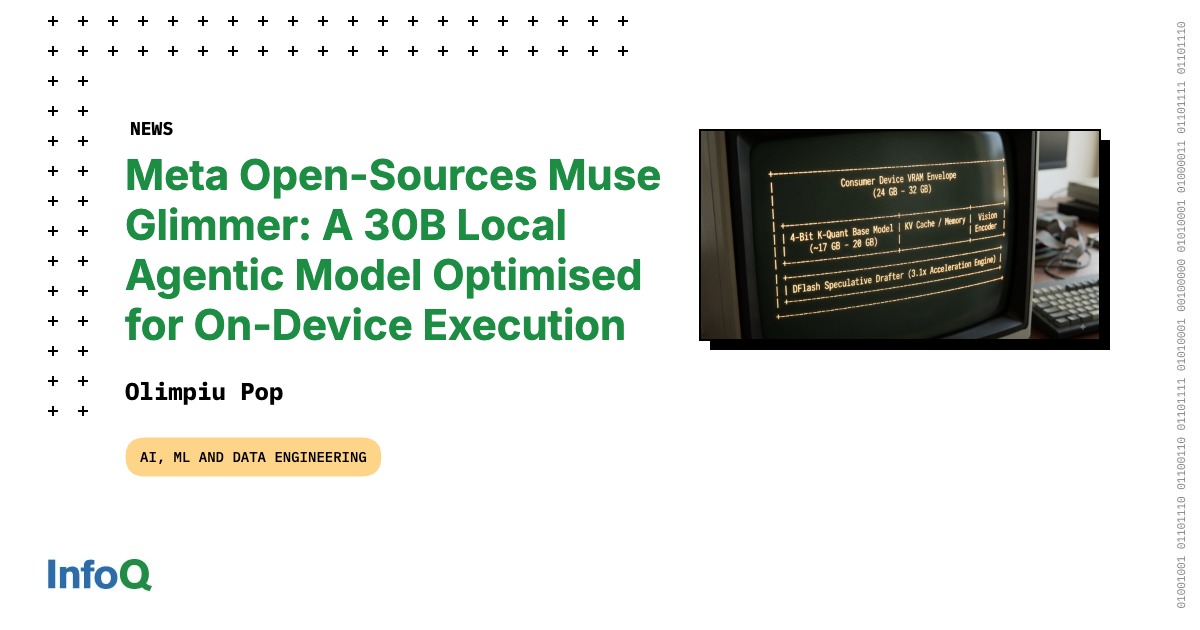
Uncompressed 30B models typically require over 55 GB of VRAM. That is far beyond what most consumer setups offer. Muse Glimmer solves this with dynamic quantisation. The 4-bit dynamic compression technique, called K-Quant, reduces the model footprint to roughly 17-20 GB. That leaves memory headroom in 24-32 GB GPU or NPU envelopes for the KV cache, perception embeddings, and speculative decoding overhead.
The recommended hardware is practical. A Mac with M4 or M5 Max unified memory works, as does a PC with an NVIDIA RTX 5090 or RTX 4090. The 24-32 GB envelope ensures sufficient memory for extended agentic sessions, including the quantised 4-bit weights, the vision encoder, the DFlash drafter, and the KV context cache.
DFlash speculative decoding pairs with a lightweight drafter model. The drafter proposes multi-token blocks, and the base model validates them in parallel. That approach yields up to a 3.1x increase in generation throughput on Apple Silicon M4 and M5 Max chips and on the NVIDIA RTX 5090. Speculative decoding is a known technique for speeding up inference, and here it is applied aggressively to close the gap with cloud-hosted models.
Benchmarks Against Peers
Meta compared Muse Glimmer against two peer open models in the 30B class: Gemma 4 31B and Qwen 3.6 27B. The benchmarks include SWE-Bench for code generation, DeepSearch QA for retrieval, τ-Bench for tool use, and MCP-Atlas for model context protocol evaluation.
Stay ahead of the AI curve
The most important updates, news, and content — delivered weekly.
No spam. Unsubscribe anytime.
The results show a clear pattern. Muse Glimmer demonstrates superior multi-step tool reliability and failure recovery compared to both peers. It maintains competitive general coding and reasoning capabilities. The model achieves strong success rates in benchmarks against leading open models in its class, according to the evaluation data.
The failure recovery capability stands out as a notable advantage. Many agentic models stall when a tool call fails. Muse Glimmer is trained to keep going, diagnosing the issue and trying another route. That behavior matters in real-world automation, where errors are common and retries are essential.
Ecosystem and Deployment
Model weights are available on Hugging Face. Native execution is supported across a wide range of frameworks, including llama.cpp, ExecuTorch, Apple MLX, Ollama, LM Studio, and vLLM. Fine-tuning workflows run through PyTorch's TorchTitan. The model also supports agent frameworks like OpenClaw.
That breadth of support lowers the barrier to adoption. Developers already using local inference tools can drop in Muse Glimmer without changing their stack. The Apache 2.0 license permits commercial use and modification, which should encourage integration into products.
The model also features adjustable reasoning effort. Users can balance speed against decision quality depending on the task. That flexibility is useful for always-on agents that need to respond quickly in some contexts and think carefully in others.
A Shift Toward Local Agents
Muse Glimmer represents a shift toward viable local AI agents that safeguard data privacy and maintain low-latency execution. The model is engineered specifically for always-on local workflows. That positioning matters as privacy concerns grow and as users seek alternatives to cloud-dependent AI services.
The training strategy, combined with dynamic quantisation and speculative decoding, makes consumer hardware deployment practical. The hardware recommendations are not aspirational. They match what many developers already own, such as the RTX 4090 or a recent Mac with unified memory.
The open-source release gives researchers and developers a capable agentic model they can run, modify, and fine-tune freely. The failure recovery capability, the multimodal perception encoder, and the throughput gains from DFlash speculative decoding all contribute to a model that feels designed for real work, not just benchmarks.
Meta AI Research has positioned Muse Glimmer as a serious option for local agentic computing. The question now is how developers will use it, and whether the local agent paradigm gains the traction that cloud-based agents have enjoyed.