
NVIDIA and LG Group have announced plans to build an AI factory that will drive the next wave of AI-powered businesses for the South Korean conglomerate. The facility will support LG's work in robotics, autonomous driving, data center technologies, and GPU cloud services.
The AI factory will give LG Group access to accelerated computing infrastructure for training, simulating, validating, and deploying AI applications across its key business units. The partnership combines NVIDIA's end-to-end AI factory platform with LG's worldwide expertise in consumer electronics, robotics, mobility components, smart spaces, and data center technologies.
Together, the two companies are connecting AI model development, physical AI data generation, robot simulation and training, edge deployment, and factory-scale digital twins into a single workflow for building physical AI systems.
Advancing Physical AI and Robotics
LG's manufacturing know-how and production data from global sites will combine with NVIDIA's AI infrastructure and digital twin technologies to boost AI-driven manufacturing competitiveness. The companies plan to create an autonomous manufacturing ecosystem where the entire process from raw material procurement to production, logistics, and customer delivery is connected in real time through data and AI. They aim to establish this as a new global standard for smart factories.
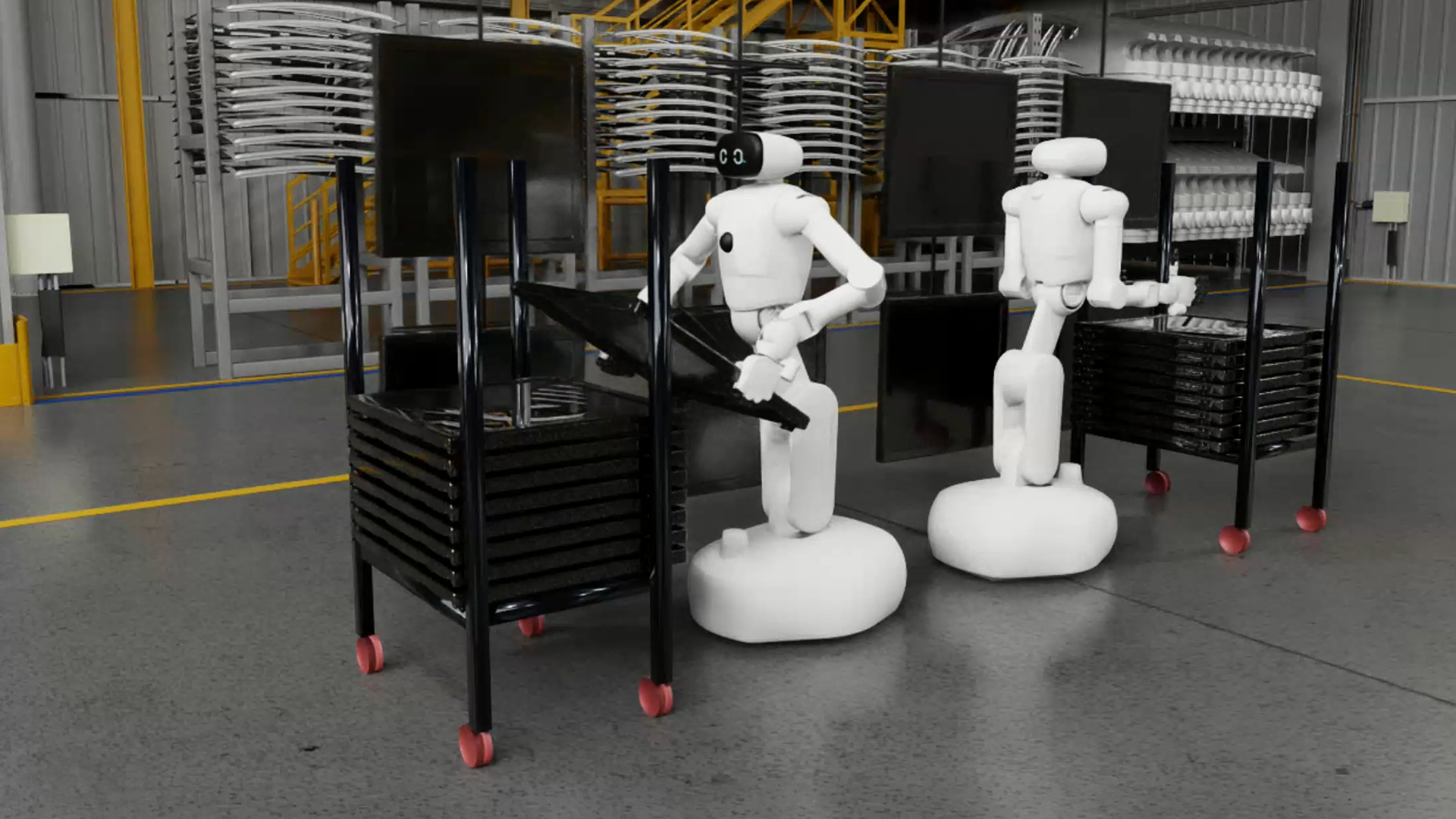
LG Electronics is developing home robots like CLoiD to handle a wide range of indoor household tasks. By integrating NVIDIA Isaac Sim and NVIDIA Isaac Lab open robotics frameworks into its development workflows, LG can simulate, train, and validate these home cobots in physically accurate virtual environments before deployment.
LG is also exploring the use of the NVIDIA Isaac GR00T open reasoning vision action language model for both its home robots and modular robotics platforms. The GR00T model will give LG robots humanlike reasoning and the ability to perform complex tasks. NVIDIA and LG Electronics plan to jointly develop reference robots, positioning LG's robots as part of the Isaac GR00T ecosystem.
To address the training data challenge for robotics, LG Electronics is building a physical AI data factory that will help Korean and global companies accelerate physical AI projects. LG will turn compute into data, providing high-quality training data for robotics and industrial AI projects using NVIDIA Cosmos world foundation models for synthetic data generation and augmentation.
LG Innotek, using its optical expertise, plans to supply state-of-the-art robotics components including sensing solutions optimized for NVIDIA's development environments and GPU architecture. LG CNS is building an ecosystem that allows anyone to easily adopt AI robots in manufacturing and logistics sites. By integrating NVIDIA's robotics technologies including Isaac open robotics frameworks, Cosmos open world models, and Isaac GR00T robotic foundation models into its PhysicalWorks industrial robot platform, LG CNS is accelerating AI transformation on the factory floor.
Building an NVIDIA DSX-Aligned AI Factory Infrastructure
The two companies are expanding cooperation on next-generation AI factories to support the AI era. LG Electronics already holds certification from NVIDIA for cooling solutions such as cooling distribution units (CDUs) and cold plates. Now LG is further enhancing its AI factory capabilities through technical collaboration on prefabricated modular design technologies. This initiative aligns with the NVIDIA DSX AI factory platform, enabling rapid deployment of scalable, high-performance supercomputing infrastructure.
These technologies including CDUs, cold plates, and prefab modular designs help address the power, thermal, and deployment requirements of next-generation liquid-cooled AI factories.
Stay ahead of the AI curve
The most important updates, news, and content — delivered weekly.
No spam. Unsubscribe anytime.
LG Uplus, a telecommunications provider under LG Corp., plans to build scalable, power-efficient AI factories based on NVIDIA DSX in collaboration with LG Electronics and LG Energy Solution. The effort combines NVIDIA accelerated computing and AI factory reference architectures with LG's infrastructure, energy, and telecommunications capabilities to support future AI cloud and GPU service opportunities.
LG CNS plans to build scalable, power-efficient, high-performance AI factories powered by NVIDIA GPUs based on NVIDIA DSX. LG Uplus plans to build a large-scale AI data center capable of accommodating the latest NVIDIA GPUs. LG Energy Solution plans to collaborate with NVIDIA on emerging 800 volt-direct-current data center energy solutions, in alignment with NVIDIA's BESS Self-Qualification guidelines, to keep pace with next-generation GPUs.
Accelerating Autonomous Driving and Mobility AI
LG Electronics is working with NVIDIA to align its advanced driver-assistance systems (ADAS) and in-vehicle AI systems with the NVIDIA DRIVE platform. The collaboration focuses on aligning sensor, compute, and software architectures with the NVIDIA DRIVE Hyperion architecture, supporting LG Electronics' roadmap for autonomous driving, ADAS, and software-defined vehicles.
LG Electronics also plans to use NVIDIA DRIVE AGX accelerated compute for future mobility applications including AI-powered cockpits and edge AI processing. This work aims to strengthen LG's automotive electronics portfolio and accelerate AI-driven mobility solutions for global manufacturers.
LG Innotek is cementing its leadership in the autonomous driving market with sensing, connectivity, and lighting solutions. LG Innotek plans to collaborate with NVIDIA on next-generation components engineered specifically for NVIDIA architecture.
Advancing Sovereign AI With EXAONE
NVIDIA and LG AI Research are collaborating to advance EXAONE, one of Korea's leading sovereign AI models and an open model family available to developers, enterprises, and researchers. LG AI Research used NVIDIA Blackwell GPUs, the NVIDIA NeMo framework, and NVIDIA Nemotron open datasets to support EXAONE model development. The team also used NVIDIA TensorRT-LLM software to build high-performance inference engines for optimized deployment.
LG Group is exploring broader adoption of EXAONE and agentic AI technologies across its businesses through platforms such as ChatEXAONE, LG Group's EXAONE-based enterprise chatbot service. NVIDIA will help power LG AI Research's sovereign AI models so LG Group can accelerate enterprise AI transformation, software-defined operations, and productivity across its business portfolio.
NVIDIA CEO Jensen Huang is scheduled to deliver a keynote at GTC Taipei on June 1 at 11 a.m. Taipei time.
Related on Neura Market
- Explore the AI Tools Directory for more AI development platforms.
- Check out the Robotics Automation Marketplace for robotic solutions.
- Visit the AI Infrastructure Section for data center and compute news.