
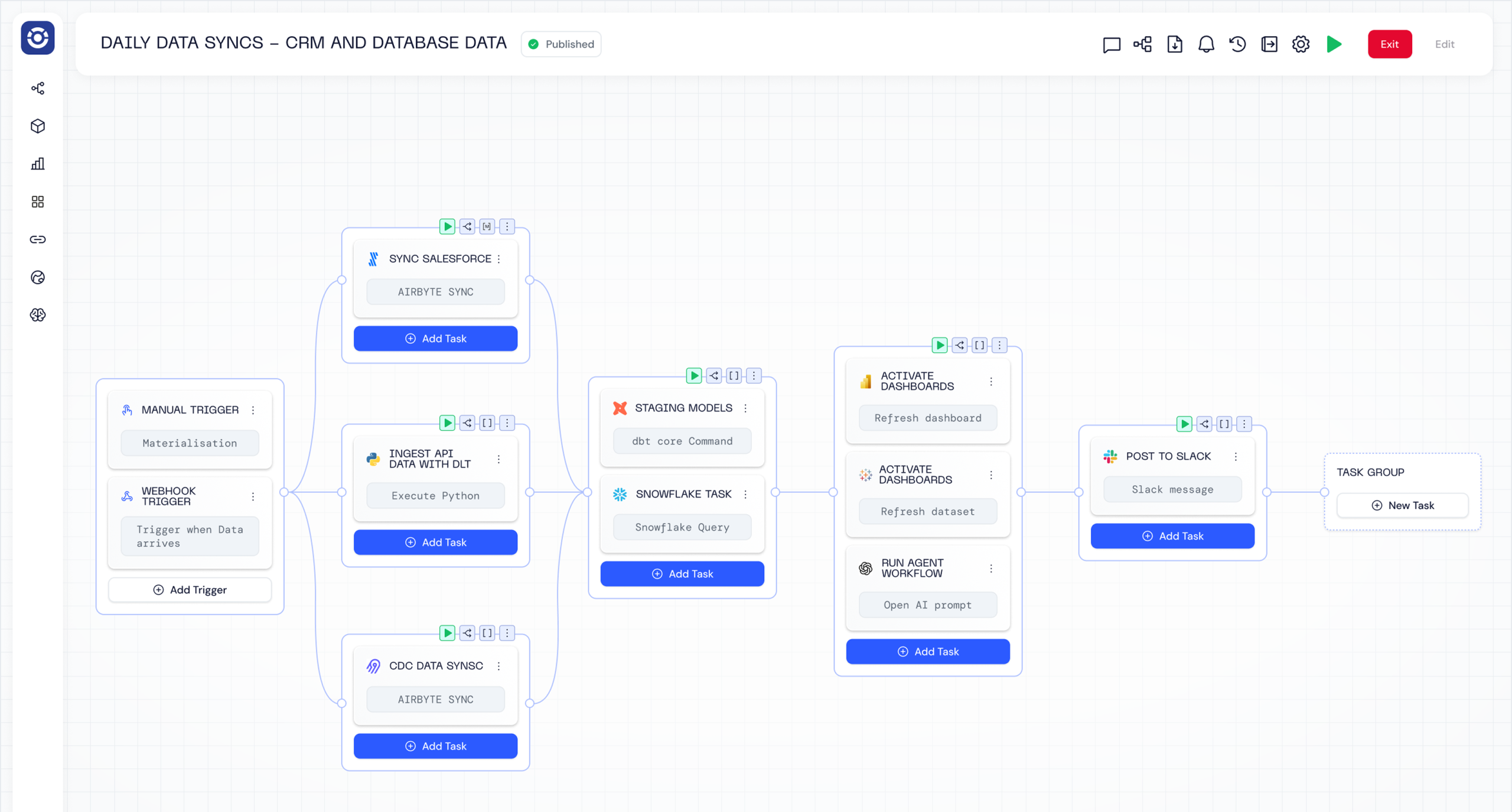
Orchestra Technologies Ltd. today announced the launch of its Agentic Control Plane, a platform designed to help enterprises manage data and AI workflows through a single, context-aware interface. The platform connects to existing data infrastructure, giving engineering teams a dashboard and low-code builder to orchestrate AI agents and data at scale.
The launch comes as companies wrestle with the operational burden of AI adoption. Hugo Lu, co-founder and chief executive of Orchestra Technologies, framed the problem in stark terms. "AI is creating enormous demand across the enterprise, but data and now AI teams are still managing infrastructure that was never designed to support it," he said.
A Single Pane of Glass for Data and AI
Orchestra's Agentic Control Plane is built to sit on top of a company's current data stack rather than replace it. The platform connects to existing data products and AI tools, creating what the company describes as a "single pane of glass" for data and AI operations. Engineering teams can view and orchestrate millions of tasks and agents in parallel, all without maintaining their own large clusters.
The platform relies on managed infrastructure, so teams do not need to provision or operate their own compute environments. Instead, they can build an interface in just a few lines of code. The company says this approach provides visibility across the entire organization, allowing data teams to connect different tools and visualize workflows end to end.
If something goes wrong during a workflow, an agent takes action to repair the issue or notify the relevant team. Orchestra says the platform automates hundreds of failure investigations every day, reducing the manual burden on engineers. The company reports that this automation can cut pipeline development time by up to 95%, a figure that would represent a major productivity gain for engineering teams.
Built for Scale, Security, and Flexibility
The Agentic Control Plane includes more than 100 core integrations with existing data products and AI tools. These include Microsoft Teams, Slack, GitHub Actions, Datadog, Google LLC's BigQuery, and Snowflake. The platform also supports connections via SSH, HTTP, SFTP, and other protocols, and it can link with AI providers such as Anthropic PBC's Claude, OpenAI Group PBC's ChatGPT, and Amazon Web Services Inc.'s Bedrock.
The platform is AI model agnostic, meaning teams can switch between providers without rearchitecting their workflows. Every AI agent runs in a secure environment, isolated with controlled access. The company says this data and AI isolation helps agents maintain security and transparency while operating across the enterprise.
Teams can build agents and workflows without manually handling every request. The platform provides a shared foundation for teams to work across the enterprise, allowing them to run any code on managed data. Orchestra says this approach gives teams greater control over how they build, automate, and operate AI workflows.
Funding Supports Expansion and Customer Gains
Orchestra has raised a total of $4.6 million to date. The company closed a $3.3 million seed round led by Differential Ventures, following a $1.3 million pre-seed round led by Moonfire. Additional backers include Breakers, Tokyo Black, and Contour Venture Partners.
Stay ahead of the AI curve
The most important updates, news, and content — delivered weekly.
No spam. Unsubscribe anytime.
The funding will fuel hiring for engineering and go-to-market teams in London. It will also advance product development and increase traction in the United States and Europe. The company is positioning itself as a key player in the growing market for AI operations and data management.
Orchestra's current customers include Experian plc, Campfire Software Inc., the San Francisco Giants, and Trust & Will. The company says these customers have seen significant improvements in their data and AI operations. Customers report cutting runtime costs by up to 80%. They have also shortened migration times from years to months, a dramatic shift for enterprises moving between data platforms. The company further claims the platform can cut pipeline development time by up to 95%, a figure that would represent a major productivity gain for engineering teams.
These numbers, while provided by the company, point to the platform's core value proposition: reducing the operational overhead of running data pipelines and AI agents. For enterprises with large, complex data estates, the ability to automate failure investigations and streamline migrations could translate into substantial savings.
A Growing Market for AI Operations
The launch of Orchestra's Agentic Control Plane comes at a time when enterprises are increasingly looking for ways to operationalize AI. Many organizations have adopted AI models and data tools, but they often struggle to manage the underlying infrastructure. Orchestra's approach is to provide a management layer that works with existing tools rather than forcing a replacement.
The platform's low-code builder is designed to lower the barrier to entry for teams that want to build custom workflows. By allowing teams to connect different tools and visualize workflows, Orchestra aims to give organizations a shared foundation for data and AI operations.
The company's focus on security and isolation is also notable. With AI agents handling sensitive data, enterprises need assurances that these agents operate in controlled environments. Orchestra says every AI agent runs in a secure environment, isolated with controlled access, which helps maintain security and transparency.
Looking Ahead
Orchestra's Agentic Control Plane is now available to customers. The company plans to use its recent funding to expand its team and grow its presence in key markets. With customers like Experian and the San Francisco Giants already on board, Orchestra is building momentum in the enterprise data and AI space.
The platform's ability to integrate with a wide range of tools, from Microsoft Teams to Snowflake to Claude, positions it as a flexible option for organizations with diverse technology stacks. As AI adoption continues to grow, the demand for management platforms like Orchestra's is likely to increase.
For now, the company is focused on delivering on its promise of a "single pane of glass" for data and AI. Whether it can maintain that focus as it scales remains to be seen, but the early customer results are encouraging. The company's pricing starts at $10 per month for small teams, with enterprise plans available on request. Orchestra expects to roll out additional features and integrations throughout 2026, building on the platform's current capabilities.