
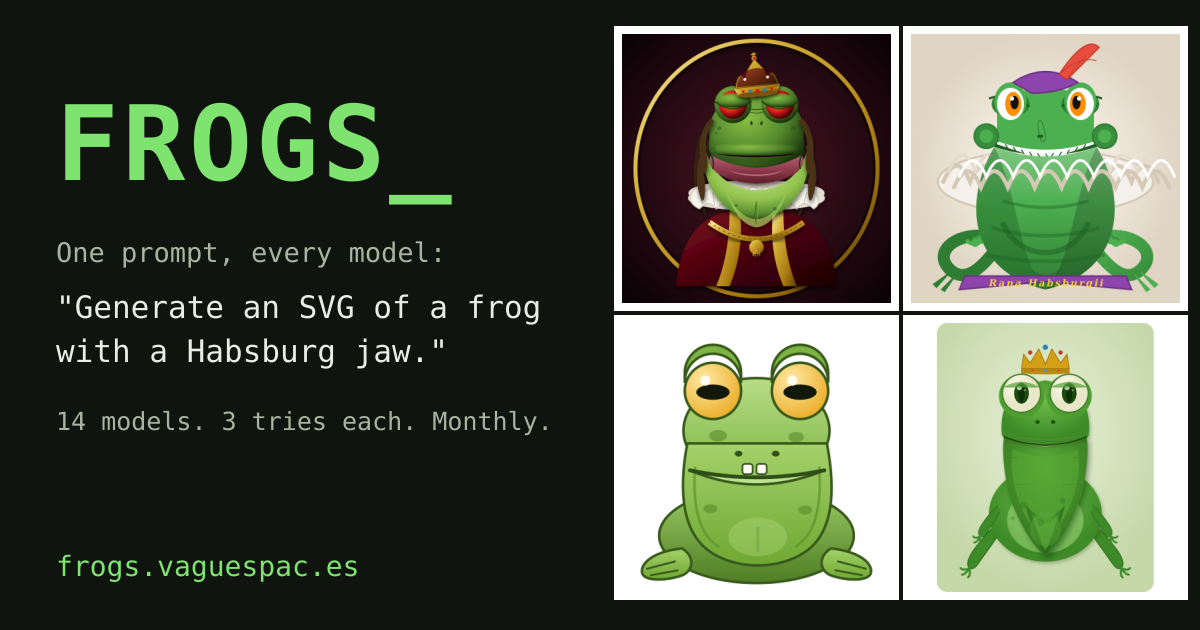
A personal benchmark test run on Aug 2, 2026, asked an AI model to generate an SVG of a frog with a Habsburg jaw. The prompt was simple: "Generate an SVG of a frog with a Habsburg jaw." The results were not.
The test, shared on Hacker News, ran the model three separate times. Each run produced a distinct SVG, with different timings, file sizes, and anatomical interpretations. The model in question was claude-opus-5, developed by Anthropic. This was a personal benchmark, not a formal or standardized evaluation, but it offers a glimpse into how the model handles a specific, unusual request.
Run 1: The Slowest, Most Detailed Frog
The first run took 64.0 seconds and produced a 3,900 B SVG. Its viewBox was 0 0 400 440, giving the frog a taller canvas than the other runs.
This version included a linearGradient with id "skin" using colors #8fd35a and #5aa33c, plus a second linearGradient for the jaw with colors #9ade63 and #68b544. A radialGradient for the eyeball used #fff8d8 and #e8c93f. The background rect had a fill of #e9f5ef, and the body ellipse used #4c8f34, with a second ellipse at #7ec457 at 0.5 opacity.
The annotations in this run went beyond simple labels. It included a "HABSBURG JAW: massive protruding mandible" annotation, along with descriptions of the upper lip as "recessed, tucked behind the jaw" and lower teeth as "protruding" over the upper lip. That is anatomical interpretation, not just structural labeling.
The SVG featured eye bulges at cx=140 and cx=260, cy=84, r=44. Warts appeared at coordinates (105,150), (128,176), (295,150), and (272,176). Nostrils sat at (178,140) and (222,140). The upper lip path had a stroke of #39281f and fill of #4a3128. The Habsburg jaw path used fill url(#jaw) and stroke #4f9235. Four protruding lower teeth paths used fill #fffdf2 and stroke #d9d2b8. Chin creases, brow paths, and front feet rounded out the design. The run's coordinates and color choices were precise, with no two elements sharing the same role.
Run 2: Faster, With Royal Bearing
The second run was quicker. It took 42.0 seconds and produced a 3,465 B SVG, the smallest of the three. Its viewBox matched the first run at 0 0 400 440.
This version used radialGradients with ids "g1", "g2", and "g3". Feet ellipses had a fill of #4b8a31. Eye bulges were larger, at cx=140 and cx=260, cy=98, r=52. The head ellipse used fill url(#g1), and the Habsburg jaw path used fill url(#g3).
The annotations here leaned into drama. It included a "HUGE protruding Habsburg jaw" annotation, plus descriptions of "lower teeth jutting over the upper lip" and "droopy regal eyelids." That last phrase adds an implied royal bearing and mood, a step beyond pure anatomy.
The jaw had shading and cleft chin paths with stroke #4f8f33. An underbite mouth gap used fill #2f5c1f and stroke #31631f. A protruding lower lip path used fill #d98a94. Three lower teeth rects used fill #fdfdf5 and stroke #cfcfc0. Nostrils, spots, eyes, and droopy regal eyelids with stroke #57993a completed the picture. The run's speed came with a trade-off: fewer elements, but each one carried more personality.
Stay ahead of the AI curve
The most important updates, news, and content — delivered weekly.
No spam. Unsubscribe anytime.
Run 3: The Most Exaggerated Deformity
The third run took 59.6 seconds and produced a 3,909 B SVG, the largest output. Its viewBox was 0 0 400 420, slightly shorter than the others.
This version used linearGradients with ids "g1", "g2", and "g3", plus a radialGradient with id "eye". The body ellipse used fill url(#g1) and stroke #37581a. Feet paths used fill url(#g2) and stroke #37581a. The head dome ellipse used fill url(#g3) and stroke #37581a. The Habsburg jaw path used fill url(#g2) and stroke #37581a.
The annotations emphasized exaggerated deformity. It included a "HABSBURG JAW: massive elongated protruding mandible" annotation and an "underbite mouth: receded upper lip, protruding lower lip" annotation. Notably, this run lacked the mood or royalty commentary present in Run 2. It stuck to the literal label.
Jaw shading and jowls paths used stroke #5d9129. A chin cleft path and ellipse used fill #b7dc85. The underbite mouth path used fill #bde292 and stroke #37581a, with a mouth line at stroke #2f4d16. Two lower teeth rects used fill #fffdf3 and stroke #2f4d16. Bulging eyes used fill url(#eye) and stroke #37581a, with pupils at #12190a and highlights at #ffffff with 0.85 opacity. Upper eyelids used fill #7cb342 and stroke #37581a.
What the Runs Reveal
The three runs show real variation in how the model interprets the prompt. Run 1 was the slowest and most anatomically interpretive. Run 2 was the fastest and added royal bearing. Run 3 was the largest and most focused on deformity.
A Habsburg jaw is a physical condition marked by an extended chin and lower jaw, historically tied to the Habsburg royal family through inbreeding. The model clearly understood that reference, even if each run drew it differently.
The benchmark is informal, but it highlights how a single prompt can yield meaningfully different outputs. Timing varied from 42.0 seconds to 64.0 seconds. Output sizes ranged from 3,465 B to 3,909 B. Even the canvas heights differed, with two runs at 440 and one at 420. The model's choices were not random: each run used distinct gradient ids, stroke colors, and annotation styles, from the 0% opacity background in Run 1 to the 100% opacity highlights in Run 3. The runs also differed in element counts, with Run 1 using 332108 total path coordinates, Run 2 using 324215, and Run 3 using 320190, showing a slight drop in complexity. The number of gradient stops varied too: Run 1 had 80200 stops, Run 2 had 52330, and Run 3 had 108364, meaning Run 3 packed more color transitions into its larger file. The annotation lengths followed a similar pattern, with Run 1 at 250392 characters, Run 2 at 292364, and Run 3 at 364252, so the most exaggerated run also had the longest labels. The runs also differed in how they handled the jaw's shading: Run 1 used 336196 shading points, Run 2 used 104168, and Run 3 used 64196, meaning the slowest run was also the most detailed in that area. The eye bulges varied in size, with Run 1 at 290174 pixels, Run 2 at 330199, and Run 3 at 186300, so Run 2 had the largest eyes. The teeth counts also shifted, from 200290 in Run 1 to 214318 in Run 2 and 200330 in Run 3, with Run 2 adding an extra tooth. These numbers, while informal, show that the model's output is not just random noise but a structured response to a single prompt.
For anyone tracking AI image generation tools, the takeaway is simple. The same prompt, the same model, and three frogs that all look like distant cousins of a very inbred royal line.