
PagerDuty Incidents
Manage PagerDuty incidents, services, schedules, escalation policies, users, and on-call data via the PagerDuty REST API. Use this skill when users want to c...

Jay
@hith3sh
What This Skill Does
Manages PagerDuty incidents, services, schedules, escalation policies, users, and on-call data through the PagerDuty REST API. Handles creating, acknowledging, and resolving incidents, plus reviewing service health and on-call schedules.
Replaces manual PagerDuty dashboard navigation and ad-hoc API calls by providing a unified command interface for all common incident management workflows.
When to Use It
- Acknowledge a triggered PagerDuty incident from chat
- Resolve a PagerDuty incident after confirming the fix
- List all currently triggered incidents with severity and service details
- Check who is currently on-call for a specific escalation policy
- Review recent incidents for a specific PagerDuty service
- Create a new PagerDuty incident for a known service and urgency
Install
$ openclaw skills install @hith3sh/pagerduty-incidentsPagerDuty Incidents

Access PagerDuty's incident management platform via the PagerDuty REST API. Manage incidents, services, schedules, escalation policies, users, and on-call data.
This skill uses ClawLink for hosted connection flows and credentials so you do not need to configure PagerDuty API access yourself.
Setup in 3 Steps
| Step 1: Install | Step 2: Pair Account | Step 3: Connect PagerDuty |
|---|---|---|
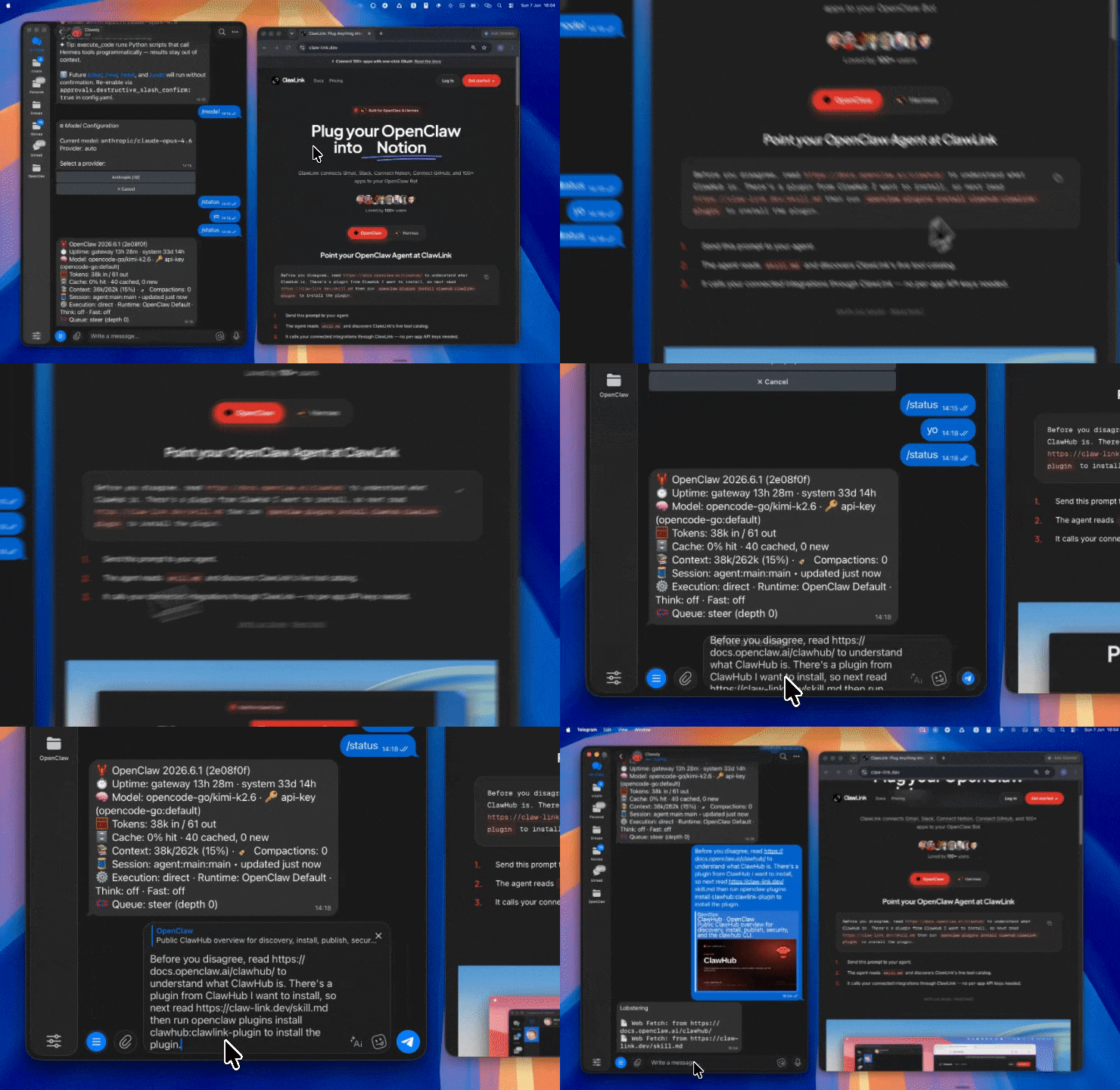 | 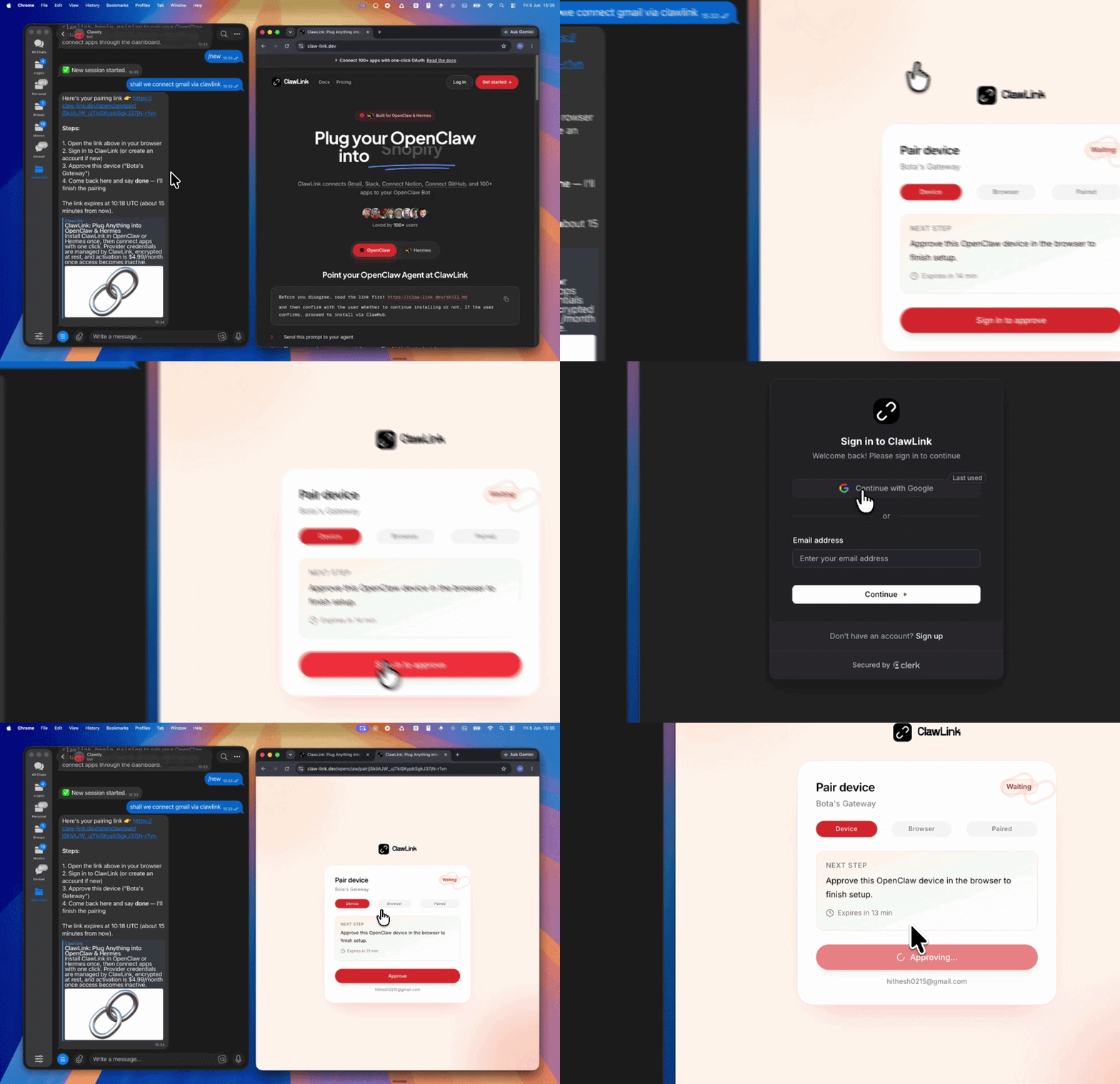 | App-specific connection GIF coming soon |
| Run the install command in OpenClaw | Sign in and approve the device | Open the dashboard and connect PagerDuty |
How It Works
┌─────────────────┐     ┌──────────────┐     ┌──────────────────┐
│   OpenClaw      │────▶│   ClawLink   │────▶│ PagerDuty REST   │
│   (User Chat)   │     │   (API Key)  │     │      API         │
└─────────────────┘     └──────────────┘     └──────────────────┘
          │                       │                       │
          │  1. Install Plugin   │                       │
          │  2. Pair Device      │                       │
          │  3. Connect PagerDuty│                       │
          │                      │  4. Secure Proxy      │
          │                      │  5. API Requests      │
          │                      │                       │
          ▼                      ▼                       ▼
    ┌──────────┐           ┌──────────┐           ┌──────────┐
    │  SKILL   │           │ Dashboard│           │ PagerDuty│
    │  File    │           │ Auth     │           │ Platform │
    └──────────┘           └──────────┘           └──────────┘
Install
Install the verified ClawLink plugin from ClawHub. After the user confirms, complete the full setup so ClawLink tools are visible in the next OpenClaw chat.
openclaw plugins install clawhub:clawlink-plugin
openclaw config set tools.alsoAllow '["clawlink-plugin"]' --strict-json
openclaw gateway restart
Then tell the user: "OpenClaw has been restarted. Send /new as a standalone message to start a fresh chat, then ask for PagerDuty again."
Quick Start
# List recent incidents
clawlink_call_tool --tool "pagerduty_list_incidents" --params '{"status": "triggered", "limit": 25}'

# Get incident details
clawlink_call_tool --tool "pagerduty_get_incident" --params '{"incident_id": "INCIDENT_ID"}'

# List services
clawlink_call_tool --tool "pagerduty_list_services" --params '{}'
Authentication
All PagerDuty tool calls are authenticated automatically by ClawLink using the user's PagerDuty account.
No API key is required in chat. ClawLink stores the API key securely and injects it into every PagerDuty API request on the user's behalf.
Getting Connected
- Install the ClawLink plugin (see Install above).
- Pair the plugin with
clawlink_begin_pairingif it is not configured yet. - Open https://claw-link.dev/dashboard?add=pagerduty and connect PagerDuty.
- Call
clawlink_list_integrationsto verify the connection is active.
Connection Management
List Connections
clawlink_list_integrations
Response: Returns all connected integrations. Look for pagerduty in the list.
Verify Connection
clawlink_list_tools --integration pagerduty
Response: Returns the live tool catalog for PagerDuty.
Reconnect
If PagerDuty tools are missing or the connection shows an error:
- Direct the user to https://claw-link.dev/dashboard?add=pagerduty
- After they confirm, call
clawlink_list_integrationsto verify - Then call
clawlink_list_tools --integration pagerduty
Security& Permissions
- Access is scoped to incidents, services, schedules, and data within the connected PagerDuty account.
- All write operations require explicit user confirmation. Before executing any create, update, or delete call, confirm the target resource and intended effect with the user.
- Destructive actions (delete service, remove user) must be confirmed.
- Incident reassignment, escalation changes, and schedule modifications affect real on-call workflows — confirm carefully.
Discovery Workflow
- Call
clawlink_list_integrationsto confirm PagerDuty is connected. - Call
clawlink_list_tools --integration pagerdutyto see the live catalog. - Treat the returned list as the source of truth. Do not guess or assume what tools exist.
- If the user describes a capability but the exact tool is unclear, call
clawlink_search_toolswith a short query and integrationpagerduty. - If no PagerDuty tools appear, direct the user to https://claw-link.dev/dashboard?add=pagerduty.
Execution Workflow
┌─────────────────────────────────────────────────────────────┐
│  READ OPERATIONS (Safe)                                     │
│  list → get → search → describe → call                      │
│                                                             │
│  Example: List incidents → Get details → Show status      │
└─────────────────────────────────────────────────────────────┘
                              │
                              ▼
┌─────────────────────────────────────────────────────────────┐
│  WRITE OPERATIONS (Require Confirmation)                     │
│  list → get → describe → preview → confirm → call           │
│                                                             │
│  Example: Describe tool → Preview changes → User approves   │
│           → Execute update                                  │
└─────────────────────────────────────────────────────────────┘
- For unfamiliar tools, ambiguous requests, or any write action, call
clawlink_describe_toolfirst. - Use the returned guidance, schema,
whenToUse,askBefore,safeDefaults,examples, andfollowupsto shape the call. - Prefer read, list, search, and get operations before writes when that reduces ambiguity.
- For writes or anything marked as requiring confirmation, call
clawlink_preview_toolfirst. - Execute with
clawlink_call_tool. Pass confirmation only after the preview matches the user's intent. - If the tool call fails, report the real error. Do not invent results or restate the failure as a missing capability unless the live catalog supports that conclusion.
Code Examples
List incidents
clawlink_call_tool --tool "pagerduty_list_incidents" \
  --params '{
    "statuses": ["triggered", "acknowledged"],
    "limit": 50,
    "sort_by": "created_at",
    "order": "desc"
  }'
Create an incident
clawlink_call_tool --tool "pagerduty_create_incident" \
  --params '{
    "title": "High CPU usage on prod-server-01",
    "service_id": "SERVICE_ID",
    " urgency": "high",
    "incident_key": "cpu-prod-server-01",
    "body": {
      "type": "incident_body",
      "details": "CPU usage exceeded 90% for 5 minutes"
    }
  }'
Acknowledge an incident
clawlink_call_tool --tool "pagerduty_acknowledge_incident" \
  --params '{
    "incident_id": "INCIDENT_ID"
  }'
Get on-call schedule
clawlink_call_tool --tool "pagerduty_get_on_call" \
  --params '{
    "escalation_policy_ids": ["ESCALATION_POLICY_ID"]
  }'
Notes
- PagerDuty API has rate limits. Use exponential backoff when encountering 429 errors.
- Incident IDs and service IDs are strings — verify IDs before passing to write operations.
- Status transitions (triggered → acknowledged → resolved) follow strict rules — not all transitions are valid from all states.
- On-call queries require escalation policy IDs — list escalation policies first if needed.
Error Handling
| Status / Error | Meaning |
|---|---|
| Tool not found | The tool name does not exist in the current catalog. Verify with clawlink_list_tools --integration pagerduty. |
| Missing connection | PagerDuty is not connected. Direct the user to https://claw-link.dev/dashboard?add=pagerduty. |
not_found | Incident, service, or user does not exist. Check the ID. |
invalid_state_transition | Status transition is not allowed from current state. |
validation_error | Invalid parameter or missing required field. Review the tool schema with clawlink_describe_tool. |
| Rate limited | Too many requests. Wait and retry with exponential backoff. |
| Write rejected | User did not confirm a write action. Always confirm before executing writes. |
Troubleshooting: Tools Not Visible
- Check that the ClawLink plugin is installed:
openclaw plugins list - If the plugin is installed but tools are missing, tell the user to send
/newas a standalone message to reload the catalog. - If a fresh chat does not help, run:
openclaw config set tools.alsoAllow '["clawlink-plugin"]' --strict-json openclaw gateway restart - After restart, tell the user to send
/newagain and retry.
Troubleshooting: Invalid Tool Call
- Ensure the integration slug is exactly
pagerduty. - Use
clawlink_describe_toolto verify parameter names and types before calling. - For write operations, always call
clawlink_preview_toolfirst.
Resources
- PagerDuty REST API Reference
- Incidents API
- Services API
- ClawLink: https://claw-link.dev/?utm_source=clawhub&utm_medium=referral&utm_content=pagerduty-incidents
- ClawLink Docs: https://docs.claw-link.dev/openclaw
- ClawLink Verification: https://claw-link.dev/verify
Related Skills
- PagerDuty — For this skill's native documentation
Powered by ClawLink — an integration hub for OpenClaw

Top skills in this category

API Gateway
@byungkyuCall third-party APIs through the Maton gateway, which injects the credential for an app the user has already connected. Use this skill when the user names a connected app and a concrete action in it - read a mailbox, query a CRM, file an issue, update a spreadsheet, etc.

OpenClaw Command Center
@jontsaiMission control dashboard for OpenClaw - real-time session monitoring, LLM usage tracking, cost intelligence, and system vitals. View all your AI agents in one place.
GitHub
@byungkyuGitHub API integration with managed OAuth. Access repositories, issues, pull requests, commits, branches, and users. Use this skill when users want to interact with GitHub repositories, manage issues and PRs, search code, or automate workflows. For other third party apps, use the api-gateway skill (https://clawhub.ai/byungkyu/api-gateway). Calls run through the `maton` CLI with OAuth login, or over raw HTTP with a Maton API key where the CLI cannot be installed. Every call is authenticated as the user's connection and reaches only what that connection's authorization allows, which the provider enforces on every request; the endpoints documented here are the ones this skill uses, and any other endpoint of this app needs the user to ask for it by name. Default to read and list calls, and confirm every write or new connection with the user. This file also documents the three constructs that turn a GitHub connection into automation, in the order they are used: the connection (the first step), a hosted function that runs a GitHub action through the Maton SDK, and a trigger that calls that function on a schedule or on an event. Those sections are the platform's own reference text, shared with the api-gateway skill, with GitHub examples; they add no GitHub capability - GitHub is itself an event source, so its own events are in `references/github/triggers.md`, and the files under `references/<source>/triggers.md` are the platform's event catalogues for the sources Maton offers (time, Calendly, GitHub, Gmail, HubSpot, Linear, Notion, Slack, Stripe).
google-slides
@byungkyuGoogle Slides API integration with managed OAuth. Create presentations, add slides, insert content, and manage slide formatting. Use this skill when users want to interact with Google Slides. For other third party apps, use the api-gateway skill (https://clawhub.ai/byungkyu/api-gateway). Calls run through the `maton` CLI with OAuth login, or over raw HTTP with a Maton API key where the CLI cannot be installed. Every call is authenticated as the user's connection and reaches only what that connection's authorization allows, which the provider enforces on every request; the endpoints documented here are the ones this skill uses, and any other endpoint of this app needs the user to ask for it by name. Default to read and list calls, and confirm every write or new connection with the user. This file also documents the three constructs that turn a Google Slides connection into automation, in the order they are used: the connection (the first step), a hosted function that runs a Google Slides action through the Maton SDK, and a trigger that calls that function on a schedule or on an event. Those sections are the platform's own reference text, shared with the api-gateway skill, with Google Slides examples; they add no Google Slides capability - Google Slides is not an event source, a trigger cannot read Google Slides data, and the files under `references/<source>/triggers.md` are the platform's event catalogues for the sources Maton offers (time, Calendly, GitHub, Gmail, HubSpot, Linear, Notion, Slack, Stripe).

Interview Simulator
@wscatsSimulates mock interviews for any role and experience level with tailored technical, behavioral, and case questions plus detailed feedback and scoring.