
Resources
Guides, news, and articles on building and managing AI agents — curated from across the site.
AI Agent Guides
Hermes Agent Integrations: Complete Guide to Connecting Tools and Platforms
A comprehensive guide to all Hermes Agent integrations: AI providers, MCP tool servers, web search, browser automation, voice, IDE, memory, messaging platforms, home automation, and plugins.
Hermes Agent QQ Bot Integration: Chat-Based Agent Access Setup Guide
Connect Hermes Agent to QQ Bot for chat-based agent access. Learn safe setup, allowlist configuration, smoke testing, and common workflows like incident triage and approvals.
Hermes Agent Webhooks: Trigger Agent Runs from External Events
Learn how to configure Hermes Agent webhooks to receive events from GitHub, GitLab, Jira, Stripe, and custom systems, validate signatures, and route agent responses to chat platforms or other tools.
Hermes Agent SMS Integration: Twilio Text Message Gateway Setup Guide
Connect Hermes Agent to SMS via Twilio for short requests, alerts, and fallback workflows. This guide covers setup, safe rollout, common workflows, and troubleshooting.
Hermes Agent + Mattermost: Self-Hosted Team Chat Gateway Setup Guide
Connect Hermes Agent to Mattermost for self-hosted team chat. Covers bot setup, gateway configuration, allowlisting, smoke testing, and common workflows like incident triage and approvals.
Hermes Agent Feishu / Lark Integration: Team Chat Gateway Setup
Connect Hermes Agent to Feishu or Lark so teams can message the agent from chat, route work into tools, and receive status reports. Covers setup, allowlisting, safe rollout, common workflows, and troubleshooting.
AI Agents News
LangChain Open-Sources the Paid Media Agent It Uses to Run Its Own Ads
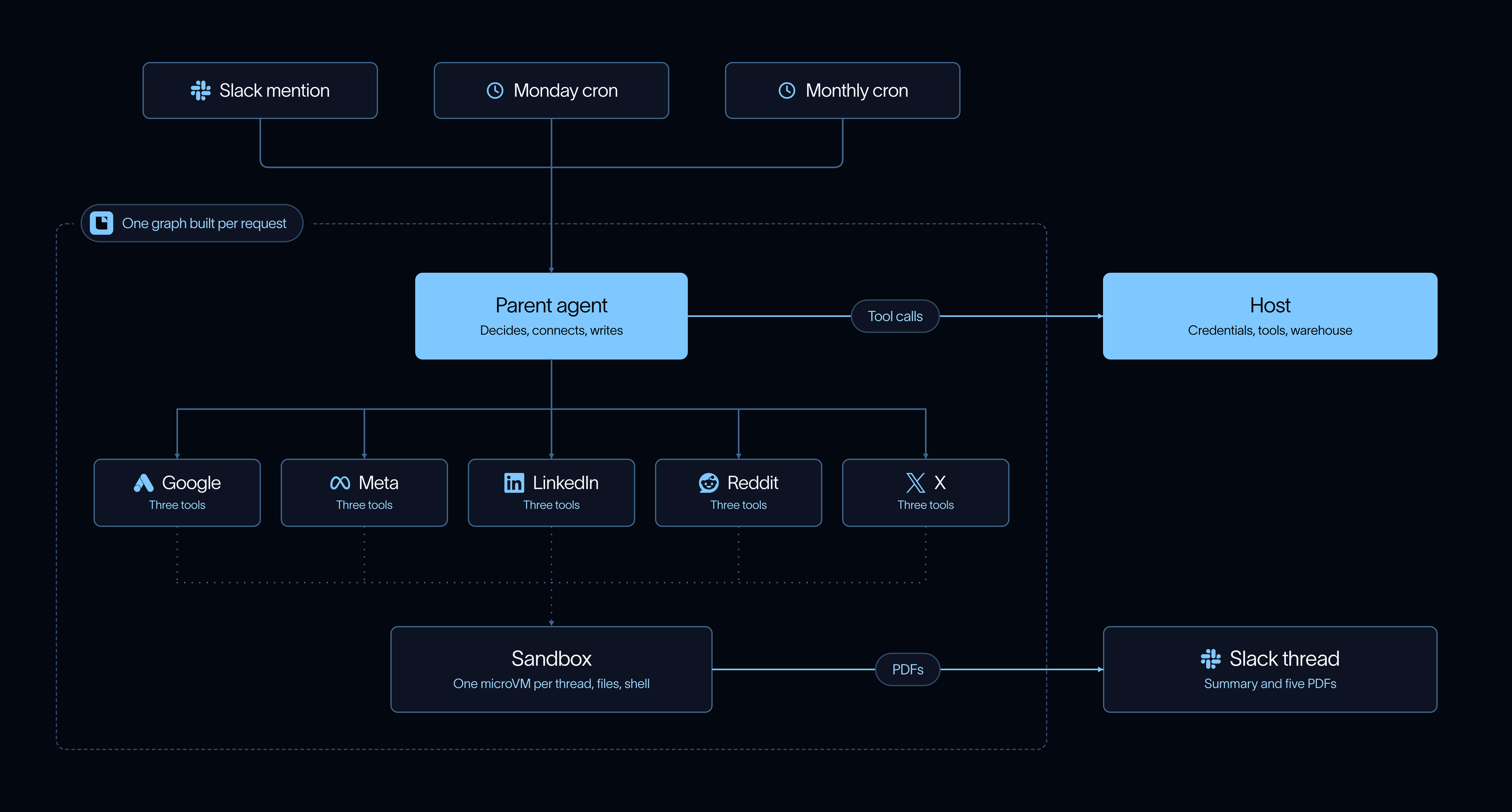
LangChain has open-sourced the internal Paid Media Agent it uses to run its own advertising, detailing the build in a September 13, 2026 blog post. The Slack-based agent combines ad-platform data with warehouse lead and pipeline data weekly, posting summaries and branded PDFs. LangChain reports paid media grew from 0 to 20% of marketing pipeline in six months, a 30% drop in cost per qualified lead from June to August, and roughly $5K per month saved by replacing agency analysis.
LangChain's Paid Media Agent Took Paid Ads From 0 to 20% of Marketing Pipeline in Six Months
LangChain published a case study on its internal Paid Media Agent, which it says took paid media from 0 to 20% of marketing pipeline in six months, cut cost per qualified lead 30% from June to August and saved about $5K per month by moving analysis in-house. The long-running Slack agent combines ad-platform and warehouse data, posts weekly reports and PDFs, and proposes keywords, targeting and ad copy. LangChain open-sourced the agent and will host a webinar on September 23.
LangChain Open-Sources the Paid Media Agent That Took Its Marketing Pipeline From 0 to 20% in Six Months
LangChain has open-sourced the Paid Media Agent it built for its own marketing team, publishing an engineering writeup on September 13, 2026. Paid media went from 0 to 20% of marketing pipeline in six months, cost per qualified lead fell 30% from June to August, and in-housing analysis saved about $5K per month. The Slack-based agent ships with ad-platform tools, paid media skills, a sample wiki, reporting, and approval workflows.
LangChain Open-Sources the Paid Media Agent That Runs Its Ads From Slack
LangChain has open-sourced the Paid Media Agent it built to run its own advertising operation, publishing a blog post on September 13, 2026. The agent lives in Slack, executes every Monday, and manages campaigns across five paid channels, helping paid media reach 20% of marketing pipeline in six months while cost per qualified lead fell 30% from June to August.
LangChain's Paid Media Agent Cuts Weekly Reporting Cost 40x and Runtime 13x
LangChain published a blog post on September 13, 2026 detailing its internal Paid Media Agent, which cut the cost of its weekly reporting workflow by 40x and made it 13x faster. The open-sourced agent runs in Slack every Monday, combining ad-platform data with warehouse pipeline data, and moved calculations from the model into deterministic Python code. Runtime dropped from 18 minutes to 85 seconds.

Meta Puts Muse on the Mac, Ten Days After Its US Debut
Meta released a Mac app for its Muse personal AI agent on September 18, 2026, ten days after the product's US debut on iOS, Android, and muse.ai. The desktop build organizes files, fills forms, and pulls from Messages, Calendar, and Notes, with cross-device continuity via WhatsApp. Muse runs on Muse Spark inside an isolated Muse Secure VM, with Sentinel approving internet access, Link by Stripe payments, and a planned Muse Confidential VM later in 2026.
AI Agents Blog
AI Agent Orchestration in 2026: The Complete Guide
Most AI agent pilots fail not because the model is weak, but because the orchestration layer is missing. This guide breaks down persistent runtimes, multi-model routing, and execution patterns, with concrete workflow builds for Zapier, Make.com, n8n, and Pipedream.
Prompt Caching in 2026: Cut AI Agent Costs by 90%
Prompt caching is the most underused cost lever in AI automation. This guide explains how it works and shows you exactly where to apply it inside your Zapier, Make.com, n8n, and Pipedream workflows.
AI Model Flexibility: Stop Automation Lock-In in 2026
Tying your workflows to a single AI model is a 2026 liability, not a strategy. Here's how to architect model-agnostic automations across Zapier, Make.com, n8n, and Pipedream so you can swap providers without rebuilding from scratch.
AI Agents in Production: A 2026 Case Study
AI agents are moving from demos to daily operations. This case study breaks down how one team built a production-grade agent workflow with measurable results—and where it almost failed.
WhatsApp Business MCP Server: AI Agents for Setup
Meta's WhatsApp Business MCP server hands template creation, messaging setup, and troubleshooting to AI coding agents like Claude and Cursor. Here's how automation teams should fold it into their stack without breaking production flows.
Microsoft AutoGen: Build Multi-Agent Conversations
Most AutoGen tutorials stop at two agents saying hello. This one starts where they stop: a working multi-agent system wired to real tools, with cost controls, sandboxing, and a path to production.