PreprintCommunications of the ACM
ImageNet classification with deep convolutional neural networks
Alex Krizhevsky, Ilya Sutskever et al.
130k2017
0
Citations
0
Influential Citations
Neura Market Technical Report NM-TR-2026-02
Venue
2026
Year
Automation platforms let people wire third-party services together without writing code, and their public template galleries are a written record of how that work is assembled. We analyse the reliability configuration of 5,250 deduplicated n8n templates — every template we could parse from a corpus of 13,126 — by reading each template’s own executable specification rather than its description. 5,147 of them call at least one external system. The result is one-sided. 81.0% (95% CI 79.9–82.1) of templates that call an external system declare no error handling of any kind: no node-level error policy, no followed error branch, no workflow error handler, no error trigger. Counting individual calls rather than templates, 5.2% of 40,863 external calls declare any error handling, 2.44% declare a retry, and 0.33% declare a timeout. The median template makes 6 external calls and protects none of them. Two secondary results. Integrations co-occur in 6 distinct communities recoverable from structure alone. And AI-containing templates carry fewer deterministic branching steps than templates matched on size — a small effect (Cliff’s delta −0.224) in the direction that displacement of deterministic logic by model calls would predict. Ten candidate anti-pattern detectors were manually audited; the audit rejected three of them outright, and each rejection was an implementation that did not match its own definition. Published templates are artefacts of intent, not evidence of deployment. What they show is that the reliability engineering an automation needs in production is almost entirely absent from the examples people copy. This is an unreviewed technical report: no external researcher reviewed it, and the publisher operates a marketplace listing templates from this corpus.
Neura Market Technical Report NM-TR-2026-02 · Published 21 August 2026 · Download the PDF
This report has not been peer reviewed, and no academic institution has been involved in it. It was written by Neura Market, which assembled the corpus and owns the database. No external researcher reviewed the methodology, the analysis, or these conclusions. It is published as an unreviewed technical report because that is what it is.
Preregistration, code and stat files: preregistration.md, src/, outputs/stats/.
Automation platforms let people wire third-party services together without writing code, and their public template galleries are a written record of how that work is assembled. We analyse the reliability configuration of 5,250 deduplicated n8n templates — every template we could parse from a corpus of 13,126 — by reading each template's own executable specification rather than its description. 5,147 of them call at least one external system, and those are the subject of every figure below.
The result is one-sided. 81.0% (95% CI 79.9-82.1) of templates that call an external system declare no error handling of any kind: no node-level error policy, no followed error branch, no workflow error handler, no error trigger. Counting individual calls rather than templates, 5.2% of 40,863 external calls declare any error handling, 2.44% declare a retry, and 0.33% declare a timeout. The median template makes 6 external calls and protects none of them.
Two secondary results. Integrations co-occur in 6 distinct communities recoverable from structure alone. And AI-containing templates carry fewer deterministic branching steps than templates matched on size — a small effect (Cliff's delta -0.224) in the direction that displacement of deterministic logic by model calls would predict.
Ten candidate anti-pattern detectors were manually audited; the audit rejected three of them outright and each rejection was an implementation that did not match its own definition.
Published templates are artefacts of intent, not evidence of deployment. What they show is that the reliability engineering an automation needs in production is almost entirely absent from the examples people copy.
A workflow automation is a small distributed system. It calls services it does not control, over networks that fail, on behalf of a person who is not watching. The engineering that makes such a system survive contact with production is well understood and unglamorous: retry the call that failed, bound how long you wait, make the write safe to repeat, and send the failure somewhere a human will read it.
Public template galleries are where people go to learn how to build these. n8n, Make, Zapier and others publish thousands of templates that can be imported and run. They function as worked examples, and worked examples teach.
This report asks what those examples declare about failure.
These are templates, not deployments — and that shapes everything that follows. The corpus was collected from n8n's public template gallery. We cannot observe whether any template here was ever imported, let alone run. A template that omits a retry may sit beside a production workflow, in the same author's account, that has one. Everything measured here is declared configuration in a published artefact, and the report says "templates" rather than "automations" throughout for that reason.
That limitation is real, and it is also narrower than it first appears. A published template is a claim about how a job should be done. It is copied, adapted and shipped. If the examples people copy contain no error handling, the omission propagates whether or not the original author knew better.
We make three contributions. First, a reliability measurement across 5,250 templates covering six mechanisms, reported under three explicitly stated denominators. Second, a set of deterministic detectors for structural anti-patterns, with their prevalence and their observability limits stated. Third, the code and the per-statistic outputs, so that any number here can be recomputed or contradicted.
This report follows NM-TR-2026-01, What Builders Publish, and What Gets Used, which analysed the same corpus for structure and adoption. That report measured error handling with a single boolean and did not examine retries, timeouts, idempotency or recovery paths. This one does. Where a finding of that report is needed as context it is cited, not restated.
Workflow corpora. Prior structural analysis of no-code automation has been mostly n8n-only and mostly descriptive: node counts, popular integrations, growth of AI nodes. NM-TR-2026-01 extends this to two platforms and relates structure to each platform's own adoption counter. Neither that work nor its predecessors examine failure handling beyond presence or absence.
Reliability in distributed systems. The mechanisms measured here — bounded retry with backoff, timeouts, idempotency keys, dead-letter queues — are standard practice in message-driven architecture and are treated as table stakes in that literature. The gap this report addresses is that no one has asked how much of that practice survives into the low-code layer, where the person assembling the system is frequently not a distributed-systems engineer and the platform defaults decide what happens.
Declared versus observed configuration. Studies of infrastructure-as-code and CI configuration face the same limitation this one does: a file records intent, not behaviour. The convention in that literature is to state the gap plainly and measure the artefact anyway, because the artefact is what gets copied. We follow it.
The analysis plan, inclusion criteria, feature definitions, denominators and seven conditional
decision rules were written to preregistration.md and committed before any script read the
corpus. Three of those rules fired and are reported where they apply (R3, R4, R7). One did not
and is reported as not taken (R1). Nothing in this report was chosen after seeing its result.
The corpus is the frozen snapshot neura-automation-study-2026-08-17, read-only, shared with
NM-TR-2026-01 so that both reports describe the same templates. Of 13,126 n8n rows, 12,892 parse
into a step graph.
Fields known to be synthetic in the source database — ratings, prices, featured, author
identities, n8n download counts and created_at — are not read by any script in this study.
The evidence is each template's own specification.
Make's scenario format exposes no per-module error field. Make error handling is unobservable, not absent, and pooling the two platforms would code "not recorded" as "not configured". Every reliability figure in this report is n8n-only, and Make appears in no reliability comparison. Zapier (334 templates), Activepieces (65) and Pipedream (23, none parseable) are reported as a coverage gap and excluded.
Marketplace corpora contain forks and reskins, and counting them separately inflates every frequency. We compute a canonical graph hash per template — the sorted step-type multiset plus edge shape, ignoring node names, positions, identifiers and credentials — and collapse exact collisions.
A second, near-duplicate stage using multiset Jaccard was implemented and then removed: manual adjudication measured its precision at 0.17 and no threshold repaired it. Section 4.7 reports what that inspection found. Deduplication in this report is the exact-hash stage alone.
Deduplication removes 59.3% of parseable templates, leaving 5,250 templates of which 5,147 make an external call. That exceeds the 25% threshold of decision rule R4, so the deduplicated figure leads throughout and the pre-deduplication figure is reported beside it.
The loss is not a hashing artefact. The largest cluster is 33 members of one 16-step agent scaffold — a chat trigger, a director agent, and six sub-agents — republished with the domain labels changed from LinkedIn content to social media to creative design. Templates of this kind are one artefact, not thirty-three observations.
Figure 1 reports the flow from retrieved templates to the analysed set, with the count dropped at each step.
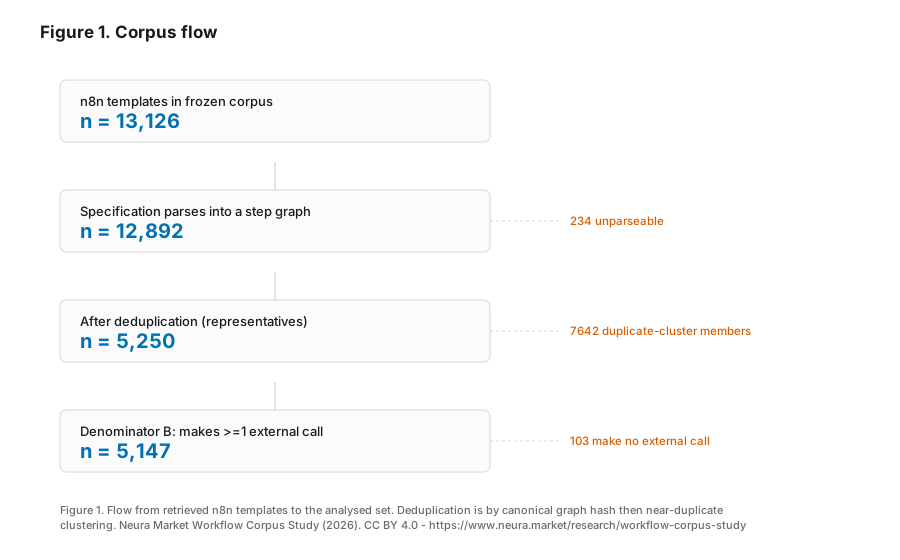
Figure 1. Flow diagram. 13,126 n8n templates in the frozen corpus; 12,892 parse into a step graph; 5,250 remain after deduplication; 5,147 of those make at least one external network call and form denominator B.
A step makes an external call when it reaches a third-party system: an HTTP-family node, a raw transport, or a node bound to an identifiable application. Control flow, data shaping and documentation nodes do not, whatever verb they declare. n8n sticky notes are documentation and are excluded from every count, as are LangChain sub-nodes, which are attachments to an AI step rather than steps.
Six mechanisms, each detected from declared configuration: node-level error policy (onError,
continueOnFail, retryOnFail); a followed error branch; a workflow-level error handler; a
node or workflow timeout; an idempotency guard (an explicit deduplication step, an upsert verb,
or a read on an application immediately upstream of a write to it); and a recovery path — an
error branch terminating in a store or notification, or performing an alternative action.
One trap is worth recording because it would invert the headline. n8n overloads output
port 1. It is the error path only on a node that sets onError = continueErrorOutput; on an
if it is the false branch, on a switch the second case, on splitInBatches the loop output.
Counting port-1 edges as error branches inflates error handling by roughly an order of
magnitude. Every detector here gates on the onError value before reading the port.
Every proportion states its own denominator.
n8n does not serialise a defaulted parameters.operation, so a verb is visible on a median
11.1% of external-call steps
(2333 templates
declare none at all). Upsert and read-before-write detection is bounded by that. Every
idempotency figure in this report is a floor, not an estimate, and is labelled as one.
Proportions carry a 95% Wilson score interval, chosen over the normal approximation because several of these proportions sit near zero, where the normal interval produces a negative lower bound. Distributions are reported as median and interquartile range, not mean and standard deviation, because step and call counts are right-skewed. Effect sizes accompany every comparison; at these sample sizes significance is guaranteed and uninformative on its own.
Nothing here is causal. Templates are not randomly assigned their features, and platform, author, age and purpose are confounded with everything measured. The word used is "associated".
81.0% (95% CI 79.9-82.1) of templates making at least one external call declare no error handling of any kind — no node-level error policy, no followed error branch, no workflow error handler, no error trigger. Denominator B, n = 5,147.
The single most common mechanism is a node-level error policy, present in 17.5% (95% CI 16.5-18.6) of denominator B (n = 5,147). No mechanism reaches one template in five.
Retry is declared by 7.5% (95% CI 6.8-8.3) of denominator B (n = 5,147).
A timeout — at either node or workflow level — is declared by 2.1% (95% CI 1.8-2.6) of denominator B (n = 5,147).
An error branch that is actually followed somewhere is present in 4.5% (95% CI 4.0-5.1) of denominator B (n = 5,147).
A recovery path — an error branch terminating in a store or a notification — is present in 2.6% (95% CI 2.2-3.1) of denominator B (n = 5,147).
An idempotency guard is present in 8.9% (95% CI 8.2-9.7) of denominator B (n = 5,147). This is a floor. It is bounded by the operation-declaration ceiling in Section 3.8, and the true rate is higher by an unknown amount.
Four mechanisms have confidence intervals lying entirely below 2% of denominator B (n = 5,147) and are reported as essentially absent under decision rule R3: a workflow-level error handler (1.4%), an explicit stop (1.3%), an error trigger (1.0%), and a workflow-level execution timeout (0.5%). None is modelled further; a logistic model fitted to a few dozen positives is noise.
Deduplication barely moves these numbers — node-level error policy is 17.5% of denominator B (n = 5,147) deduplicated, against 16.5% before deduplication. The reskinned clones are not systematically better or worse engineered than the templates they came from, which is itself worth knowing.
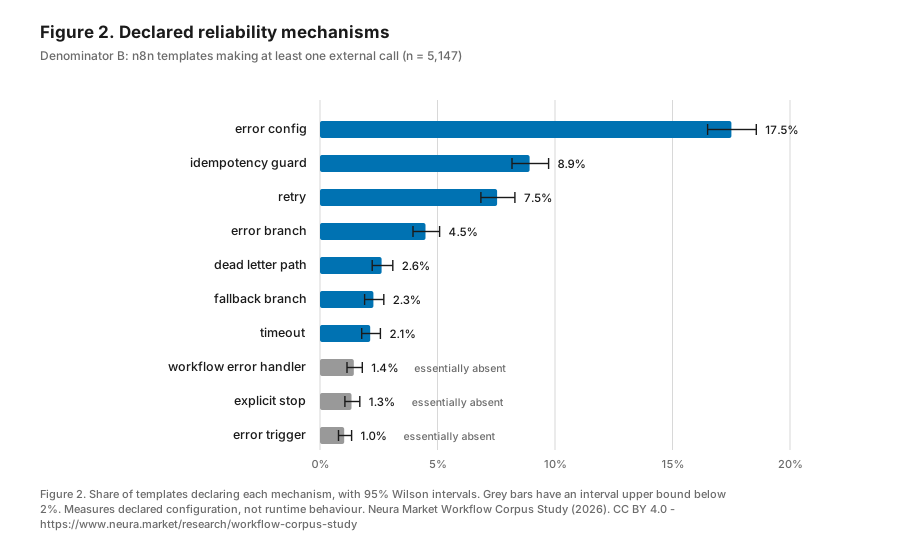
Figure 2. Horizontal bar chart of declared reliability mechanisms among 5,147 n8n templates that make external calls. The most common is error config at 17.5%. All mechanisms fall below 18%; several have confidence intervals entirely below 2% and are marked essentially absent.
A template-level boolean is generous: one configured call in eleven scores the whole template as protected. Denominator C removes that generosity.
5.2% of 40,863 individual external calls declare any error handling (95% CI 5.0-5.4).
2.44% of external calls declare a retry (95% CI 2.3-2.6).
0.33% of external calls declare a timeout (95% CI 0.3-0.4).
The median template makes 6 external calls across 10 steps. Almost none of those calls are bounded in time or retried.
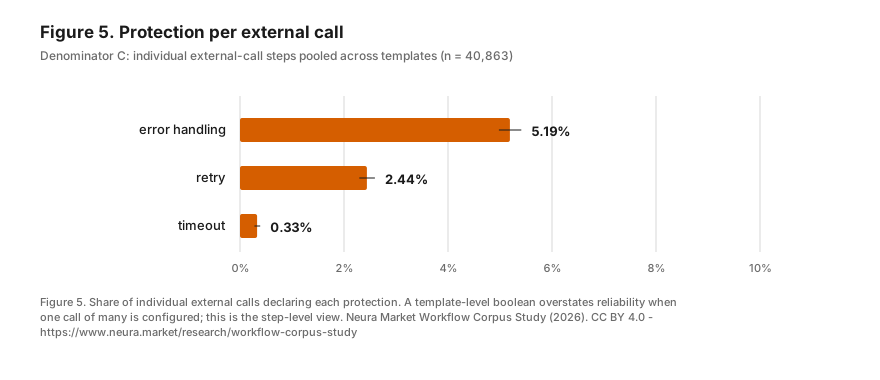
Figure 5. Bar chart of protection per external call across 40,863 external-call steps. Error handling covers 5.2% of calls, retry 2.4%, and timeout 0.33%.
Ten of twelve implementable detectors clear the preregistered 2% screen. Decision rule R7 is therefore not triggered and the catalogue stands as a contribution.
Precision for each of these is measured in Section 4.6, against one annotator rather than the two Section 11.2 requires. The rates below are the prevalence screen's output; read them with that section's caveats attached.
| ID | Pattern | Rate | 95% CI | Denominator |
|---|---|---|---|---|
| AP-01 | Silent Failure | 98.0% | 95% CI 97.6-98.3 | templates with >=1 external call (n = 5,147) |
| AP-11 | Timeout-Free Long Chain | 96.8% | 95% CI 95.7-97.6 | templates whose longest path contains >=5 external calls (n = 1,308) |
| AP-02 | No-Retry Ingest | 90.6% | 95% CI 89.7-91.3 | templates with >=1 external call (n = 5,147) |
| AP-06 | Unbounded Fan-Out | 75.8% | 95% CI 73.4-78.1 | templates containing >=1 loop or split step (n = 1,253) |
| AP-08 | Chatty Model Loop | 72.5% | 95% CI 69.1-75.6 | templates containing both a loop and an AI step (n = 720) |
| AP-04 | Unvalidated Model Output | 52.1% | 95% CI 50.2-53.9 | templates containing >=1 AI step (n = 2,756) |
| AP-10 | Zombie Branch | 7.3% | 95% CI 6.6-8.1 | all analysed templates (n = 5,250) |
| AP-13 | Inline Prompt Sprawl | 15.1% | 95% CI 12.6-18.0 | templates containing >=3 AI steps (n = 670) |
| AP-05 | Non-Idempotent Write | 16.5% | 95% CI 15.5-17.5 | templates with >=1 external call (n = 5,147) |
| AP-03 | Model as Filter | 7.9% | 95% CI 7.0-9.0 | templates containing >=1 AI step (n = 2,756) |
Two candidates fail the screen and are reported rather than dropped. Single-Credential Sprawl appears in 0.27% of templates (n = 5,250) and Hardcoded Secret in 0.13% (n = 5,250). The second is good news and worth stating plainly: n8n strips credentials on export, and the gallery is not leaking keys at any measurable rate. Detected values were counted and never recorded.
One candidate is not implementable from this corpus. Poll-Where-Webhook-Exists requires a per-vendor table of which n8n integrations offer a webhook trigger. That is external knowledge, not corpus content. It is reported as unobservable, which is a different claim from absent.
A pattern present in 98% of cases is a description, not a diagnostic. Silent Failure is so near-universal that calling it an anti-pattern strains the term: it is the default state of a published n8n template. It does more work as the headline of Section 4.1 than as an item on a checklist.
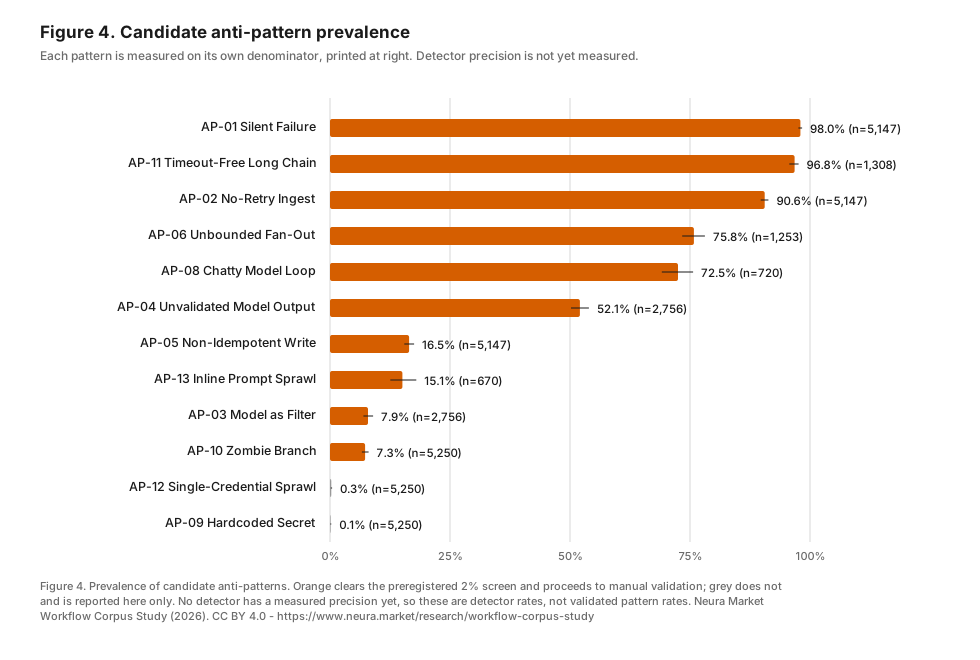
Figure 4. Bar chart of candidate anti-pattern prevalence, each on its own denominator, with 95% confidence intervals. Silent Failure is the most common at 98% of templates making external calls; Hardcoded Secret and Single-Credential Sprawl fall below the 2% screen and are reported without being labelled.
Weighting co-occurrence edges by lift rather than raw frequency — raw counts recover only that popular things are popular — yields a network of 69 integrations and 405 above-chance pairs over 3,398 templates naming at least two.
Louvain recovers 6 communities at modularity 0.4112. Read in descending size they are: conversational agents (OpenAI, agent, memory, Gmail, Telegram, Airtable, Calendar); structured generation (Sheets, structured and autofixing output parsers, LLM chain, OpenRouter, Docs, MCP, WordPress); document retrieval (Drive, Gemini, document loaders, recursive text splitter, Pinecone, Qdrant); operations and alerting (Slack, email, Notion, HubSpot, GitHub); stateful backends (sub-workflow tools, Supabase, Postgres, WhatsApp, Postgres-backed chat memory, Redis); a small Anthropic-and-Cohere retrieval cluster; and social publishing (RSS, X, LinkedIn, Facebook).
The community names are our interpretation, not a measurement. The partition is reproducible from the seed; the labels are read off it by hand. Figure 3's legend names each community by its two largest members instead, so the figure cannot drift from the partition the way a hand-written legend can — and did, for one run, when the community count changed from five to seven and the legend did not.
The strongest associations are inside the retrieval stack — token splitter with Qdrant, Cohere with character splitter, retrieval-QA chain with Qdrant — at lifts above 25 times chance. These are components that only make sense together, which is what a high lift should mean. Note that the retrieval stack spans three of the seven communities rather than forming one: the vector store travels with its loaders, but the model vendor attached to it varies.
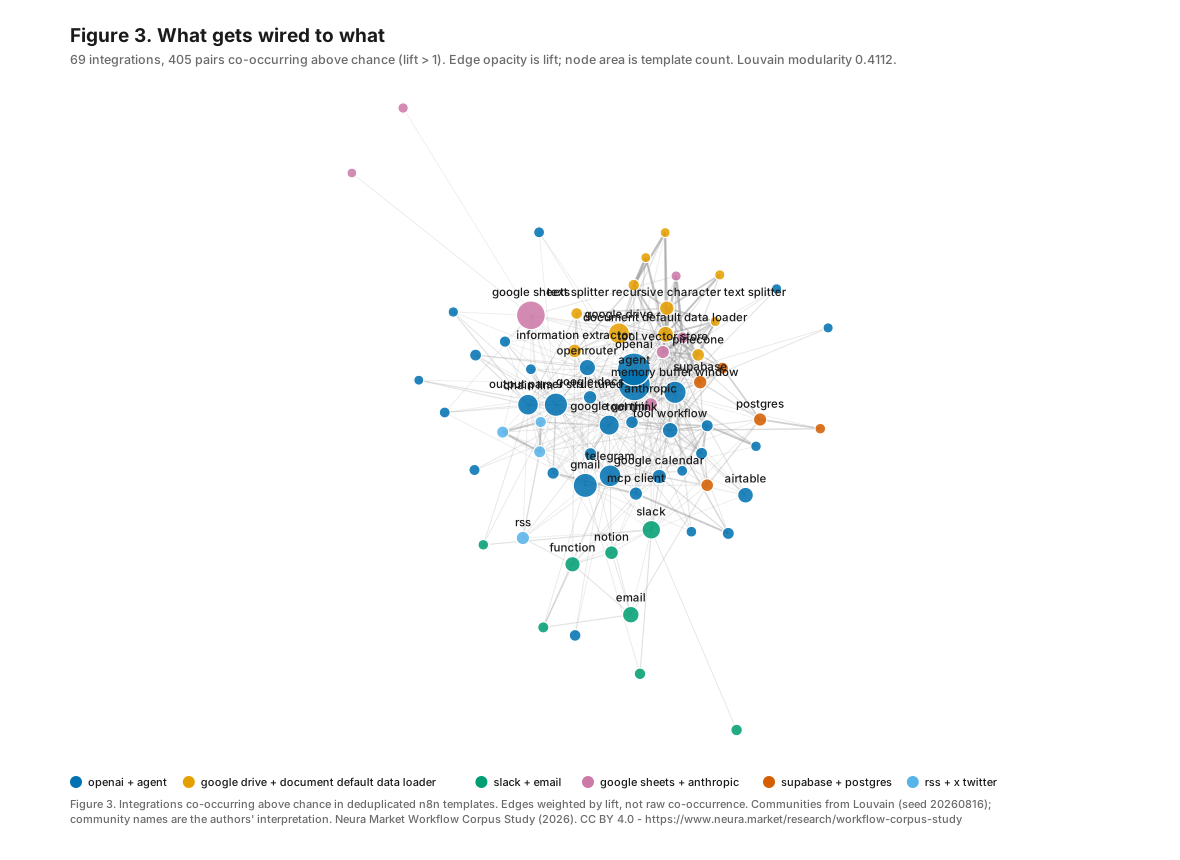
Figure 3. Force-directed network of 69 integrations connected by 405 above-chance co-occurrence pairs, grouped into 6 colour-coded communities detected by the Louvain algorithm. Node size is the number of templates using that integration; edge weight is lift, so an edge is strong when two integrations appear together far more often than their individual popularity would predict.
Matching each AI-containing template to a non-AI template on step count and external-call count yields 1,292 pairs. Matched AI templates carry a median of 0.0 deterministic branching steps against 1.0 for their matches (means 0.671 and 1.211), Cliff's delta -0.224 — small.
The direction is the one displacement predicts. The magnitude is small, and 1502 AI templates found no size-matched counterpart at all, which means AI templates occupy size regimes that non-AI templates largely do not. This is an association measured on a subset, not a mechanism.
Separately, 7.8% (95% CI 6.9-8.9) of templates containing an AI step (n = 2,794) use the model purely as a branch predicate: every immediate downstream consumer of the model output is a conditional.
The temporal arm was not taken. Decision rule R1 required at least 400 dated templates per year across four consecutive years after deduplication; the dated sub-corpus holds 2,174 templates and the requirement is not met. Nothing here is a claim about change over time, and NM-TR-2026-01 has already published the temporal AI-adoption trend on this corpus.
Section 11.2 of the preregistration requires a manual audit of every published detector, with two independent annotators and Cohen's kappa reported per pattern.
That requirement is not met, and the shortfall is large enough to state before the numbers. One annotator has run: annotator A, who is also the author of the detectors. Cohen's kappa is undefined on a single pass and is reported as not computed rather than as high. Precision below is an upper bound on what an independent annotator would find, and the human second pass required by section 11.3 is outstanding.
With that said, the audit did its job, because it broke three detectors.
The first validation round rejected three of the ten detectors that had cleared the prevalence screen. Zombie Branch scored 0.325, Timeout-Free Long Chain 0.675, and Inline Prompt Sprawl 0.700, against a bar of 0.85. Each failure was an implementation that did not match its own written definition:
toolCalculator,
toolWikipedia, modelSelector and every community tool node, and reported them as
unreachable subgraphs. The codebook defines an attachment structurally — a node that reaches
its orchestrator only by a non-main port — and the detector now does the same.After those repairs, and on a sample redrawn from the corrected detectors, 10 of 11 detectors with a computable precision meet the 0.85 bar.
That second round is not independent evidence of quality. It followed fixes that the first round prompted, and it is better read as confirmation that three specific defects were repaired. The first round is the one that measured something, and it is reported here for that reason.
| ID | Pattern | Precision | 95% CI | Recall | Round 1 |
|---|---|---|---|---|---|
| AP-01 | Silent Failure | 100.0% | 95% CI 91.2-100.0 | 0.976 | — |
| AP-02 | No-Retry Ingest | 100.0% | 95% CI 91.2-100.0 | 0.976 | — |
| AP-03 | Model as Filter | 100.0% | 95% CI 91.2-100.0 | 1.0 | — |
| AP-05 | Non-Idempotent Write | 100.0% | 95% CI 91.2-100.0 | 1.0 | — |
| AP-06 | Unbounded Fan-Out | 100.0% | 95% CI 91.2-100.0 | 1.0 | — |
| AP-08 | Chatty Model Loop | 100.0% | 95% CI 91.2-100.0 | 1.0 | 0.975 |
| AP-10 | Zombie Branch | 100.0% | 95% CI 91.2-100.0 | 1.0 | 0.325 |
| AP-11 | Timeout-Free Long Chain | 100.0% | 95% CI 91.2-100.0 | 1.0 | 0.675 |
| AP-13 | Inline Prompt Sprawl | 92.5% | 95% CI 80.1-97.4 | 1.0 | 0.700 |
| AP-04 | Unvalidated Model Output | 85.0% | 95% CI 70.9-92.9 | 1.0 | 0.900 |
AP-05 could not be judged on 103 of the templates assigned to it. Where no external step in a template declares an operation, the evidence cannot support a verdict either way, and the annotator recorded a question mark rather than guessing. That is the operation-declaration ceiling of Section 3.8 showing up again, now as an annotation problem rather than a measurement one.
AP-12 has no precision. Its prevalence, 0.27%, is low enough that the stratified draw contained no positives to audit. It had already failed the prevalence screen.
Recall should be read with suspicion. The sample is stratified by detector-positive, so it is enriched for the cases the detector already finds. The false negatives it can detect come from a negative pool of 108 templates, which is small. A recall of 1.000 here means "the negative pool contained almost nothing the detector missed", not "the detector misses nothing".
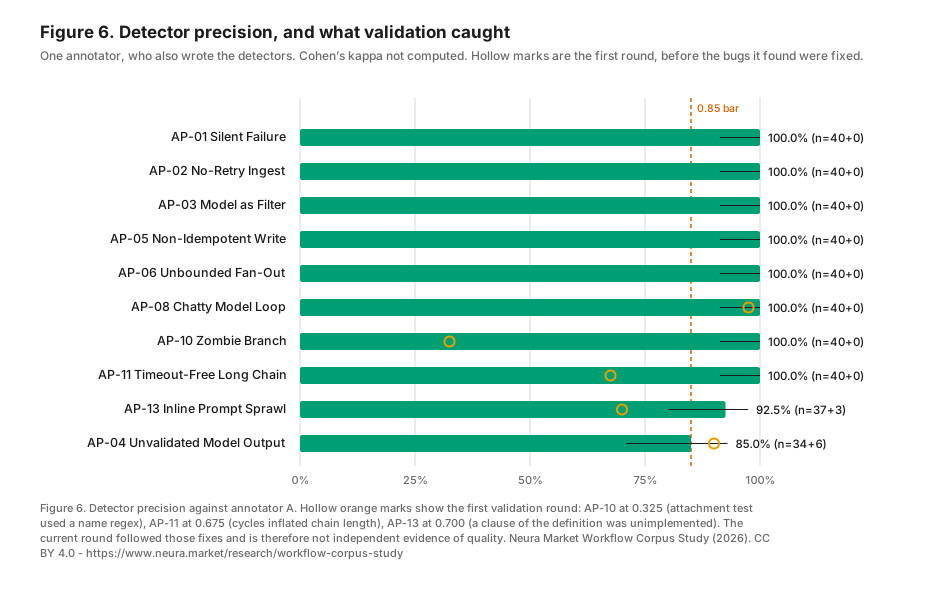
Figure 6. Bar chart of detector precision against a single annotator, with a 0.85 threshold line. Hollow markers show markedly lower precision in the first validation round for three detectors, before the defects that round exposed were repaired.
Section 6.4 of the preregistration commits to justifying the near-duplicate threshold by inspecting pairs that straddle it, and to publishing the log. Doing so cost the study its near-duplicate stage.
The inspection set was itself defective at first: it recorded only pairs below the merge threshold — the ones kept apart — and so hid every pair that had been merged, which is the side where a false merge silently shrinks the corpus. Widened to straddle the threshold, the band held 298 pairs, 55 of them merged.
All 55 merged pairs were inspected. Eight are the same artefact. Thirty-nine are not. Eight could not be judged because neither side retains creator-authored text. Measured precision of the near-duplicate stage: 8 of 47 judgeable, 0.17.
The failures are not marginal. "Convert Spotify Tracks to MP3" was merged with "Convert Pinterest Videos to MP4"; "Court Date Reminder" with "Product Launch Email"; "Real-time lead routing in Webflow" with "Extract and Verify Book Titles from Bookshelf Photos".
No threshold rescues it. Multiset Jaccard over step types cannot separate a lightly edited template from a different template assembled from the same parts. On a seven-step template one differing node scores 0.857; on an eleven-step template, 0.917. Automation templates are built from a small shared vocabulary, so distinct workflows routinely land above any threshold that still catches real variants — and the false merges ran to the very top of the inspected band.
The stage was therefore dropped. Deduplication rests on the exact canonical graph hash, which also carries edge structure, and which was validated separately against its largest cluster: 33 members of one 16-step agent scaffold republished with the domain labels changed from LinkedIn content to social media to creative design. Those are one artefact.
The analysable set is 5,250 rather than the 5,163 the
near-duplicate stage produced. Deduplication still removes
59.3% of parseable templates, essentially all of it from the
exact stage. Genuine near-variants are now counted separately, which inflates the denominator
rather than shrinking it — the conservative direction, and no reliability proportion is
flattered by it. The full log is labeling/dedup_adjudication.md.
The striking number in this report is not any individual mechanism's rate. It is that 81.0% of templates calling external systems declare nothing at all (denominator B, n = 5,147), and that at the level of individual calls the figure for any protection is 5.2% (denominator C, n = 40,863).
That is not a distribution with a tail of careless authors. It is a population in which configuring failure handling is the exception, across authors, sizes and application stacks.
The most economical explanation is that the platform default decides the outcome. n8n's default is to stop the execution on a failed node, which is a defensible default and requires no configuration. Every mechanism measured here requires the author to know it exists, find it in a settings panel, and decide a value. What gets measured as "reliability engineering" is really "the rate at which authors override a default", and that rate is low for every override in every category.
A gallery template is copied. Whatever it declares becomes the starting point for whatever the copier builds. If 90.6% of templates making an external call declare no retry anywhere (n = 5,147), the copier starts from no retry.
This is the sense in which "listed, not deployed" understates rather than overstates the finding. We cannot claim these templates run. We can observe that they are the examples on offer, and that the examples contain almost no failure handling.
7.8% of AI-containing templates (n = 2,794) consume the model's output only through a conditional. In those templates a non-deterministic component is deciding a binary branch — a job a deterministic rule could do, more cheaply and more repeatably.
The matched comparison points the same way at a small effect size: AI templates carry fewer deterministic branches than size-matched non-AI templates (-0.224, Cliff's delta, small). We are careful about this. It is cross-sectional, associational, and computed on the 1,292 AI templates that found a size match — a minority of those available, because 1502 more had no non-AI counterpart of comparable size. It is consistent with displacement. It does not establish it.
Four changes, in the order their absence costs most:
Neura Market lists templates from this corpus in its workflow marketplace, alongside n8n, Make, Zapier, Activepieces and Pipedream listings. The finding is that the inventory, judged as production-ready automation, is not production-ready: on the fair denominator (B, n = 5,147), 81.0% of listed templates that touch an external system declare nothing about what happens when it fails.
That is an uncomfortable result for the party that funded the analysis, and it is reported at full strength because a report that softened it would be worth nothing. It also suggests the obvious product response, which is out of scope here and is not a finding: the gap between a published template and a deployable one is a gap someone could close.
(a) Listed is not deployed. This is the largest threat to the report and is stated in the Introduction rather than only here. The corpus is n8n's public template gallery. We cannot observe whether any template was imported, scheduled or run. An author who publishes a template without a retry may run a version with one.
(b) Declared configuration is not runtime behaviour. Every detector reads what a
specification says. A template declaring retryOnFail has not demonstrated a retry; a template
omitting it may be wrapped by an error workflow configured outside the specification, in the
account rather than the artefact. The direction of this bias is toward understating reliability.
(c) Templates are selected for shareability. A gallery template is written to be legible and generic. Environment-specific error handling — the alert channel, the dead-letter table, the account-level error workflow — is exactly the kind of detail an author strips before publishing. This is the most serious alternative explanation for the headline, and this report cannot rule it out. It would mean the numbers here are a floor for published templates and not an estimate for the same authors' private work.
(d) One platform. Reliability is measured on n8n alone because Make exposes no per-module error field. Nothing here generalises to Make, Zapier, Activepieces or Pipedream, and the report makes no claim about them.
(e) Idempotency is bounded by an observability ceiling. n8n does not serialise a defaulted
parameters.operation, so a verb is visible on a median
11.1% of external-call steps. Upsert and
read-before-write detection sees only that slice. Every idempotency figure is a floor.
(f) Detector validation rests on one annotator, who wrote the detectors. Section 11.3 requires two, one of them human. Cohen's kappa is undefined on a single pass and is not reported. Measured precision is an upper bound on what an independent annotator would find. Worse for interpretation, the current precision figures follow repairs that the first validation round prompted, so they confirm that three specific defects were fixed rather than establishing that the detectors are sound. The first round — which rejected three of ten detectors — is the informative one.
(g) Deduplication is exact-match only. 59.3% of parseable templates are removed as exact structural duplicates. The near-duplicate stage was adjudicated and dropped at precision 0.17 (Section 4.7), which means genuine near-variants — the same template lightly edited — are now counted separately. That inflates the denominator rather than shrinking it, so no proportion here is flattered by the decision, but the corpus is less deduplicated than the preregistration envisaged. Pre-deduplication figures are reported alongside throughout.
(h) The n8n corpus is a snapshot of unknown representativeness. We do not know how n8n's gallery selects, ranks or prunes, so we cannot say how the templates we see relate to the templates that exist.
(i) No temporal claim. Genuine publication dates exist for only part of the corpus and the preregistered threshold for a time-series arm was not met. Nothing here describes change.
(j) The analysis is unreviewed, and the Methods section has not been read by anyone who did not write it. No external researcher checked the code, the definitions or the interpretation. Several of the detection rules encode judgement calls — what counts as an external call, what counts as a recovery path — and a second reader would likely draw at least one of those lines differently.
Across 5,147 deduplicated n8n templates that call external systems, 81.0% (95% CI 79.9-82.1) declare no error handling of any kind. Counted per call rather than per template, 5.2% of 40,863 external calls declare any error handling, 2.44% a retry, and 0.33% a timeout.
These are published templates, not running systems, and the gap between the two is the report's principal limitation. What the corpus shows is what the worked examples teach: that a workflow automation is assembled from calls to services that can fail, and that the handling of that failure is, in the material people copy from, essentially absent.
The measurement is cheap to repeat. The detectors are deterministic functions over a
specification, the code is public, and every number in this report is regenerable from
outputs/stats/. A platform could run them over its own gallery and would learn the same thing
in an afternoon.
make reproduce.outputs/stats/, carrying its
denominator definition, its n, its confidence interval, the script that produced it and the
commit that script ran at.preregistration.md, committed before any script read the corpus.docs/methods_review.md
lists the specific questions such a reader should put to it; it is not a substitute for one.The deduplication band has now been adjudicated, and the answer was to drop the stage (Section 4.7).
Listed separately rather than woven into the findings, because they are context for a reader, not evidence for a claim. Neura Market published this report; see the disclosure above.
Neura Market (2026). Nobody Handles the Error: Reliability engineering in published automation templates. Neura Market Technical Report NM-TR-2026-02.
Figures are CC BY 4.0. The analysis code is MIT. The template corpus is not redistributed. Download the full report as a PDF.
Alex Krizhevsky, Ilya Sutskever et al.
Ashish Vaswani, Noam Shazeer et al.
Douglas M. Bates, Martin Mächler et al.
Diederik P. Kingma, Jimmy Ba