
Back to Blog rag
rag
 ai
ai googlecloud
 discuss
 agents
 agenticarchitect
 ai
ai
RAG debugging is harder than I expected
Yuji Ito April 20, 2026
0 views
I've started building a vector database to learn modern vector search for the AI era. In my...
title: RAG debugging is harder than I expected published: true description: tags: rag, vectordatabase, pinecone, qdrant
cover_image: https://direct_url_to_image.jpg
Use a ratio of 100:42 for best results.
published_at: 2026-04-20 14:01 +0000
I've started building a vector database to learn modern vector search for the AI era.
In my professional work, I maintain Jepsen/Antithesis tests for distributed databases and blockchain systems. These tests check system correctness through transactional behaviors under real-world failures.
When working on a vector database, I started wondering:
what does "correctness" even mean in vector search?
By definition, ANN results don't have to exactly match exact search. Some level of approximation is acceptable.
In RAG systems, there are evaluation methods — but most of them focus on the final LLM output.
When something goes wrong, it's hard to tell:
- was it the retrieval?
- the prompt?
- or the model itself?
I wanted to isolate the retrieval layer and understand what actually changed.
I changed the embedding model, but I couldn't clearly tell what changed in retrieval results.
Some queries looked fine. Some felt off. But I had no systematic way to understand the differences.
So instead of trying to judge correctness, I focused on something simpler:
What actually changed?
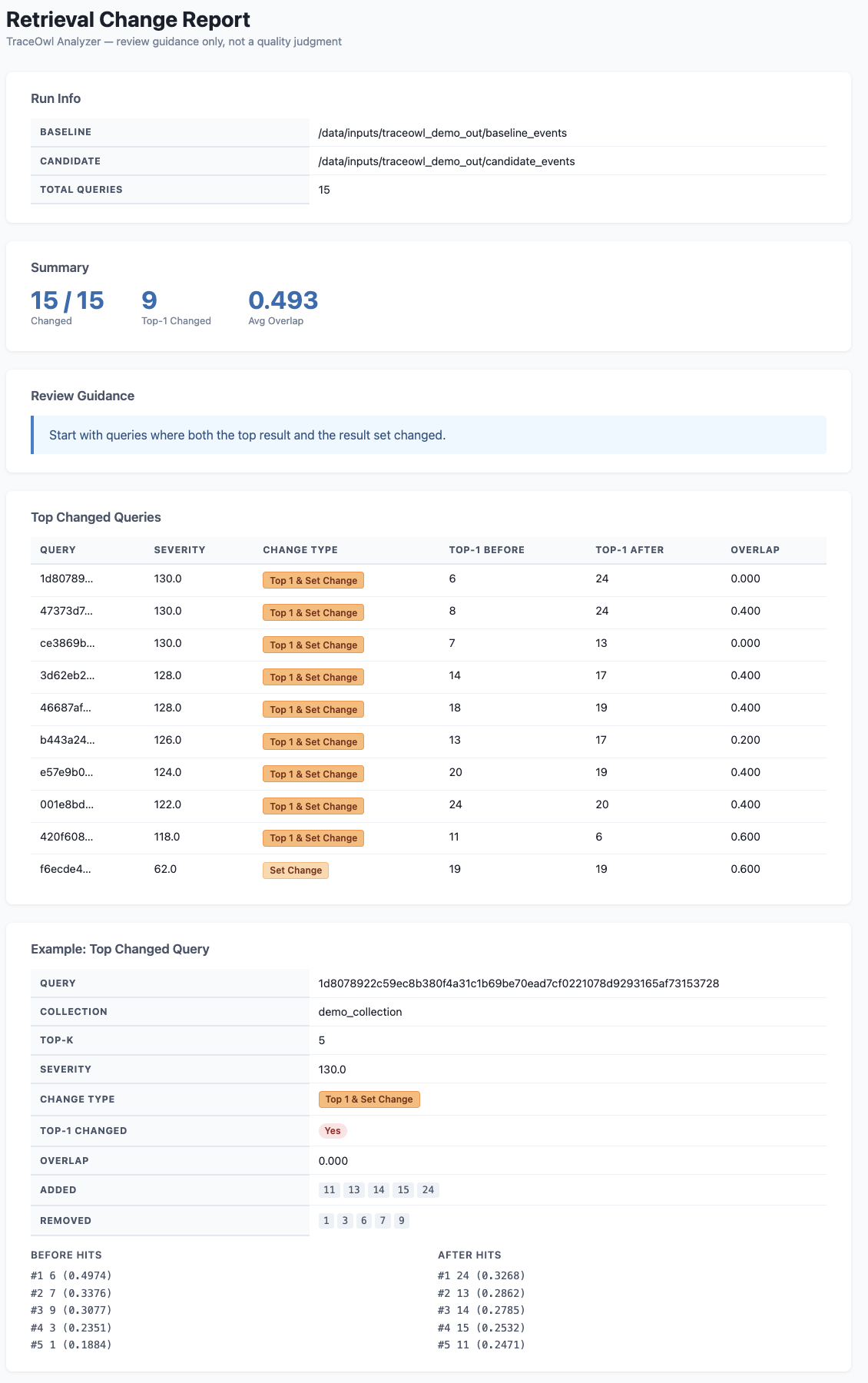
I built a small tool to diff retrieval results.
https://github.com/yito88/traceowl
It captures, compares, and explains differences in VectorDB search results so you can quickly understand what changed and where to focus your review.
If you're working on RAG or vector search, I'd love to hear how you evaluate changes in your system.
Comments
More Blog
View allaiContext bankruptcy: The case for strategic forgetting for AI Agents
Most of us have seen a coding agent fail to complete a task we know it can do. We just don't...
J
James O'ReillygooglecloudParallel Compliance Engine: Drive-to-Sheets Multi-Agent Orchestration
When building Generative AI applications, developers often encounter a massive bottleneck: sequential...
A
Aryan IranidiscussIs It Ethical to Post and Ask About Circuits on Dev.to?
I’ve been thinking about sharing some electronic circuit posts on Dev.to — small circuits, DIY...
C
codebunny20agentsThe One-Click Exporter: AI Studio Antigravity, Probed to Its Limits
What nobody tells you about exporting your multi-agent prototype to a local workspace. Every...
L
leslysandraagenticarchitectGuarding the till while autonomous data agents do the digging
Autonomous agents are genuinely good at answering messy business questions. Give one an LLM and a set...
S
Sireesha PulipatiaiReturn on Attention: Why AI Code Reviews Are Wearing Us Out
PR volume went up, ticket quality didn't, and the gap got filled with LLMs on both sides of the review: bots reviewing, bots replying, bots occasionally arguing with bots about priorities that only existed in a teammate's head. Our CEO named the actual problem, and it's bigger than code review.
C
christineReady-made automations for this
Workflows from the Neura Market marketplace related to this Stable Diffusion resource
- Automate Google Sheets Triggered List Building Workflown8n · $9.53 · Related topic
- Automate Your Website Building with N8N: Unsubscribe Workflowmake · $6.62 · Related topic
- Building Your First WhatsApp AI Sales Chatbotn8n · $19.99 · Related topic
- Interactive n8n Lesson 1: Data Flow, Execution & Debuggingn8n · $12.99 · Related topic