
Back to Blog saas
saas
 ai
ai googlecloud
 discuss
 agents
 agenticarchitect
 ai
ai
Why I'm Building SaaS in 2026
arunkant April 29, 2026
0 views
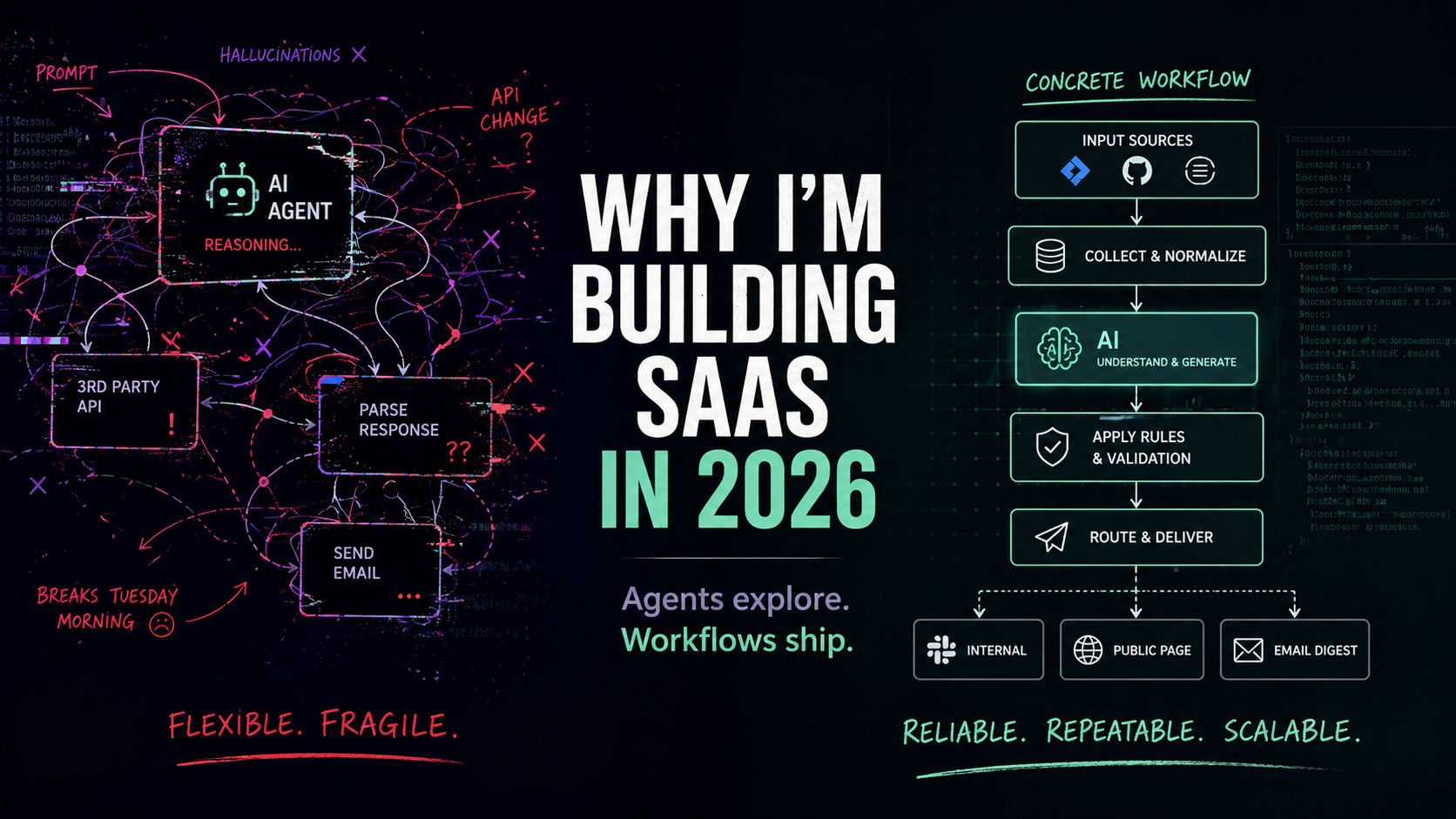
In-house AI agents are seductive but fragile. Here's the case for using agents to explore and concrete workflows to ship
title: Why I'm Building SaaS in 2026 published: true canonical_url: https://www.arunkant.com/posts/building-saas-in-2026/ description: In-house AI agents are seductive but fragile. Here's the case for using agents to explore and concrete workflows to ship tags: [saas, ai, agents, workflows] cover_image: https://dev-to-uploads.s3.amazonaws.com/uploads/articles/oa45e1vj8vysgno36jl3.png
Use a ratio of 100:42 for best results.
published_at: 2026-04-29 12:36 +0000
Every few months, someone declares SaaS dead. The argument has gotten louder in 2026: why pay for vertical tools when an LLM and a GitHub Action can do the same job in an afternoon?
I've heard this pitch enough times - and built enough of those afternoon GitHub Actions myself - to know where it breaks. The demo always works. The Tuesday morning two months later, when the upstream API changes its response shape and your "AI agent" silently ships nonsense to customers, is where the wheels come off.
I think SaaS in 2026 is healthier than the obituaries suggest, but the conversation around it is shifting in ways worth paying attention to.
SaaS Isn't Dying, But the Conversation Is Shifting
You've seen the takes. "SaaS is dead." "AI agents will replace every vertical tool." "Why buy software when you can just prompt an LLM to do it in-house?"
I don't buy it.
Those takes confuse the interface with the infrastructure. Yes, AI changes how we interact with software. But the need for shared, maintained, specialized tools doesn't vanish just because you can spin up an Autogen crew in ten minutes.
If anything, the more AI floods the market, the more valuable it becomes to have a concrete workflow that actually works while you sleep.
The Agent Trap: Swiss Army Knives Made of Jelly
In-house AI agents are seductive because they're infinitely flexible. The same agent can summarize tickets, draft emails, assign blame for bugs, and probably order pizza if you give it a DoorDash API key.
But that flexibility comes at a hidden cost: reliability.
An agent is essentially a reasoning layer wrapped around hope. It guesses at priorities. It hallucinates whether a PR description is customer-facing or internal. It breaks when an upstream tool sneezes. And every time a new model drops, you're back to prompt-engineering a Friday afternoon away.
The real cost isn't the OpenAI bill. It's you, at 11 PM, debugging why your changelog included "fix typo in admin panel" in the email that just went to 10,000 users.
The Framework: Agent First, Workflow Second
This isn't an argument against agents. It's an argument for knowing when to use them.
The pattern I keep coming back to:
1. Use agents to figure out the workflow. What do internal teams actually want - raw ticket lists grouped by squad, or plain-English summaries? Should security patches get a red border? Should refactors be auto-filtered? Agents are great for exploration. You can ask, iterate, and throw away.
2. Convert the agent into a concrete workflow. Once you know the shape of the work, stop treating it like a conversation. Hard-code the rules. Build the validation layer. Lock the integration. Turn the fuzzy agent into reliable software that does the same correct thing every Tuesday at 9 AM.
3. Mix intelligence and consistency where each belongs. Use AI for the parts that benefit from intelligence - reading unstructured tickets, understanding context, writing human prose. Use software for the parts that require consistency - formatting, routing, permissions, delivery.
The mistake most teams make is stopping at step one and shipping the agent.
Build vs. Buy: The Hidden Maintenance Tax
There's another argument I keep hearing: "We'll just build our own AI tools internally. It's cheaper, and our data stays in-house."
Sure. But agents are not set-and-forget.
You still need people to maintain them. New API version from JIRA? Fix the parser. New model release? Retest all your prompts. Linear changed their webhook format again? Back to the logs. You've built a fragile ETL pipeline dressed up as a chatbot, and now you're the on-call engineer for a paragraph generator.
There's also a quieter cost most teams don't price in: external tools learn faster.
If every company builds its own changelog bot, you've got 500 engineering teams each solving the same edge cases in isolation. One team figures out how to handle JIRA sub-tasks. Another figures out GitHub co-author attribution. Nobody shares notes. A shared tool learns from all of them. Your internal agent only learns from you. Over time, that compounds.
What This Looks Like in Practice
Imagine the work of generating release notes done right.
You connect to your JIRA board (or GitHub, or Linear). You define your audiences - maybe an internal Slack channel for the engineering team and a public page for users. From your earlier exploration, you already know the rules:
- Internal changelogs need ticket IDs and squad assignments.
- External changelogs need human-readable context, no jargon.
- Security patches always get highlighted.
- "WIP" and "refactor" tickets get filtered out unless manually overridden.
Those rules become a workflow. Every release, it reads your tickets, applies the logic, generates the prose, and delivers it to the right place. It doesn't get creative. It doesn't forget the rules because it's Tuesday. It just works.
You get the intelligence of AI - it understands your messy tickets - wrapped in the reliability of actual software. That's the shape of the SaaS I want to use, and it's the shape of the SaaS I'm building with Releasedog.
SaaS in 2026 Is the Plumbing, Not the Hype
I'm not skeptical of AI. I'm skeptical of where people are pointing it.
Agents are incredible demos. They're terrible infrastructure.
The future belongs to tools that take AI's flexibility and trap it inside software's reliability. Use agents to explore. Use workflows to run your business. And for the love of your future self, stop maintaining that Friday-night GitHub Action that generates your changelog.
Your 11 PM self will thank you.
Comments
More Blog
View allaiContext bankruptcy: The case for strategic forgetting for AI Agents
Most of us have seen a coding agent fail to complete a task we know it can do. We just don't...
J
James O'ReillygooglecloudParallel Compliance Engine: Drive-to-Sheets Multi-Agent Orchestration
When building Generative AI applications, developers often encounter a massive bottleneck: sequential...
A
Aryan IranidiscussIs It Ethical to Post and Ask About Circuits on Dev.to?
I’ve been thinking about sharing some electronic circuit posts on Dev.to — small circuits, DIY...
C
codebunny20agentsThe One-Click Exporter: AI Studio Antigravity, Probed to Its Limits
What nobody tells you about exporting your multi-agent prototype to a local workspace. Every...
L
leslysandraagenticarchitectGuarding the till while autonomous data agents do the digging
Autonomous agents are genuinely good at answering messy business questions. Give one an LLM and a set...
S
Sireesha PulipatiaiReturn on Attention: Why AI Code Reviews Are Wearing Us Out
PR volume went up, ticket quality didn't, and the gap got filled with LLMs on both sides of the review: bots reviewing, bots replying, bots occasionally arguing with bots about priorities that only existed in a teammate's head. Our CEO named the actual problem, and it's bigger than code review.
C
christineReady-made automations for this
Workflows from the Neura Market marketplace related to this Stable Diffusion resource
- Automate Google Sheets Triggered List Building Workflown8n · $9.53 · Related topic
- Automate Your Website Building with N8N: Unsubscribe Workflowmake · $6.62 · Related topic
- Building Your First WhatsApp AI Sales Chatbotn8n · $19.99 · Related topic
- Build AI Agents with Think-Plan-Act Architecture Using Llama-4 Reasoningn8n · Free · Related topic