
Back to Blog agents
 ai
ai googlecloud
 discuss
 agents
 agenticarchitect
 ai
ai
Deploying a Rust MCP Server to Azure Functions
xbill May 15, 2026
0 views
The rmcp crate and standard Rust libraries are used to build a basic MCP Server in Rust. This MCP...
title: Deploying a Rust MCP Server to Azure Functions published: true series: Azure-Rust date: 2026-05-15 13:01:46 UTC tags: aiagent,mcpserver,rust,azure canonical_url: https://xbill999.medium.com/deploying-a-rust-mcp-server-to-azure-functions-4e85ab1443ee
The rmcp crate and standard Rust libraries are used to build a basic MCP Server in Rust. This MCP Server is then built and deployed to Azure Functions and validated locally with Gemini CLI.

More MCP Demos?
Yup. A2A- is next!
Why not just use Python?
Python has traditionally been the main coding language for ML and AI tools. One of the strengths of the MCP protocol is that the actual implementation details are independent of the development language. The reality is that not every project is coded in Python- and MCP allows you to use the latest AI appt roaches with other coding languages.
What is this Tutorial Trying to Do?
Building on previous tutorials, the goal is to extend a Rust MCP server with basic support for deployment to Azure.
What is Rust?
Rust is a high performance, memory safe, compiled language:
Rust provides memory safe operations beyond C/C++ and also can provide exceptional performance gains as it is compiled directly to native binaries.
So Why Am I reading this?
So what is different about this lab compared to all the others out there?
This is one of the first deep dives into deploying a Rust based MCP server hosted on Azure. The Azure ACI service was targeted for compatibility with Docker Images.
Rust Setup
Instructions to install Rust are available here:
For a Linux like environment the command looks like this:
curl — proto ‘=https’ — tlsv1.2 -sSf https://sh.rustup.rs | sh
Rust also depends on a working C compiler and OpenSSL setup. For a Debian 12 system — install the basic tools for development:
sudo apt install build-essential
sudo apt install libssl-dev
sudo apt install pkg-config
sudo apt-get install libudev-dev
sudo apt install make
sudo apt install git
Gemini CLI
If not pre-installed you can download the Gemini CLI to interact with the source files and provide real-time assistance:
npm install -g @google/gemini-cli
Testing the Gemini CLI Environment
Once you have all the tools and the correct Node.js version in place- you can test the startup of Gemini CLI. You will need to authenticate with a Key or your Google Account:
▝▜▄ Gemini CLI v0.33.1
    ▝▜▄
   ▗▟▀ Logged in with Google /auth
  ▝▀ Gemini Code Assist Standard /upgrade no sandbox (see /docs) /model Auto (Gemini 3) | 239.8 MB
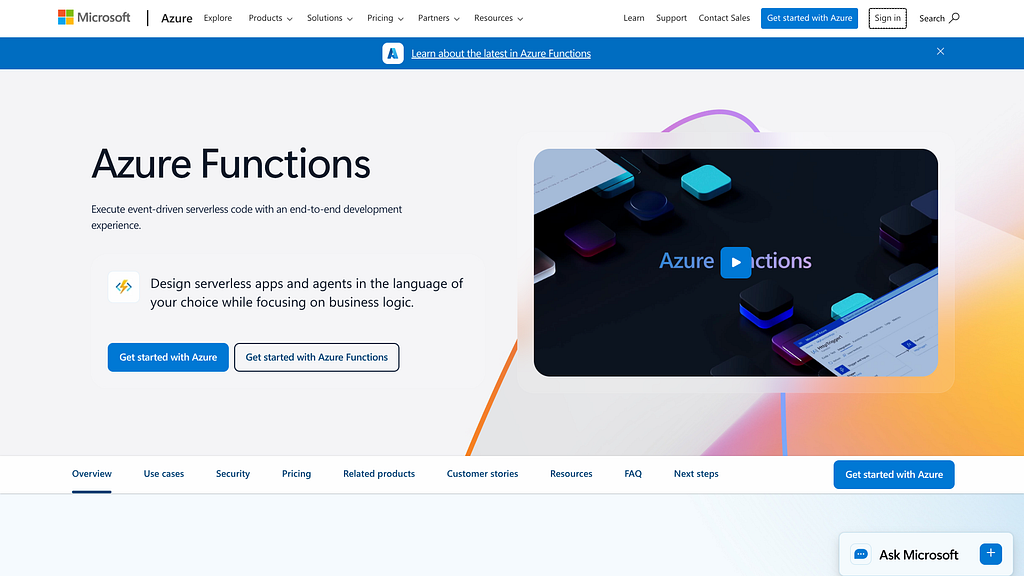
Azure Functions
Azure Functions is a serverless, event-driven compute service that allows developers to run code on-demand without managing infrastructure. It supports multiple languages (C#, Python, JavaScript, Java, PowerShell) and scales automatically, charging only when code executes. Key use cases include building APIs, processing data, and running scheduled tasks. [1, 2, 3, 4, 5]
Key Aspects of Azure Functions
- Serverless Architecture: You focus on code, while Azure handles infrastructure, patching, and scaling.
- Event-Driven Triggers: Functions are triggered by events such as HTTP requests, timers, or data changes in Azure Storage/Cosmos DB.
- Bindings: Connect to other services (e.g., queues, databases) with minimal code.
- Durable Functions: Enable stateful, long-running workflows with features like chaining, fan-out, and checkpoints.
More details are available here:
https://azure.microsoft.com/en-us/products/functions
Why would I want Gemini CLI with Azure? Isn’t that a Google Thing?
Yes- Gemini CLI leverages the Google Cloud console and Gemini models but it is also open source and platform agnostic. Many applications are already cross-cloud so this enables familiar tools to be run natively on Microsoft Azure.
Azure Functions Configuration
To configure your Azure Service with the base system tools- this article provides a reference:
MCP Development with Gemini CLI, Python, and Azure Functions
Azure CLI
The Azure Command-Line Interface (CLI) is a cross-platform tool used to connect to Azure and execute administrative commands on your cloud resources. [1, 2]
It allows you to manage services like virtual machines, storage accounts, and networks through a terminal using either interactive prompts or automated scripts.
More information is here:
Setup the Basic Environment
At this point you should have a working Rust environment and a working Gemini CLI installation. All of the relevant code examples and documentation is available in GitHub.
The next step is to clone the GitHub repository to your local environment:
cd ~
git clone https://github.com/xbill9/gemini-cli-azure
Then run init.sh from the cloned directory.
The script will attempt to determine your shell environment and set the correct variables:
source init.sh
If your session times out or you need to re-authenticate- you can run the set_env.sh script to reset your environment variables:
source set_env.sh
Variables like PROJECT_ID need to be setup for use in the various build scripts- so the set_env script can be used to reset the environment if you time-out.
Refresh the Azure credentials:
xbill@penguin:~/gemini-cli-azure/mcp-functions-rust-azure$ az login
Finally install the packages and dependencies:
cd ~/gemini-cli-azure/mcp-functions-rust-azure
Build The Rust MCP Server
Some background information on building and configuring a Rust MCP server is here:
Building a Secure HTTP Transport MCP Server with Rust, and Gemini CLI
The mcp-aci-rust-azure subdirectory has the complete Rust MCP server in one subdirectory.
Minimal System Information Tool Build
The first step is to build the basic tool directly with Rust. This allows the tool to be debugged and tested locally before adding the MCP layer.
First build the tool locally:
xbill@penguin:~/gemini-cli-azure/mcp-functions-rust-azure$ make
Building the Rust project...
    Finished `dev` profile [unoptimized + debuginfo] target(s) in 0.46s
xbill@penguin:~/gemini-cli-azure/mcp-functions-rust-azure$
then lint check the code:
xbill@penguin:~/gemini-cli-azure/mcp-functions-rust-azure$ make lint
Linting code...
    Finished `dev` profile [unoptimized + debuginfo] target(s) in 0.47s
xbill@penguin:~/gemini-cli-azure/mcp-functions-rust-azure$
and run local tests:
xbill@penguin:~/gemini-cli-azure/mcp-functions-rust-azure$ make test
Running tests...
    Finished `test` profile [unoptimized + debuginfo] target(s) in 0.15s
     Running unittests src/main.rs (target/debug/deps/mcp_functions_rust_azure-358fc0d2659d6bb6)

running 1 test
test tests::test_greeting ... ok

test result: ok. 1 passed; 0 failed; 0 ignored; 0 measured; 0 filtered out; finished in 0.00s
The last step is to build the production version:
xbill@penguin:~/gemini-cli-azure/mcp-functions-rust-azure$ make release
Building Release...
    Finished `release` profile [optimized] target(s) in 0.55s
The MCP server can be started locally:
make start
The MCP tool can then be tested locally:
🟢 local-rust - Ready (1 tool)
  Tools:
  - mcp_local-rust_greeting

> mcp_local-rust_greeting hello local

Executing Greeting Tool: Executing the greeting tool on the local Rust MCP server.

╭────────────────────────────────────────────────────────────────────────────────────────────────────────────────────────────────────────────╮
│ ✓ greeting (local-rust MCP Server) {"message":"hello local"} │
│ │
│ Hello World MCP! hello local │
╰────────────────────────────────────────────────────────────────────────────────────────────────────────────────────────────────────────────╯
  Greeting Completed: Greeting successful. Standing by for next instruction.

✦ Hello World MCP! hello local
Deploy To Azure Functions
A basic Dockerfile is used to build an image for deployment:
xbill@penguin:~/gemini-cli-azure/mcp-functions-rust-azure$ make deploy
Building the Docker image...
[+] Building 2.2s (14/14) FINISHED docker:default
 => [internal] load build definition from Dockerfile 0.0s
 => => transferring dockerfile: 763B 0.0s 0.0s
Get the deployment status:
xbill@penguin:~/gemini-cli-azure/mcp-functions-rust-azure$ make status
mcp-functions-rust-azure is not running locally.
Checking Function App status for mcp-func-penguin...
Name State HostNames
---------------- ------- ----------------------------------
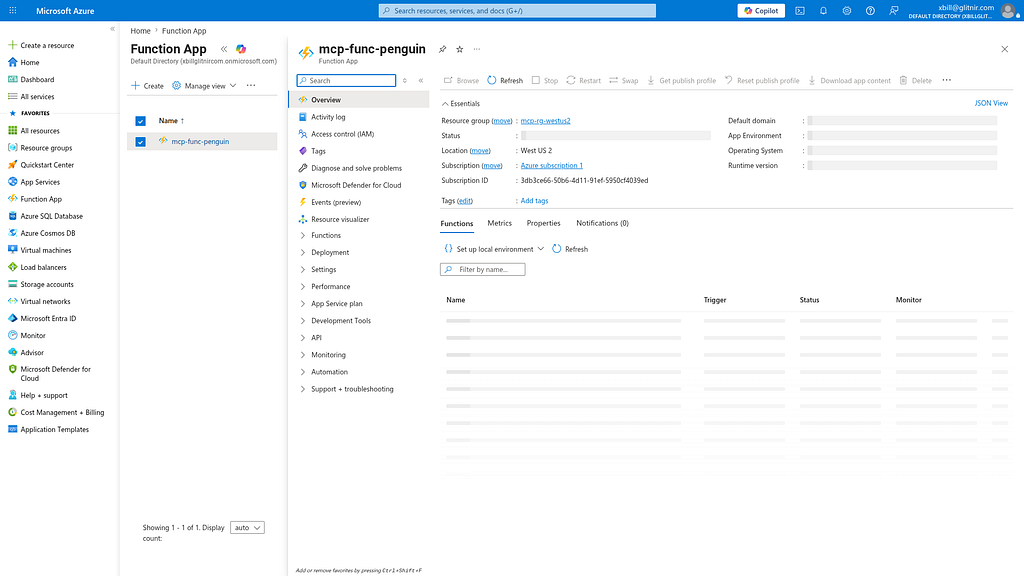
mcp-func-penguin Running mcp-func-penguin.azurewebsites.net
xbill@penguin:~/gemini-cli-azure/mcp-functions-rust-azure$
Get the Endpoint:
xbill@penguin:~/gemini-cli-azure/mcp-functions-rust-azure$ make endpoint
https://mcp-func-penguin.azurewebsites.net/api/mcp
Check Gemini MCP settings:
{
  "mcpServers": {
    "mcp-functions-rust-azure": {
      "httpUrl": "https://mcp-func-penguin.azurewebsites.net/api/mcp"
    },
    "local-rust": {
      "httpUrl": "http://127.0.0.1:8080/mcp"
    }
  }
}
The service will be visible on the Azure console:
Final Test
Start up Gemini CLI and check the MCP server status:
 > mcp_mcp-functions-rust-azure_greeting Hello Azure Functions!

╭────────────────────────────────────────────────────────────────────────────────────────────────────────────────────────────────────────────╮
│ ✓ greeting (mcp-functions-rust-azure MCP Server) {"message":"Hello Azure Functions!"} │
│ │
│ Hello World MCP! Hello Azure Functions! │
╰────────────────────────────────────────────────────────────────────────────────────────────────────────────────────────────────────────────╯

✦ Hello World MCP! Hello Azure Functions!
Summary
A complete HTTP transport MCP server was built using Rust. This application was tested locally with Gemini CLI. Then, the entire solution was deployed to Azure Functions. The remote MCP server was validated with Gemini CLI locally.
Comments
More Blog
View allaiContext bankruptcy: The case for strategic forgetting for AI Agents
Most of us have seen a coding agent fail to complete a task we know it can do. We just don't...
J
James O'ReillygooglecloudParallel Compliance Engine: Drive-to-Sheets Multi-Agent Orchestration
When building Generative AI applications, developers often encounter a massive bottleneck: sequential...
A
Aryan IranidiscussIs It Ethical to Post and Ask About Circuits on Dev.to?
I’ve been thinking about sharing some electronic circuit posts on Dev.to — small circuits, DIY...
C
codebunny20agentsThe One-Click Exporter: AI Studio Antigravity, Probed to Its Limits
What nobody tells you about exporting your multi-agent prototype to a local workspace. Every...
L
leslysandraagenticarchitectGuarding the till while autonomous data agents do the digging
Autonomous agents are genuinely good at answering messy business questions. Give one an LLM and a set...
S
Sireesha PulipatiaiReturn on Attention: Why AI Code Reviews Are Wearing Us Out
PR volume went up, ticket quality didn't, and the gap got filled with LLMs on both sides of the review: bots reviewing, bots replying, bots occasionally arguing with bots about priorities that only existed in a teammate's head. Our CEO named the actual problem, and it's bigger than code review.
C
christineReady-made automations for this
Workflows from the Neura Market marketplace related to this Stable Diffusion resource
- Build MCP Server with Google Calendar & Custom Functionsn8n · $19.99 · Related topic
- Automate RSS Feed Creation with Datetime Functions and Webhooksn8n · $10.35 · Related topic
- Connect Retell Voice Agents to n8n Custom Functionsn8n · $14.99 · Related topic
- Supabase Functions JS Client for n8n Automationsn8n · $12.99 · Related topic