
Back to Blog kubernetes
 ai
ai googlecloud
 discuss
 agents
 agenticarchitect
 ai
ai
Surviving the eviction: How to build interrupt-resilient AI workloads on GKE
Olivier Bourgeois May 20, 2026
0 views
Learn strategies for building interrupt-resilient AI workloads on Google Kubernetes Engine (GKE).
title: Surviving the eviction: How to build interrupt-resilient AI workloads on GKE published: true description: Learn strategies for building interrupt-resilient AI workloads on Google Kubernetes Engine (GKE). tags: kubernetes, ai, gke, googlecloud cover_image: https://dev-to-uploads.s3.amazonaws.com/uploads/articles/ht3q28btunq9lofna1k1.png
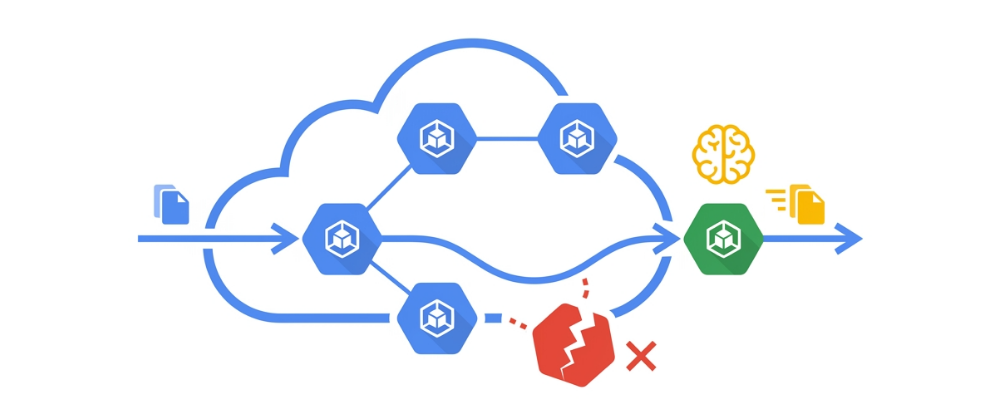
Use a ratio of 100:42 for best results.
published_at: 2026-05-20 20:22 +0000
You did everything right. You containerized your massive model training job, deployed it to Google Kubernetes Engine (GKE), and cleverly routed it to a Spot VM node pool to save up to 90% on compute costs.
Everything is humming along perfectly for 38 hours. Then, a priority on-demand customer needs capacity, Google Cloud reclaims your underlying Spot VM, and your node vanishes.
Whether you are using preemptible Spot VMs to save money, or leveraging the Dynamic Workload Scheduler (DWS) to queue for scarce GPUs, you are building on top of ephemeral compute. The hardware will eventually be taken away. To successfully run critical AI workloads on un-committed capacity, your application architecture must assume failure is a given.
Here is a practical guide to building interruptible workloads on GKE.
1. Trap the warning
When Google Cloud reclaims a Spot VM, it doesn't just pull the power cord immediately. It sends an ACPI signal to the underlying node to begin a power off cycle. Kubernetes intercepts this and translates it into a SIGTERM signal sent directly to your running containers.
You have a grace period (up to 15 seconds for non-system pods) between that SIGTERM and the fatal SIGKILL.
Your application must explicitly listen for this signal. When caught, your code should immediately stop accepting new batches, finish its current loop, flush any in-memory data to disk, and exit with a 0 (success) status.
Here is a simple example on how to catch this signal in Python:
import signal
import sys
import time

def handle_sigterm(signum, frame):
    print("Received SIGTERM. Initiating graceful shutdown...")
    # 1. Stop processing new data
    # 2. Flush memory to persistent storage
    # 3. Save final checkpoint
    print("State saved. Exiting cleanly.")
    sys.exit(0)

# Register the signal handler
signal.signal(signal.SIGTERM, handle_sigterm)

# Your main training loop
print("Starting training loop...")
while True:
    # Train model...
    time.sleep(1)
2. Externalize your checkpoints
If your container dies, everything inside its local filesystem dies with it. To survive an interruption, you must periodically save your progress (model weights, optimizer states, epoch counters, etc.) to an external storage location.
Cloud Storage (GCS) is a common solution for this on Google Cloud.
- Save frequently: Decide on a checkpointing interval that balances the cost of lost work against the overhead of writing to storage. Saving every epoch or every few thousand steps is common, but this can vary based on your needs.
- Keep it local: Ensure your GCS buckets are in the same region as your GKE cluster (e.g., us-central1) to minimize latency and avoid outbound data transfer fees.
- Resume, don't restart: The first thing your container's startup script should do is to check for that GCS bucket. If a checkpoint exists in the bucket, load it and resume from that exact step.
3. Design for Idempotency
"Idempotency" is a fancy way of saying that doing something twice yields the same result as doing it once.
Imagine a batch inference job that reads an image, processes it, and writes the result to a database. If your pod is preempted milliseconds after writing to the database but before it can mark the task as complete, the rescheduled pod will likely process that image again.
If your database blindly inserts new rows, you now have unintentional, duplicate data.
To build an idempotent pipeline:
- Use UPSERT (update or insert) operations in your database based on a unique identifier (like an image ID).
- Check if a record already exists before spending expensive GPU cycles processing it.
4. Decouple work queues for batch processing
If you are running a massive batch processing or inference job across thousands of files, do not write a monolithic Python script that iterates through a static CSV list. If the node dies at row 5,000, managing the state of where to restart is a nightmare.
Instead, decouple the workload:
- Publish the work: Break your dataset down into discrete messages and push them into a message broker like Pub/Sub.
- Pull the work: Have your Spot VM worker pods pull messages off the queue one by one or as a small chunk (e.g. 10 at a time).
- Acknowledge completion: Only send an "ACK" (acknowledgment) back to Pub/Sub once the result is safely stored.
If a Spot node is preempted mid-inference, the worker dies before sending the ACK. After a brief timeout, Pub/Sub will automatically make that specific message available again. Another surviving worker pod will pick it up seamlessly. No data lost, no manual intervention required.
Key takeaways
Running on ephemeral compute like Spot VMs isn't just an infrastructure choice; it is a design choice. By handling termination signals, checkpointing aggressively to GCS, ensuring idempotent operations, and decoupling your queues, you can unlock massive cost savings and tap into scarce GPU pools without sacrificing reliability.
Comments
More Blog
View allaiContext bankruptcy: The case for strategic forgetting for AI Agents
Most of us have seen a coding agent fail to complete a task we know it can do. We just don't...
J
James O'ReillygooglecloudParallel Compliance Engine: Drive-to-Sheets Multi-Agent Orchestration
When building Generative AI applications, developers often encounter a massive bottleneck: sequential...
A
Aryan IranidiscussIs It Ethical to Post and Ask About Circuits on Dev.to?
I’ve been thinking about sharing some electronic circuit posts on Dev.to — small circuits, DIY...
C
codebunny20agentsThe One-Click Exporter: AI Studio Antigravity, Probed to Its Limits
What nobody tells you about exporting your multi-agent prototype to a local workspace. Every...
L
leslysandraagenticarchitectGuarding the till while autonomous data agents do the digging
Autonomous agents are genuinely good at answering messy business questions. Give one an LLM and a set...
S
Sireesha PulipatiaiReturn on Attention: Why AI Code Reviews Are Wearing Us Out
PR volume went up, ticket quality didn't, and the gap got filled with LLMs on both sides of the review: bots reviewing, bots replying, bots occasionally arguing with bots about priorities that only existed in a teammate's head. Our CEO named the actual problem, and it's bigger than code review.
C
christineReady-made automations for this
Workflows from the Neura Market marketplace related to this Stable Diffusion resource
- Kubernetes Management with GPT-4o and MCP Integrationn8n · $24.99 · Related topic
- FB Ad Spy Tool - Uncover Competitors' Strategiesn8n · $19.99 · Related topic
- Kubernetes RCA & Alerting: Gemini, Loki, Prometheus, Slackn8n · $24.99 · Related topic
- Kubernetes Management with NL using GPT-4o & MCP Toolsn8n · $24.99 · Related topic