
Back to Blog watercooler
 ai
ai googlecloud
 discuss
 agents
 agenticarchitect
 ai
ai
Dystopian Civilization Scenarios
Ingo Steinke, web developer June 5, 2026
0 views
Gaming, like AI, is far from what fascinates me most about technology and creative development....
Gaming, like AI, is far from what fascinates me most about technology and creative development. Still, that's what many fellow developers talk about these days, and what makes for good, controversial topics for further nerdy small talk.
This post continues the ideas from my earlier article, Learning Lessons from Gaming. As an experiment, some of the concepts below were developed in conversation with AI. Later articles, besides this series, will return to a more traditional, human-authored approach.
Deliberately Dystopian Civilization Game Ruleset
An idea that came to my mind was a deliberately dystopian Civilization-style ruleset: a future society in which AI has made Literacy obsolete, while a hidden, initially inaccessible branch of the technology tree contains potential biological threats. Instead of discovering advanced technologies in ancient ruins, players might accidentally unlock viruses such as Ebola, Hantaan virus, or COVID by exploring a remote village or an abandoned research facility.
- The Hidden Tech Tree Branch: "Biological Anomalies"
- The Trigger: Entering a Tribal Village (Goody Hut) post-industrial era.
- The Mutation: High-tech ruins contain preserved pre-collapse pathogens.
- The Risk: 5% base chance per unmapped ancient ruin. The Consequences: Immediate global pandemic notification with no text, just warning symbols.
I wonder what could make this fail in practice, like coding a peaceful civ ruleset but still either getting veterans and pirate barbarians or a game crash?
What would break first?
The history of Civilization modding suggests that highly complex systems often fail in surprising ways. Minor code changes can have major consequences. A famous example from Civilization VI (3 lines of code in April patch that shot the AI through the head) involved only a few lines of code that dramatically altered AI priorities, leaving computer-controlled civilizations unable to pursue basic expansion and military strategies. Small assumptions embedded deep in a system can reshape the entire simulation.
The same applies to hypothetical "peaceful civilization" rule sets. You can disable wars, reduce aggression, and encourage cooperation, yet veteran barbarians still appear. Pirate raids still happen. Unexpected conflicts emerge. Sometimes the game crashes entirely, as I experienced when using the ruleset editor and a local FreeCiv server long ago. Even if current FreeCiv updates are more stable, the fundamental issue remains.
The "Peaceful Ruleset" Barbarian Paradox
Coding a peaceful ruleset while still getting veterans or aggressive pirate barbarians is a classic engine-priority conflict.
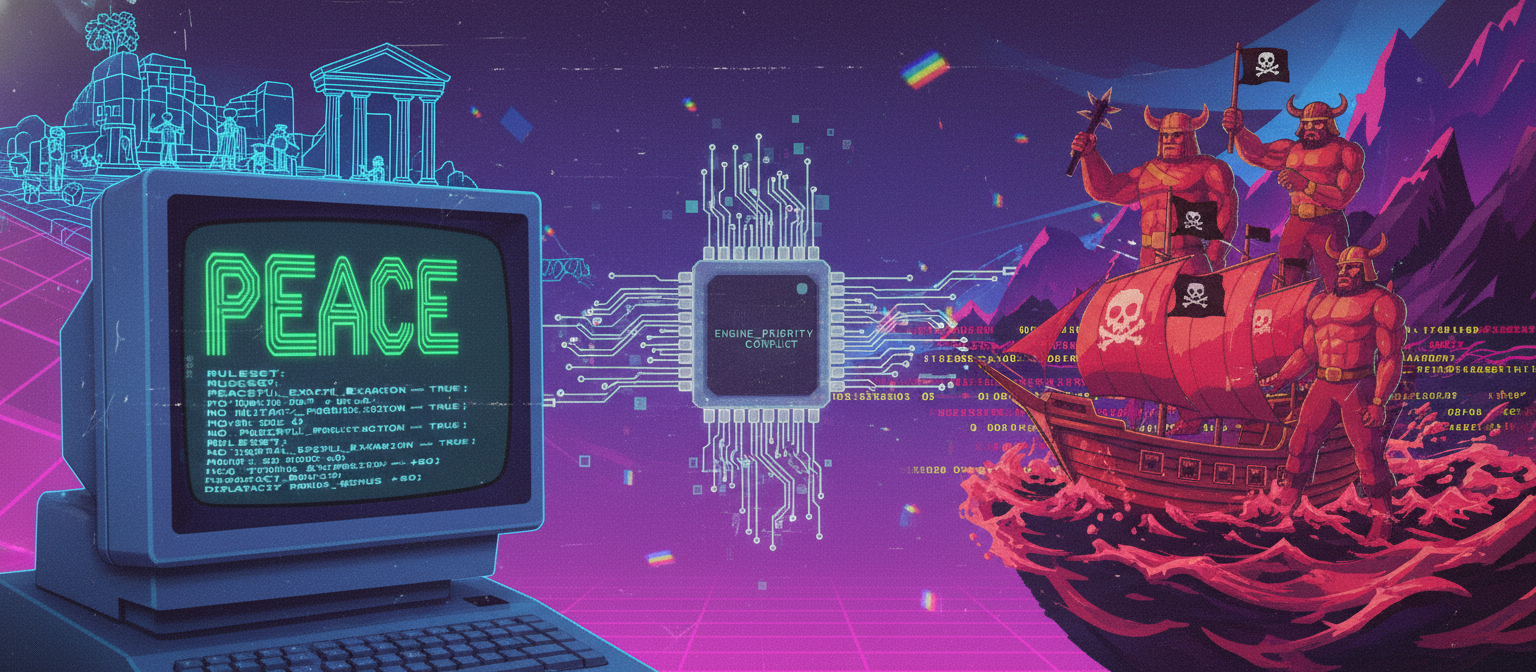
Turning off aggressive AI parameters or checking "No Barbarians" only changes the civilized AI agendas and basic spawn rates. Barbarians operate under a completely distinct sub-engine loop (BarbarianManager). If your mod does not comprehensively overwrite the special game mode triggers—like the Barbarian Clans Mode scripts—the engine will bypass your peaceful ruleset.
As a result, the game will utilize fallbacks to spawn specialized units (like Unique Unit veterans or high-tier naval raiders) in unrevealed tiles.
The more I thought about it, the more the fact that the mod failed became more interesting than the original concept.
Perhaps simulations teach us most when they resist our intentions.
Impossible Sustainable Circular Economy?
SimCity offered a similar lesson. Building a resilient, circular economy based on recycling and local sustainability is possible, but considerably harder than pursuing growth through mining and trade. The game's systems reward some strategies more naturally than others because they encode assumptions about economics, infrastructure, and human behavior.
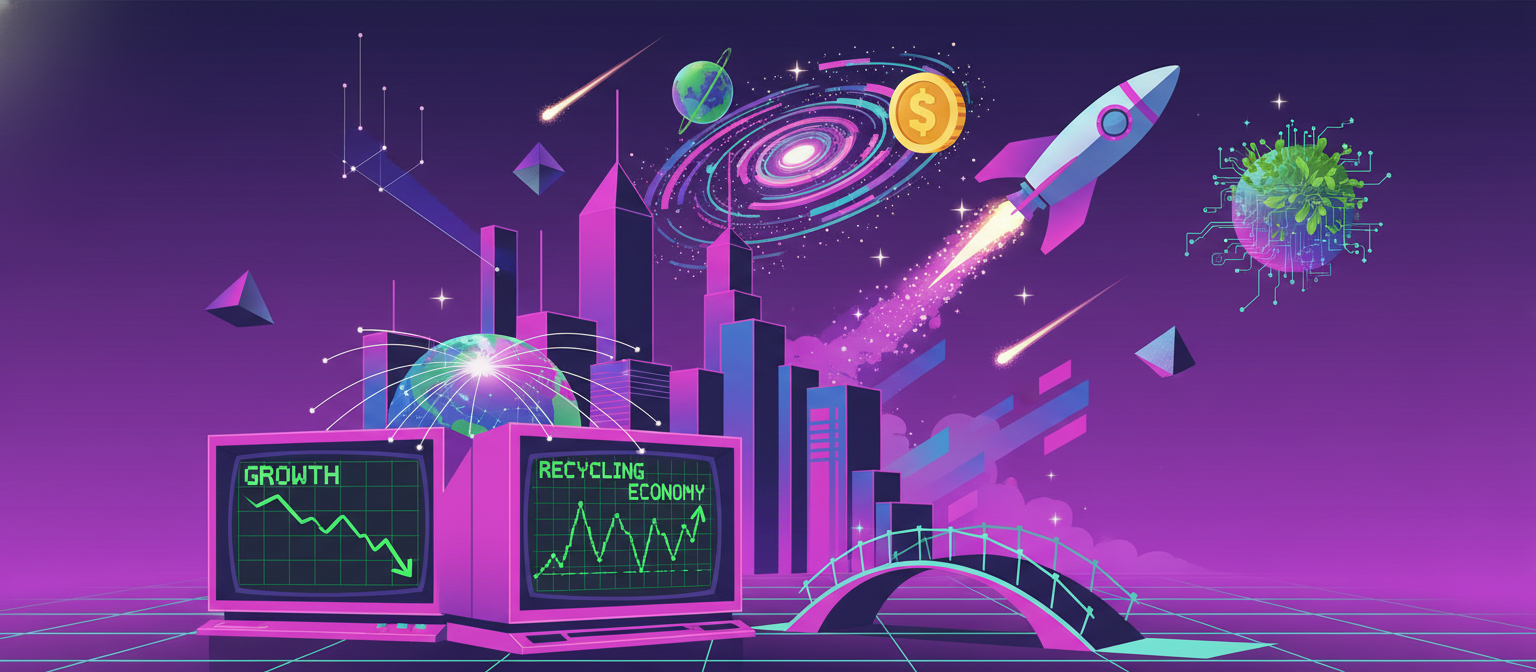
Why is it so difficult to construct a functioning civilization simulator based solely on peaceful cooperation? Why do conflict, competition, scarcity, and disruption keep reappearing as fallback states? Is that merely a limitation of the game engine, or does it reflect assumptions inherited from the historical realities the simulation was built to represent?
That's what the game is teaching after all, much like SimCity taught that, while a resilient recycling economy is hard to achieve, betting on growth and international trade alone isn't sustainable either, unless you believe space travel will open up unlimited additional growth opportunities?
Real-World Constraints Implications
I am not talking about failure within the scenario, but about what it teaches us about the constraints of the real world the scenario was modeled after? That raises a question extending far beyond games.
AI systems exhibit comparable constraints. They can remix existing knowledge with astonishing speed, but they remain bounded by the material they were trained on. They are exceptionally good at exploring the known space of possibilities. Exploring genuinely unknown territory might be fundamentally impossible.
Unknown Unknowns
"There are unknown unknowns," a great philosopher once said. Turns out that what I would ascribe to Luhmann, Habermas, or Plato, or a thought experiment that you might think you'd learn about in Sun Tzu's War Academy, is allegedly attributed to a controversial American politician quoting a common military and NASA space agency saying, inspired by prior psychological research.
A related 2x2 grid was created in 1955 by two American psychologists, Joseph Luft and Harrington Ingham, in their development of the Johari window, a "graphic model of interpersonal behavior.
Similar wisdom has "been widely quoted since the 19th century as anonymous ancient knowledge, or alternatively attributed to authors ranging from Confucius to Bruce Lee," according to the same Wikipedia article.
When a simulation repeatedly rejects a scenario, what exactly are we learning? Are we discovering a limitation of the software, a bias in the model, or a genuine constraint of the world the model was designed to represent? Are our tools just holding up a mirror to the limitations of human cognition?
Note that this article, unlike most of my other publications, was mostly written and edited by AI, based on my original scribbles, and so are the images. Later articles, besides this series, will return to a more traditional, human-authored approach.
Tags
Comments
More Blog
View allaiContext bankruptcy: The case for strategic forgetting for AI Agents
Most of us have seen a coding agent fail to complete a task we know it can do. We just don't...
J
James O'ReillygooglecloudParallel Compliance Engine: Drive-to-Sheets Multi-Agent Orchestration
When building Generative AI applications, developers often encounter a massive bottleneck: sequential...
A
Aryan IranidiscussIs It Ethical to Post and Ask About Circuits on Dev.to?
I’ve been thinking about sharing some electronic circuit posts on Dev.to — small circuits, DIY...
C
codebunny20agentsThe One-Click Exporter: AI Studio Antigravity, Probed to Its Limits
What nobody tells you about exporting your multi-agent prototype to a local workspace. Every...
L
leslysandraagenticarchitectGuarding the till while autonomous data agents do the digging
Autonomous agents are genuinely good at answering messy business questions. Give one an LLM and a set...
S
Sireesha PulipatiaiReturn on Attention: Why AI Code Reviews Are Wearing Us Out
PR volume went up, ticket quality didn't, and the gap got filled with LLMs on both sides of the review: bots reviewing, bots replying, bots occasionally arguing with bots about priorities that only existed in a teammate's head. Our CEO named the actual problem, and it's bigger than code review.
C
christineReady-made automations for this
Workflows from the Neura Market marketplace related to this Stable Diffusion resource
- AI Agent Blueprint for Streamlined Website Developmentn8n · $19.99 · Related topic
- Streamlined Testing Automation for Efficient Development Workflowsmake · $12.34 · Related topic
- Automate Your Website Development with AI-Powered Chat Workflown8n · $6.3 · Related topic
- Automate Technology Stack Data Transfer from BuiltWith to Google Sheetsn8n · Free · Related topic