
Back to Blog agents
 ai
ai googlecloud
 discuss
 agents
 agenticarchitect
 ai
ai
There Are 5 Levels of AI Coding. Most Engineers Are Stuck on Level 2.
Diya Burman June 9, 2026
0 views
The Level 5 Engineer Newsletter — Issue #1 Preface I want to be upfront about something...
The Level 5 Engineer Newsletter — Issue #1
Preface
I want to be upfront about something before we get into it. None of the frameworks in this article is mine. The ideas here come from two people who have been thinking about this stuff way harder and longer than I have — and they deserve full credit before I say another word.
Dan Shapiro — CEO of Glowforge, Wharton Research Fellow, and the person who gave this whole conversation a vocabulary. His blog post “The Five Levels: from Spicy Autocomplete to the Dark Factory” is the conceptual spine of everything I’m about to say. Read the original. It’s short, sharp, and will make you uncomfortable in the best way. danshapiro.com
Nate B. Jones — AI strategist, zero-hype practitioner, and the person whose YouTube channel made me realize I had been fooling myself about where I actually sat on this ladder. His video “The 5 Levels of AI Coding (Why Most of You Won’t Make It Past Level 2)” is what triggered this entire newsletter. natebjones.com — Watch the video
This newsletter — The Level 5 Engineer — is my public learning log. I’m a Senior Software Engineer and a Tech Lead, currently somewhere between Level 2 and Level 3 (in context of the title of this newsletter) on a good day. The goal is Level 5. I’m documenting the climb in real time — the frameworks, the tools, the mindset shifts, and the moments where I realize I’ve been doing it wrong. If you’re on a similar journey, pull up a chair.
Before you panic and close this tab — yes, I see you hovering!
I’m not naively chasing the thing that puts me out of a job — I’m aware of the irony. The tech world is in full meltdown mode about AI taking developer jobs right now, and, I think, most of that noise misses the point entirely.
A Dark Factory still needs someone who understands the system deeply enough to define what it should build, catch what it shouldn’t touch, and course-correct when it goes sideways. That’s not a developer writing code anymore — that’s a steward. The role doesn’t disappear; it transforms. From worker bee to architect. From implementer to the person who holds the mental model of the entire system and encodes that judgment into infrastructure that the agents can operate safely within. That shift is actually what this newsletter is about — and it deserves its own deep dive, which is coming. For now, just know:
Level 5 is the destination, not the cliff edge.
So. The Five Levels.
Dan Shapiro borrowed the structure from the NHTSA’s autonomous driving classification — five levels from “human does everything” to “machine does everything, humans not required.” Applied to software development, it maps out like this:
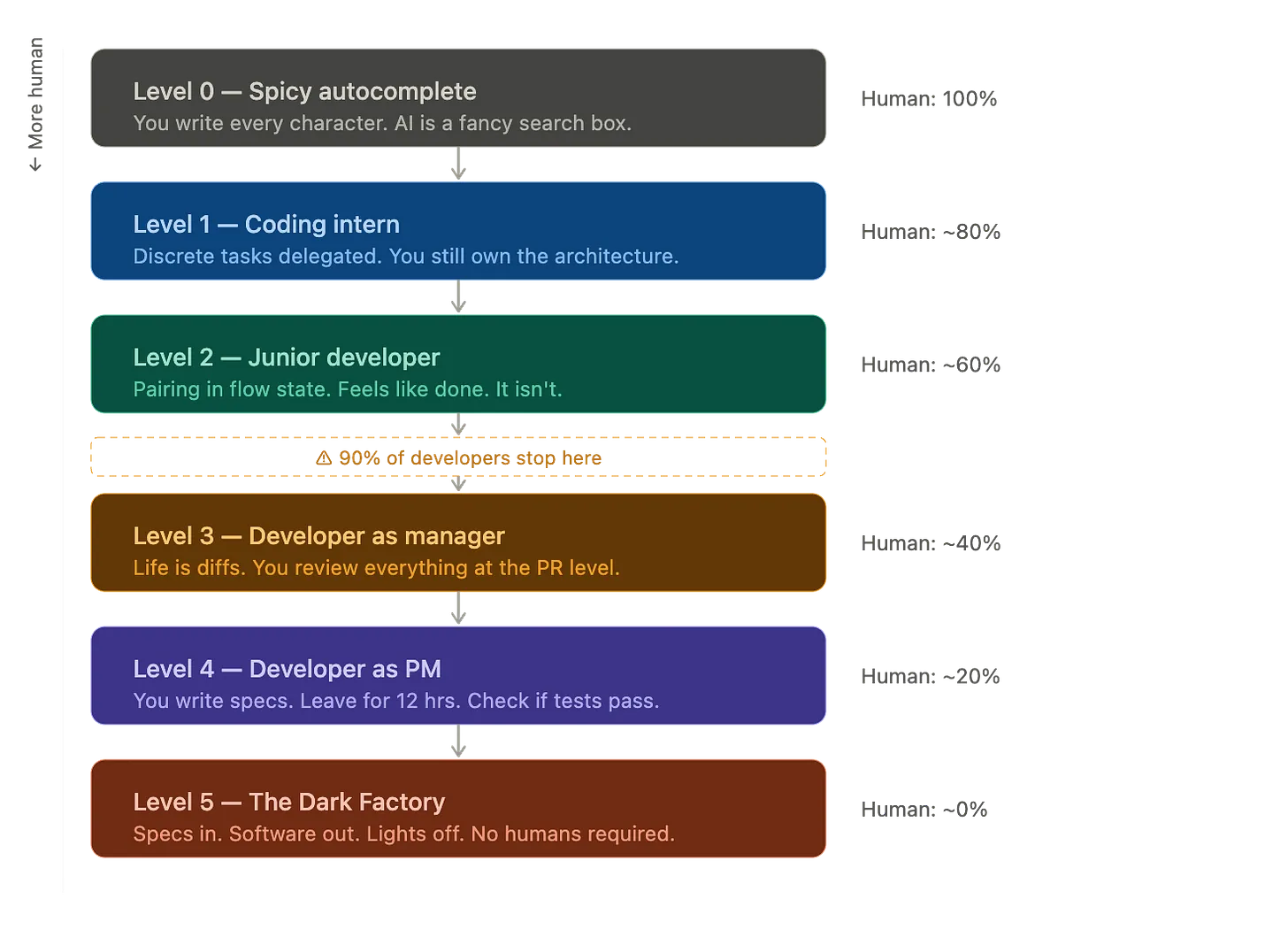
Level 0 — Spicy Autocomplete. You’re still writing every character. Maybe you use AI as a search engine or accept the occasional tab suggestion. The code is yours. You’re also losing ground every day to the people who aren’t at Level 0.
Level 1 — The Coding Intern. You’re delegating discrete tasks. “Write a unit test for this.” “Add a docstring here.” You’re seeing some speedup. Your job is essentially unchanged. YOU are still the bottleneck.
Level 2 — Junior Developer. This is where it starts to feel like something. You’re pairing with AI like a colleague. Flow state. Productivity you haven’t felt in years. You hand off the boring stuff and focus on the interesting parts. Here’s the trap though — Level 2 feels like you’re done. You’re not done. Most people who think they’re “using AI” are living here permanently and calling it Level 5.
Level 3 — Developer as Manager. You’re not writing much code anymore. Your AI agent has multiple tabs running at all times. Your life is diffs. You review everything at the PR level. For a lot of people, this actually feels worse than Level 2 — more overhead, less flow. And this is where almost everyone tops out. Not because they can’t go further. Because Level 3 feels like the ceiling.
Level 4 — Developer as Product Manager. The code is a black box. You write specs. You argue about the specs. You set up the right tools, define the right constraints, and then you leave for 12 hours. You come back and check if the tests passed. Dan Shapiro says he’s here. I believe him because of how he describes it — it doesn’t sound glamorous, it sounds like a different kind of hard work.
Level 5 — The Dark Factory. Named after Fanuc’s robot factory — staffed entirely by robots, lights off, no humans needed or welcome. At Level 5, you’re not really running a software process anymore. You have a system that turns specs into software, autonomously. A handful of teams are doing this today. Small teams, less than five people, shipping production software with no human-written or human-reviewed code. A prominent example would be Claude’s own engineering team, who claim that Claude Code wrote most of Claude Code.
Like what you read thus far? This post is public, so feel free to share it.
The Part That Actually Stings
Here’s what Nate B. Jones added to this framework, which made me sit with it for a while.
There’s a rigorous study showing that experienced developers using AI tools took 19% longer on tasks — while believing they were 24% faster. The gap between perceived productivity and actual productivity even has a name — the AI confidence gap. You feel faster. The clock disagrees.
The teams that are pulling away aren’t using more AI tools. They’re using AI differently. The bottleneck has moved. It’s no longer about how fast you can implement. It’s about how precisely you can specify.
The Dark Factory teams aren’t superhuman coders. They’ve built infrastructure around judgment — external behavioural scenarios that the AI cannot see during the build process, digital twin environments that simulate production dependencies safely, testing architectures designed specifically so the AI can’t reverse-engineer the passing criteria.
The rest of the industry is plateaued at Level 3, reviewing diffs, and measuring velocity in story points on a Jira board that hasn’t been groomed since Q2.
Why I’m Writing This
I’ve been a software engineer for nearly a decade. I’ve done the serverless architectures, the MLOps pipelines, the distributed systems. I’ve been to Re:Invent (3 times. Ooooh, fancy schmancy). I know the stack.
And I watched these videos and realized I was at Level 2. Maybe Level 3 on a good week. And I had been calling it “using AI effectively.”
This newsletter is the documentation of that climb — starting with understanding what the levels actually mean and why most of us have been misreading where we stand. Or at least that’s where I’m starting. I wouldn’t be surprised if my own understanding shifts incrementally as I make progress. That’s kind of the point.
Not the theory — the practice. The tools, the habits, the org-level thinking, the moments where something clicks. I’ll be honest when I’m stuck and honest when something works. No performance, no hype.
The climb starts with understanding the map. Now you have it.
Next issue: The specification quality problem — why the bottleneck has shifted and what “writing a good spec” actually means in practice.
Sources & Further Reading
- Dan Shapiro — The Five Levels: from Spicy Autocomplete to the Dark Factory
- Nate B. Jones — The 5 Levels of AI Coding (Why Most of You Won’t Make It Past Level 2) · natebjones.com · Substack
Thanks for reading The Level 5 Engineer! Subscribe for free to receive new posts and support my work.
This article was written with the assistance of AI tools.
Comments
More Blog
View allaiContext bankruptcy: The case for strategic forgetting for AI Agents
Most of us have seen a coding agent fail to complete a task we know it can do. We just don't...
J
James O'ReillygooglecloudParallel Compliance Engine: Drive-to-Sheets Multi-Agent Orchestration
When building Generative AI applications, developers often encounter a massive bottleneck: sequential...
A
Aryan IranidiscussIs It Ethical to Post and Ask About Circuits on Dev.to?
I’ve been thinking about sharing some electronic circuit posts on Dev.to — small circuits, DIY...
C
codebunny20agentsThe One-Click Exporter: AI Studio Antigravity, Probed to Its Limits
What nobody tells you about exporting your multi-agent prototype to a local workspace. Every...
L
leslysandraagenticarchitectGuarding the till while autonomous data agents do the digging
Autonomous agents are genuinely good at answering messy business questions. Give one an LLM and a set...
S
Sireesha PulipatiaiReturn on Attention: Why AI Code Reviews Are Wearing Us Out
PR volume went up, ticket quality didn't, and the gap got filled with LLMs on both sides of the review: bots reviewing, bots replying, bots occasionally arguing with bots about priorities that only existed in a teammate's head. Our CEO named the actual problem, and it's bigger than code review.
C
christineReady-made automations for this
Workflows from the Neura Market marketplace related to this Stable Diffusion resource
- Personalized AI Tech Newsletter Automationn8n · $19.99 · Related topic
- Telegram Meeting Booking to Newsletter and CRM Integrationn8n · $12.99 · Related topic
- Automate Weekly Motorcycle Newsletter Creation and Distributionn8n · $10.08 · Related topic
- Jobs Newsletter Automation System with n8n & RapidAPIn8n · $24.99 · Related topic