
Back to Blog devchallenge
 ai
ai googlecloud
 discuss
 agents
 agenticarchitect
 ai
ai
Letters to Tomorrow: A June Solstice Game About the Things We Carry Into Tomorrow
Hemapriya Kanagala June 15, 2026
0 views
This is a submission for the June Solstice Game Jam 🎮 Play the Game: Letters to Tomorrow 💻 Source...
This is a submission for the June Solstice Game Jam
🎮 Play the Game: Letters to Tomorrow
💻 Source Code: GitHub Repository
TL;DR
Letters to Tomorrow is a narrative game set during the June Solstice, the longest day of the year.
A summer storm has scattered the town's annual letters to the future and damaged their final lines. You play as the Postmaster working the twilight shift, helping different people complete their letters before sunset.
Each phase of the day contains up to four letters. To move time forward, you only need to help at least two of them, but you are always free to stay longer and complete every letter if you wish. Only the letters you choose to finish are sealed and carried into tomorrow.
As the day progresses, you will meet people navigating friendship, courage, belonging, kindness, uncertainty, hope, and change. You can choose from suggested endings or write your own if none of the options feel right.
At the end of the journey, after helping others find the words they want to carry forward, you are given one final empty envelope and invited to write a letter to Tomorrow yourself.
The game is about the things we choose to keep when one chapter ends and another begins.
Table of Contents
What I Built
Have you ever wanted to say something, but could not find the right words or the right moment?
That question became the starting point for Letters to Tomorrow.
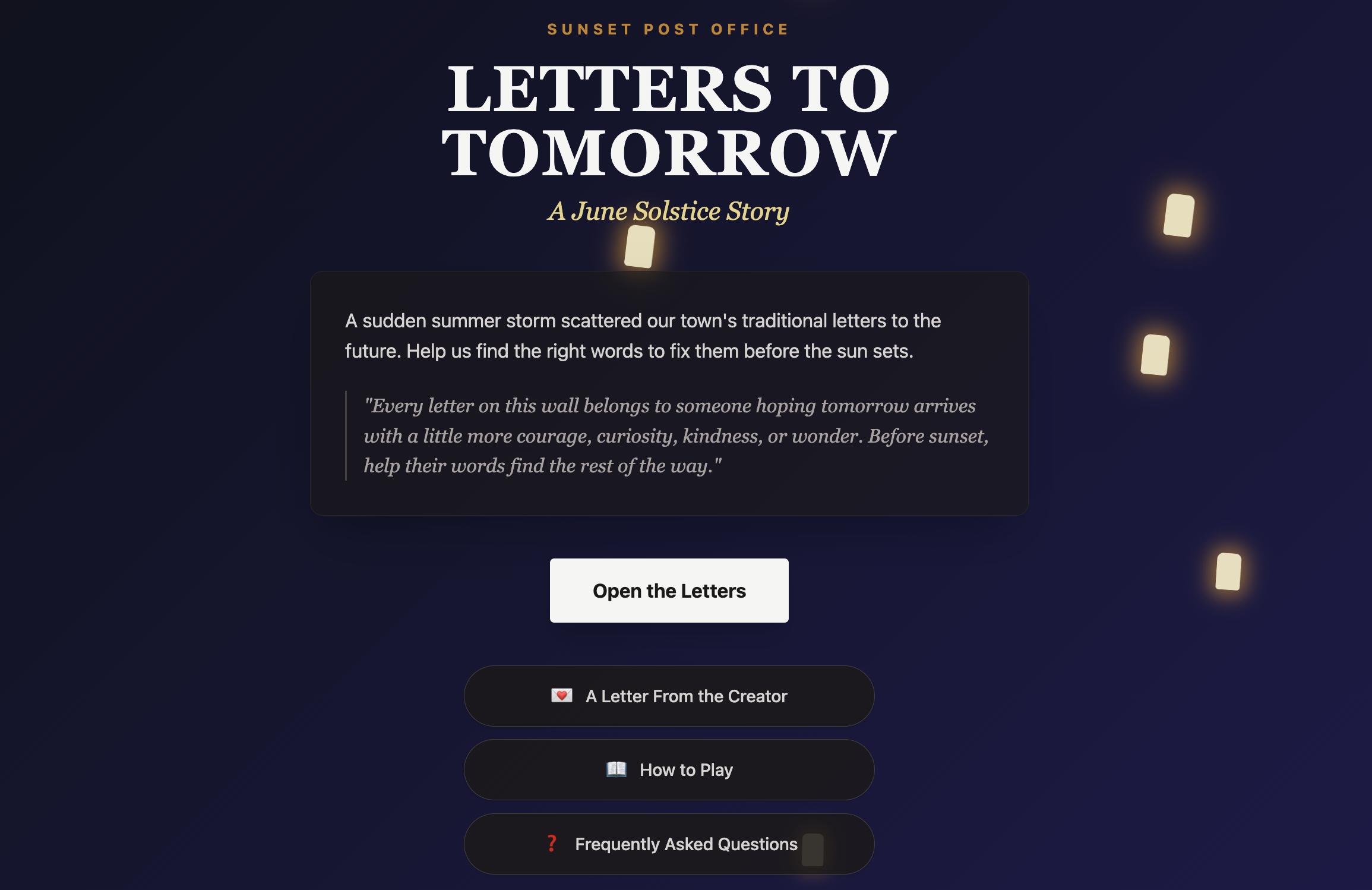
Letters to Tomorrow is a narrative web game set during the June Solstice, the longest day of the year. You play as a postmaster working the twilight shift after a summer storm scatters the town's annual letters to the future. Many of the letters have lost their final sentences, and it becomes your job to help complete them before sunset.
Each letter belongs to a different person standing at a different point in life. A baker opening his shop for the first time. A musician wondering whether she deserves to be heard. A teacher reflecting on a moment that stayed with him. Someone remembering an unexpected act of kindness from years ago. A person trying to figure out what comes next.
As you read, you choose the words that feel most true. If none of the options feel right, you can write your own.
When I first read the challenge prompt, I kept returning to one idea: the solstice is a turning point. The longest day eventually becomes evening. Time keeps moving forward. We cannot stop it, but we can decide what we carry with us into tomorrow.
That became the heart of the game.
The letters are not about saving the world. They are about ordinary moments that quietly shape who we become. A conversation. A friendship. A kindness. A new beginning. The things we often forget to celebrate, even though they stay with us the longest.
My goal was to create something that feels like taking a deep breath at the end of a long day. A small space where people can slow down, reflect, and perhaps recognize a piece of themselves in someone else's story.
Video Demo
In this walkthrough, I take you through a full shift at the Sunset Post Office, explain the core mechanics, and share some of the ideas that inspired the letters and themes throughout the game.
{% youtube HrjEMHwmPb0 %}
Prefer to play first?
Code
If you'd like to explore the source code, the entire project is available on GitHub.
One thing I enjoyed about building this game was keeping everything surprisingly simple. The whole experience lives inside a single HTML file, which made it a fun challenge to organize the narrative, game systems, save functionality, animations, accessibility features, FAQ, and player guidance all in one place.
{% github hemapriya-kanagala/letters-to-tomorrow %}
The game is deployed on Vercel and can be played directly in your browser. If you would rather experience it before reading further, you can jump straight into the Post Office below:
👉 Play Online: Letters to Tomorrow
No installation, downloads, or account creation required.
How I Built It
I wanted the experience to feel simple, accessible, and easy to run. The entire game lives in a single HTML file using HTML, CSS, and JavaScript. There is no backend, no account system, and no server required to play.
I want to be transparent about how Google AI was used throughout the project.
The concept, game structure, characters, letters, narrative themes, and overall experience were created by me. The emotional core of the game came from stories, memories, and ideas that I wanted to explore through the lens of the June Solstice.
Where Google AI helped most was during development.
I used Google AI as a coding partner to help build parts of the interface, refine layouts, improve responsiveness across devices, and implement visual details such as transitions, animations, and accessibility features. It helped me translate ideas that existed in my head into working code.
I also used Google AI to review instructional content such as the How To Play guide and FAQ section. Because the game is intentionally gentle and reflective, I wanted to make sure players would never feel confused about what to do next. I used AI as a second pair of eyes to identify questions I might have overlooked and to help improve clarity.
For the narrative content, I occasionally used AI for feedback and editing suggestions, but the letters themselves were written by me. I wanted them to feel personal, human, and grounded in real experiences rather than generated messages.
Accessibility was also important to me. The game is designed to work comfortably on phones, tablets, laptops, and desktop computers. I focused on readability, responsive layouts, and clear navigation so that players can focus on the stories rather than the interface.
One technical decision that mattered a lot to me was privacy.
The game uses local storage only. Everything the player writes stays on their own device. Custom letter endings, personal reflections, and the final letter to Tomorrow are never sent to a server and are never visible to anyone else.
I built it this way intentionally because I wanted players to feel comfortable being honest. Some people may only write a sentence. Others may write something deeply personal. Either way, those words belong entirely to them.
I also made the decision not to include background music. The silence is intentional. I wanted the game to feel like a quiet desk at the end of a long day, giving players room to reflect and hear their own thoughts while reading and writing.
Prize Category
Best Google AI Usage
Google AI, primarily Gemini Pro, played an important role in helping me bring this project to life.
I used Gemini as a development partner throughout development to help with frontend implementation, responsive design, accessibility improvements, animations, interface refinement, and general troubleshooting. It also helped me review and improve supporting content such as the How to Play guide and FAQ section.
For the narrative side of the project, the characters, themes, stories, and emotional direction came from me. I occasionally used Gemini for editorial feedback on drafts, but the letters themselves were written by me.
I also used Gemini to generate the banner image for this article. You may notice a Gemini watermark on the image, which is part of the generated output.
Most importantly, Gemini helped me spend less time fighting technical hurdles and more time focusing on the stories I wanted to tell.
Best Ode to Alan Turing
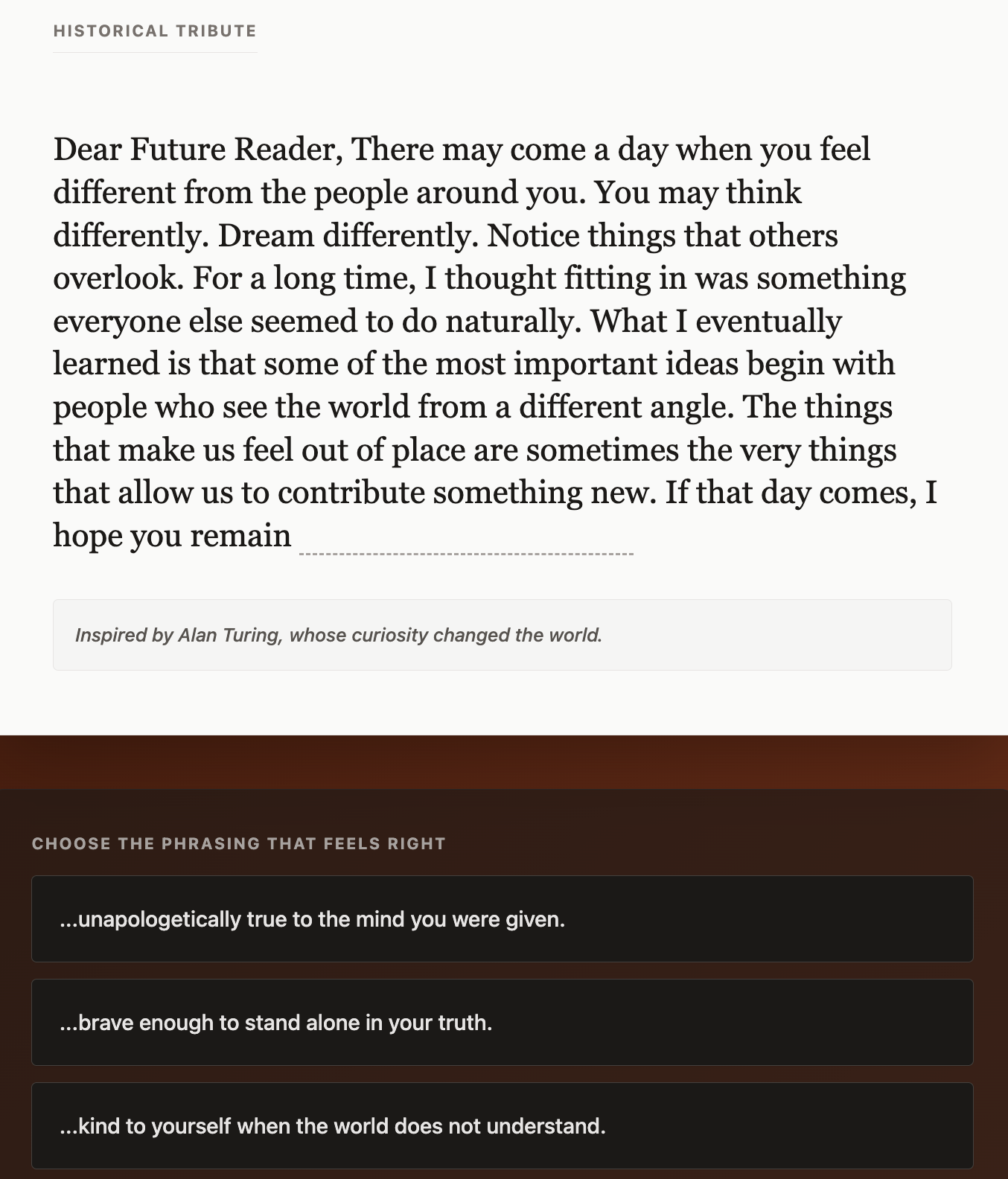
During the third phase of the game, players discover a letter called The Blue Envelope.
Rather than focusing on codebreaking or mathematics, I wanted to honor the human side of Alan Turing's story.
The letter is written for anyone who has ever felt different, thought differently, or seen the world from a different perspective. It is a reminder that some of the qualities that make us feel out of place are often the same qualities that allow us to contribute something meaningful.
The letter ends with a note acknowledging Alan Turing and the curiosity that changed the world.
Why Letters?
While designing this game, I kept asking myself a simple question: if the June Solstice is a turning point between today and tomorrow, what is the most human way to represent that?
I kept coming back to letters.
A letter exists in a strange space between the present and the future. When someone writes one, they are capturing a version of themselves that exists only in that moment. Their fears, hopes, questions, memories, and unfinished thoughts are placed on a page and sent forward to a person they have not become yet.
That felt deeply connected to the spirit of the solstice.
The longest day of the year is a reminder that time never stands still. The sunlight eventually fades. Seasons change. People change. We cannot hold on to a moment forever, but we can decide what we want to carry with us when it ends.
That is why every story in the game takes the form of a letter.
The baker is not simply remembering the day he opened his shop. He is trying to remind his future self why he started. The musician is not simply talking about fear. She is leaving herself a note for the next time doubt appears. Every person in the game is reaching across time and speaking to the person they hope to become.
In a way, that is exactly what the player is doing too.
By the end of the game, the final empty envelope is not another puzzle to solve. It is an invitation. After spending time helping other people find the words they want to carry into tomorrow, the player is given a chance to decide what they want to carry forward themselves.
That is why Letters to Tomorrow could only be told through letters.
A Piece of My Story
One of the letters in the game is based directly on a real experience from my own life.
After moving to the United States, I was struggling to carry heavy luggage up several flights of stairs when a stranger noticed and helped me without being asked. Not long afterward, one of my professors handed me her umbrella during a rainstorm and told me to keep it. When I tried to return it, she smiled and said, "No, you need it."
Neither of those moments lasted very long.
Neither of those people probably remember them now.
But I do.
What stayed with me was not the luggage or the umbrella. It was the feeling of being cared for in a place that was still unfamiliar to me. Those moments made the world feel a little less intimidating. They made me more willing to ask for help when I needed it and more willing to offer help when I saw someone struggling.
That experience became the inspiration for Hema's letter in the game.
I included it because I wanted at least one letter to come directly from my own life. It serves as a reminder that some of the things we carry into tomorrow are not major life events. Sometimes they are simply moments when someone chose kindness.
A Small Step Outside My Comfort Zone
There is one more thing I wanted to share.
The demo video for this project is narrated by me.
That may not sound like a big deal, but it was a meaningful step for me. I am usually much more comfortable expressing myself through writing than through recordings, and knowing that a video could be seen by many people made me hesitate more than once while working on this submission.
If you watch the demo, you will probably notice a few moments where I stumble over words, speak a little too quickly, or sound nervous. I tried my best to smooth those moments out during editing, but some of them are still there.
For a while, I considered using a generated voice instead. In the end, I chose not to. Letters to Tomorrow is a game about ordinary people sharing honest pieces of themselves, and I wanted the introduction to feel personal too.
So I left the imperfections in and shared it anyway.
I am still learning how to become more comfortable with speaking, recording videos, and putting my work out into the world. This project was a small step in that direction.
If you have any tips on narration, presentation, or creating better demo videos, I would genuinely appreciate the feedback. It is an area I am actively trying to improve, and every project teaches me something new.
Final Thoughts
Thank you for taking the time to read about Letters to Tomorrow.
I hope some of these letters feel familiar. If one of them stayed with you after you finished playing, I would genuinely love to know which one and why.
And if there is a letter you think belongs in this town but has not been written yet, I would love to hear that too. Some of the best stories begin as conversations.
I am also always interested in ideas for making the experience better. If there is a feature that would make the game more accessible, a question that should be added to the FAQ, or something that felt unclear while playing, please let me know.
If you would like to revisit the game, you can always return to the Sunset Post Office here:
Most of all, thank you for spending a little time with these stories.
Comments
More Blog
View allaiContext bankruptcy: The case for strategic forgetting for AI Agents
Most of us have seen a coding agent fail to complete a task we know it can do. We just don't...
J
James O'ReillygooglecloudParallel Compliance Engine: Drive-to-Sheets Multi-Agent Orchestration
When building Generative AI applications, developers often encounter a massive bottleneck: sequential...
A
Aryan IranidiscussIs It Ethical to Post and Ask About Circuits on Dev.to?
I’ve been thinking about sharing some electronic circuit posts on Dev.to — small circuits, DIY...
C
codebunny20agentsThe One-Click Exporter: AI Studio Antigravity, Probed to Its Limits
What nobody tells you about exporting your multi-agent prototype to a local workspace. Every...
L
leslysandraagenticarchitectGuarding the till while autonomous data agents do the digging
Autonomous agents are genuinely good at answering messy business questions. Give one an LLM and a set...
S
Sireesha PulipatiaiReturn on Attention: Why AI Code Reviews Are Wearing Us Out
PR volume went up, ticket quality didn't, and the gap got filled with LLMs on both sides of the review: bots reviewing, bots replying, bots occasionally arguing with bots about priorities that only existed in a teammate's head. Our CEO named the actual problem, and it's bigger than code review.
C
christine