
Back to Blog distributedsystems
 ai
ai googlecloud
 discuss
 agents
 agenticarchitect
 ai
ai
What Is a Software Invariant?
Gustavo Castillo June 21, 2026
0 views
Imagine you have $100 in your bank account. One morning, you're running late for work and stop at an ATM
title: What Is a Software Invariant? published: true description: Imagine you have $100 in your bank account. One morning, you're running late for work and stop at an ATM tags: distributedsystems cover_image: https://images.pexels.com/photos/4027658/pexels-photo-4027658.jpeg

Use a ratio of 100:42 for best results.
published_at: 2026-06-21 03:32 +0000
Imagine you have $100 in your bank account. One morning, you’re running late for work and stop at an ATM to withdraw $80. The machine dispenses the cash, you put it in your wallet, and continue with your day.
A few hours later, you check your banking app and notice something alarming:
balance: -$60
How is that possible? 😨
You only had $100 and withdrew $80. At first glance, this sounds like a bug. And it is. But more importantly, it reveals one of the most fundamental concepts in software engineering: invariants.
An invariant is a condition that must always remain true, regardless of how many operations are performed on the system.
In the case of a bank account, one obvious invariant is:
Account balance >= 0
A customer should never be able to withdraw more money than is available in their account.
Simple enough.
Now imagine two ATMs processing withdrawals at almost exactly the same time. Each ATM checks the balance and sees $100 available. Both approve a withdrawal of $80.
The result?
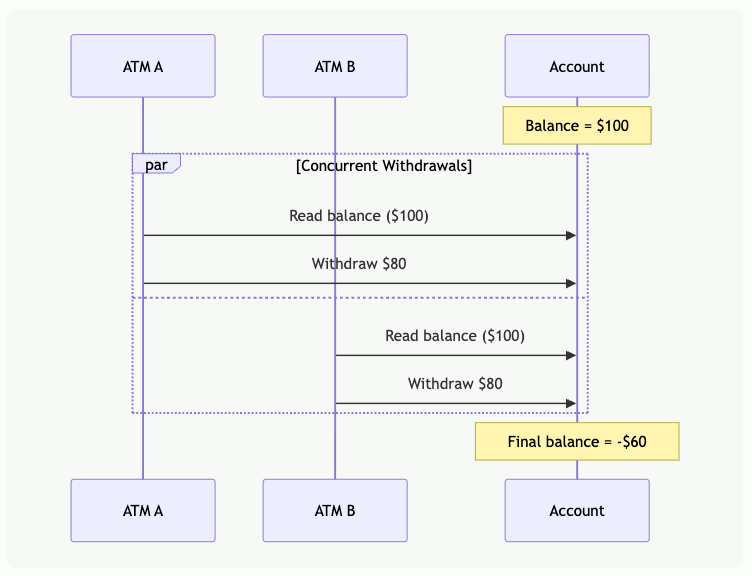
The invariant has been violated. The interesting part is that neither ATM was individually wrong. Each one made a decision based on information that was correct at the time it was read.
This is where distributed systems become difficult. The challenge is not simply moving data between computers. The challenge is ensuring that important invariants continue to hold, even when multiple users, processes, servers, or data centers are operating concurrently.
A Simple Example in Go
Let’s model our bank account in Go. We’ll start with a simple rule:
type Account struct {
    balance int
}
Remember the invariant we introduced earlier:
balance >= 0
In other words, an account should never have a negative balance. A straightforward implementation of a withdrawal operation might look like this:
func (a *Account) Withdraw(amount int) error {
	if a.balance < amount {
		return fmt.Errorf("insufficient funds")
	}

	a.balance -= amount

	return nil
}
At first glance, this seems perfectly reasonable. Before subtracting money from the account, we verify that enough funds are available. If the balance is too low, we reject the withdrawal.
Let’s see it in action:
func main() {
	account := Account{balance: 100}

	err := account.Withdraw(80)
	if err != nil {
		panic(err)
	}

	fmt.Println(account.balance)
}
Output:
20
Everything looks correct. The invariant still holds:
20 >= 0
So where does the problem come from?
The answer is that this code assumes only one withdrawal is happening at a time.
In the real world, multiple requests can arrive simultaneously. Two ATMs, two mobile devices, or two backend servers may attempt to withdraw money from the same account at nearly the same moment.
And that’s when things start to get interesting.
When Two Withdrawals Happen at the Same Time
The implementation from the previous section appears to protect our invariant.
Before withdrawing money, we check that the account has sufficient funds available. However, there’s a subtle assumption hidden in the code:
Only one withdrawal can happen at a time.
In a real system, that assumption rarely holds.
Imagine two ATMs processing withdrawals for the same account at nearly the same moment. Both requests arrive when the account balance is still $100.
Let’s simulate that scenario:
package main

import (
    "fmt"
    "sync"
    "time"
)

type Account struct {
    balance int
}

func (a *Account) Withdraw(amount int) error {
    if a.balance < amount {
        return fmt.Errorf("insufficient funds")
    }

    // Simulate some processing delay
    time.Sleep(100 * time.Millisecond)

    a.balance -= amount

    return nil
}

func main() {
    account := Account{balance: 100}
    var wg sync.WaitGroup
    wg.Add(2)

    go func() {
        defer wg.Done()
        account.Withdraw(80)
    }()

    go func() {
        defer wg.Done()
        account.Withdraw(80)
    }()

    wg.Wait()
    fmt.Println("Final balance:", account.balance)
}
At first glance, it may seem impossible for this code to produce a negative balance.
After all, every withdrawal checks whether sufficient funds are available before proceeding.
The problem is that both goroutines can read the balance before either one updates it.
A possible execution might look like this:
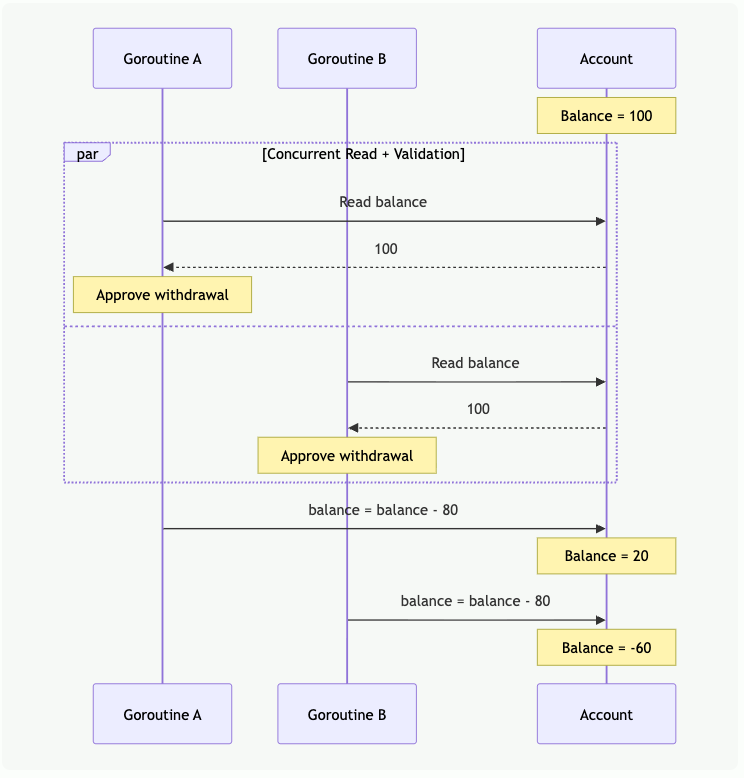
Neither withdrawal was individually incorrect.
Each goroutine observed a balance of $100 and made a decision based on information that was valid at the time it was read.
The issue is that the validation step and the update step were not performed atomically. As a result, our invariant has been violated:
balance >= 0
It is no longer true.
This example illustrates an important idea:
The hardest part of building reliable systems is often not performing the operation itself, but ensuring that critical invariants continue to hold when multiple operations occur concurrently.
And if preserving an invariant becomes challenging with just two goroutines running in the same process, imagine how much harder it becomes when those operations are happening across multiple servers, regions, or data centers!
Preserving the Invariant
The problem in our previous example wasn’t the withdrawal itself.
The problem was that two goroutines could execute the validation and update steps concurrently.
To preserve the invariant, we need to ensure that only one goroutine can perform a withdrawal at a time.
One way to achieve this in Go is by using a mutex:
type Account struct {
    balance int
    mu sync.Mutex
}

func (a *Account) Withdraw(amount int) error {
    a.mu.Lock()
    defer a.mu.Unlock()

    if a.balance < amount {
        return fmt.Errorf("insufficient funds")
    }

    a.balance -= amount

    return nil
}
Now the withdrawal operation becomes atomic from the perspective of other goroutines.
While one goroutine is executing the withdrawal, every other goroutine must wait for the lock to be released.
Let’s revisit our invariant:
balance >= 0
With the mutex in place, both withdrawals can no longer validate the balance simultaneously. A possible execution now looks like this:
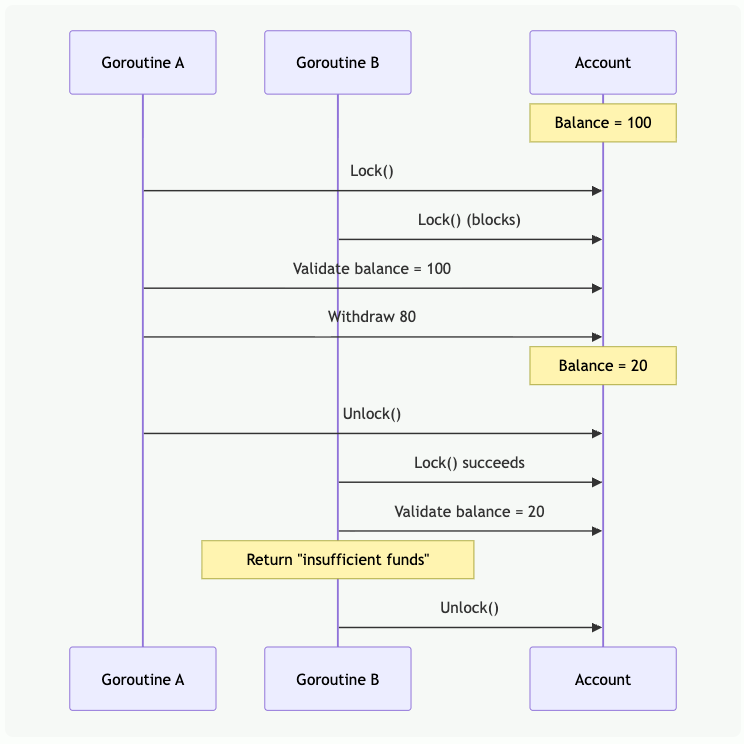
The invariant is preserved.
This illustrates an important principle:
Correctness is often achieved by protecting the operations that enforce an invariant.
In our example, a mutex is enough because everything happens inside a single process. But what happens when the same account can be modified by multiple application servers?
A mutex cannot protect data that lives on another machine. This is where databases, transactions, distributed locks, and consensus algorithms enter the picture.
They are all different mechanisms designed to solve the same fundamental problem: preserving invariants in the presence of concurrency.
Conclusion
At first glance, an invariant may seem like nothing more than a business rule. In our example, the rule was simple:
balance >= 0
However, as soon as multiple operations can occur concurrently, preserving that rule becomes much more challenging than it appears.
Comments
More Blog
View allaiContext bankruptcy: The case for strategic forgetting for AI Agents
Most of us have seen a coding agent fail to complete a task we know it can do. We just don't...
J
James O'ReillygooglecloudParallel Compliance Engine: Drive-to-Sheets Multi-Agent Orchestration
When building Generative AI applications, developers often encounter a massive bottleneck: sequential...
A
Aryan IranidiscussIs It Ethical to Post and Ask About Circuits on Dev.to?
I’ve been thinking about sharing some electronic circuit posts on Dev.to — small circuits, DIY...
C
codebunny20agentsThe One-Click Exporter: AI Studio Antigravity, Probed to Its Limits
What nobody tells you about exporting your multi-agent prototype to a local workspace. Every...
L
leslysandraagenticarchitectGuarding the till while autonomous data agents do the digging
Autonomous agents are genuinely good at answering messy business questions. Give one an LLM and a set...
S
Sireesha PulipatiaiReturn on Attention: Why AI Code Reviews Are Wearing Us Out
PR volume went up, ticket quality didn't, and the gap got filled with LLMs on both sides of the review: bots reviewing, bots replying, bots occasionally arguing with bots about priorities that only existed in a teammate's head. Our CEO named the actual problem, and it's bigger than code review.
C
christineReady-made automations for this
Workflows from the Neura Market marketplace related to this Stable Diffusion resource
- Automate Your Business Insights with Unleashed Software Integrationn8n · $6.08 · Related topic
- Notify Team Channel About New Software Releases via Slack and GitHubn8n · $9.99 · Related topic
- Monitor Software Compliance: Jamf Patch Summaries to Slackn8n · $12.99 · Related topic
- Get Completed Sales Orders from Unleashed Softwaren8n · $3.99 · Related topic