
Back to Blog kubernetes
 ai
ai googlecloud
 discuss
 agents
 agenticarchitect
 ai
ai
Agnostic Cluster Refactor Skill for Antigrafity CLI: Building an AI Agent that Migrates Apps from AWS to GKE (Subagents, HITL Gate & Workload Identity)
Carlos Barbero June 30, 2026
0 views
How I built a skill for the Antigravity CLI that automates migrating AWS-coupled Python apps to GKE — parallel subagents, mandatory human oversight, and keyless auth.
title: "Agnostic Cluster Refactor Skill for Antigrafity CLI: Building an AI Agent that Migrates Apps from AWS to GKE (Subagents, HITL Gate & Workload Identity)" published: true description: "How I built a skill for the Antigravity CLI that automates migrating AWS-coupled Python apps to GKE — parallel subagents, mandatory human oversight, and keyless auth." tags: kubernetes, googlecloud, ai, antigrafity cover_image: canonical_url: null
Have you ever inherited a codebase where import boto3 appears in 47 different files? Where AWS credentials live in hardcoded environment variables and file storage is a file.save("/tmp/...") that will blow up the moment it hits an ephemeral Kubernetes pod?
I did. And instead of refactoring everything by hand, I built an AI agent to do it for me — with mandatory human oversight before any production mutation.
This article documents what I built: a skill for the Antigravity CLI (agy) that scans cloud dependencies, spawns parallel subagents to refactor code and infrastructure, and validates everything on local Kubernetes before deploying to GKE with keyless Workload Identity.
The Problem: Invisible Vendor Lock-in
boto3 is the AWS SDK for Python. It seems harmless at first:
# Innocent on day 1
import boto3
s3 = boto3.client('s3', region_name='us-east-1')
s3.upload_fileobj(file, bucket_name, filename)
Six months later:
# examples/legacy-app/app.py — the real state after it grows
import os
import boto3
from flask import Flask, request, jsonify

app = Flask(__name__)

# "Temporary" hardcoded since 2022
DB_PASSWORD = os.getenv("DB_PASSWORD", "default-insecure-password")

S3_BUCKET = os.getenv("AWS_S3_BUCKET_NAME")
AWS_REGION = os.getenv("AWS_DEFAULT_REGION", "us-east-1")

s3_client = boto3.client(
    's3',
    aws_access_key_id=os.getenv("AWS_ACCESS_KEY_ID"),
    aws_secret_access_key=os.getenv("AWS_SECRET_ACCESS_KEY"),
    region_name=AWS_REGION
)

@app.route("/upload", methods=["POST"])
def upload_file():
    file = request.files['file']
    filename = file.filename
    if S3_BUCKET:
        s3_client.upload_fileobj(file, S3_BUCKET, filename)
        return jsonify({"message": f"Uploaded to AWS S3: {S3_BUCKET}"})
    else:
        # Fallback to local disk — will break in K8s ephemeral pods
        local_path = os.path.join("/tmp", filename)
        file.save(local_path)
        return jsonify({"message": f"Saved locally at {local_path}"})
Three coupling problems in a single file: proprietary SDK (boto3), AWS-specific credentials, and local disk storage that doesn't survive ephemeral Kubernetes pods.
Now multiply that by 10 services.
What We're Building
A skill for the Antigravity CLI that adds two commands to the agent chat:
/agnostic-cluster-refactor:scan-deps
/agnostic-cluster-refactor:spawn-refactor
The complete flow:
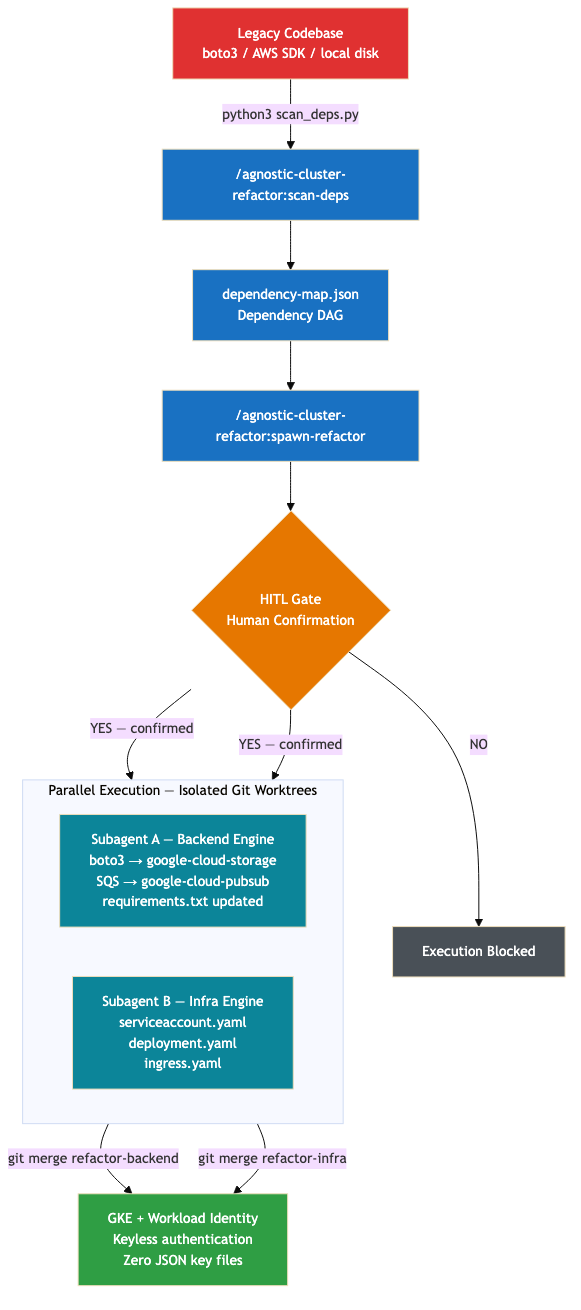
But before diving into the code, let me introduce the players.
The Players: agy, Agents, Skills, and Subagents
The Antigravity CLI (agy)
agy is not a script. It's an LLM-powered agent — you describe what you want in the chat and it decides how to do it, using a toolset: read_file, write_to_file, run_command, invoke_subagent.
The difference from a web chatbot: agy has access to your local filesystem, runs terminal commands, and operates in autonomous loops. It's an engineer working on your machine.
| Script | Agent |
|---|---|
sed 's/boto3/gcs/g' across all files | Analyzes the semantic context of each import and replaces it with the correct equivalent API |
| Fails if the environment changed | Adapts to the current state |
| Deterministic | Probabilistic + adaptive |
Skills — Teaching Capabilities to an Agent
A skill is a SKILL.md file with YAML frontmatter that defines when and how the agent uses that capability. The agent reads the description field and decides whether the skill is relevant to the current task.
---
name: scan-deps
description: Scans the project for cloud-provider dependencies and generates
             dependency-map.json. Use when the user wants to map vendor lock-in
             before migrating to GKE.
---

## Steps

1. Ask which directory to scan
2. Run: python3 .agents/skills/.../scan_deps.py <PATH>
3. Present the DAG summary
💡 Key distinction: skills in
.agents/skills/are injected silently into context. To appear as a/commandin autocomplete, you need a plugin installed at~/.gemini/config/plugins/<plugin>/. More on that in Part 6.
Subagents — Real Parallelism
A subagent is a child agent with completely isolated context. It doesn't "see" the parent's history or the other subagent's — exactly what we want: the Backend agent can't get confused by the YAML the Infra agent is writing.
# Pseudocode — how agy orchestrates this
invoke_subagent(
    name="backend-engine",
    system_prompt="You are an expert in migrating boto3 to GCS...",
    toolset=["read_file", "write_to_file", "run_command"],
    workspace="/path/to/shadow-worktree-backend",
    message="Refactor the files from dependency-map.json"
)
# Subagent B is invoked in parallel — no blocking
invoke_subagent(
    name="infra-engine",
    toolset=["write_to_file"],  # write only — principle of least privilege
    workspace="/path/to/shadow-worktree-infra",
    message="Generate serviceaccount.yaml, deployment.yaml, ingress.yaml for GKE"
)
Each subagent operates in an isolated Git Worktree — a physical copy of the repository in a separate directory, on a different branch. If Subagent A introduces a bug, main stays untouched.
Part 1: The Dependency Scanner
The first step is mapping the problem. scan_deps.py walks the project with os.walk(), applies regex patterns by category, and generates a DAG (Directed Acyclic Graph) as JSON.
# scripts/scan_deps.py
patterns = {
    "storage": [
        r"google\.cloud\.storage",
        r"boto3.*s3",         # AWS-coupled
        r"aws-sdk.*s3"
    ],
    "messaging": [
        r"google\.cloud\.pubsub",
        r"boto3.*sqs",        # AWS-coupled
        r"kafka-python",
    ],
    "secrets": [
        r"boto3.*secretsmanager",
        r"python-dotenv",
    ],
    "databases": [
        r"psycopg2", r"pymongo"
    ]
}

for root, dirs, files in os.walk(path):
    dirs[:] = [d for d in dirs if not d.startswith('.')
               and d not in ['venv', 'node_modules', '__pycache__']]
    for file in files:
        if not file.endswith(('.py', '.js', '.yaml', '.tf')):
            continue
        with open(os.path.join(root, file)) as f:
            content = f.read()
            for dep_type, pattern_list in patterns.items():
                for pattern in pattern_list:
                    if re.search(pattern, content, re.IGNORECASE):
                        dependencies[dep_type].append({
                            "file": os.path.relpath(file_path, path),
                            "matched_pattern": pattern
                        })
The output is a dependency-map.json with the full dependency graph:
{
  "dependencies": {
    "storage": [
      { "file": "examples/legacy-app/app.py", "matched_pattern": "boto3.*s3" },
      { "file": "examples/legacy-app/api.py",  "matched_pattern": "boto3.*s3" }
    ],
    "messaging": [
      { "file": "examples/legacy-app/worker.py", "matched_pattern": "boto3.*sqs" }
    ]
  },
  "architectural_dag": {
    "nodes": [
      { "id": "application",   "type": "component" },
      { "id": "dep-storage",   "files": ["app.py", "api.py"] },
      { "id": "provider-aws",  "type": "cloud-provider" }
    ],
    "edges": [
      { "source": "application",  "target": "dep-storage",  "relation": "uses_storage"   },
      { "source": "dep-storage",  "target": "provider-aws", "relation": "coupled_to_aws" }
    ]
  },
  "recommended_action": "Execute '/spawn-refactor' targeting GCP GKE"
}
❓ Why a DAG and not a plain list? The graph reveals transitive relationships:
app.pyandworker.pyboth depend on AWS viaboto3— so they need to be refactored together. A list would only say "these files have boto3."
Part 2: The HITL Gate — No Agent Touches Production Without Confirmation
This was the most important design decision: how do I ensure the agent doesn't refactor the wrong file without me seeing what's happening first?
The answer lives in two places.
Hooks — The Automatic Security Guard
The .agents/hooks.json file registers a PreToolUse hook — a command that runs before any write_to_file the agent attempts:
{
  "hitl-production-gate": {
    "enabled": true,
    "PreToolUse": [
      {
        "matcher": "write_to_file|replace_file_content|multi_replace_file_content",
        "hooks": [
          {
            "type": "command",
            "command": "python3 .agents/skills/agnostic-cluster-refactor/scripts/scan_deps.py --check-only",
            "timeout": 5
          }
        ]
      }
    ]
  }
}
The hook receives a JSON payload via stdin and responds with a decision:
# scan_deps.py — --check-only mode
SAFE_WRITE_PREFIXES = ("examples/", "terraform/", ".agents/")

def check_only_hook():
    payload = json.load(sys.stdin)
    target = payload.get("toolCall", {}).get("args", {}).get("TargetFile", "")
    workspace_root = payload.get("workspacePaths", ["."])[0]
    rel_path = os.path.relpath(target, workspace_root)

    if not any(rel_path.startswith(p) for p in SAFE_WRITE_PREFIXES):
        print(json.dumps({
            "decision": "force_ask",
            "reason": f"[HITL Gate] '{rel_path}' is outside safe directories. Confirm before proceeding."
        }))
    else:
        print(json.dumps({"decision": "allow"}))
Three possible decisions the hook can return:
| Decision | Effect |
|---|---|
"allow" | Agent proceeds automatically |
"force_ask" | agy pauses and asks the human |
"deny" | Completely blocked, no prompt |
Testing it from the command line:
# File OUTSIDE safe directories
echo '{"toolCall":{"name":"write_to_file","args":{"TargetFile":"/project/src/app.py"}},
      "workspacePaths":["/project"]}' | python3 scripts/scan_deps.py --check-only
# → {"decision": "force_ask", "reason": "[HITL Gate] 'src/app.py' is outside safe directories..."}

# File INSIDE safe directories
echo '{"toolCall":{"name":"write_to_file","args":{"TargetFile":"/project/examples/k8s/deployment.yaml"}},
      "workspacePaths":["/project"]}' | python3 scripts/scan_deps.py --check-only
# → {"decision": "allow"}
The Gate in SKILL.md — Explicit Confirmation Before Spawning
Beyond the automatic hook, the /spawn-refactor SKILL.md instructs the agent to always ask for explicit confirmation before spawning subagents:
## HITL Gate — mandatory before any mutation

Display the list of files that will be changed and ask:

  The following files will be modified:
    - examples/legacy-app/app.py    (replace boto3 → GCS)
    - examples/legacy-app/worker.py (replace SQS → Pub/Sub)

  Type YES to confirm or NO to abort.

Halt if the user does not confirm with YES.
🛡️ Two layers of protection: the hook catches any write automatically, and the SKILL.md forces you to see the full plan before anything moves.
Part 3: Before and After — Real Code
After Subagent A runs, app.py goes from the boto3 mess above to this:
# examples/refactored-app/app.py
import os
from flask import Flask, request, jsonify

app = Flask(__name__)

DB_PASSWORD = os.getenv("DB_PASSWORD")
if not DB_PASSWORD:
    raise RuntimeError("DB_PASSWORD environment variable is required!")

GCS_BUCKET_NAME = os.getenv("GCS_BUCKET_NAME", "local-mock")

# LOCAL_MOCK=true → bypasses GCS; useful for K8s plumbing tests without real credentials
LOCAL_MOCK = os.getenv("LOCAL_MOCK", "false").lower() == "true"

if LOCAL_MOCK:
    storage_client = None
    print("[LOCAL_MOCK] GCS disabled. Uploads will be simulated.")
else:
    from google.cloud import storage  # import only when we actually need GCS
    storage_client = storage.Client()  # zero credentials — ADC via Workload Identity

_mock_store: dict[str, bytes] = {}

@app.route("/health", methods=["GET"])
def health():
    return jsonify({
        "status": "healthy",
        "platform": "local-k8s" if LOCAL_MOCK else "gcp-gke",
        "gcs_bucket": GCS_BUCKET_NAME,
        "mock_mode": LOCAL_MOCK,
    })

@app.route("/upload", methods=["POST"])
def upload_file():
    file = request.files["file"]
    filename = file.filename

    if LOCAL_MOCK:
        data = file.read()
        _mock_store[filename] = data
        return jsonify({
            "message": f"[LOCAL_MOCK] {filename} stored in memory ({len(data)} bytes)",
            "gcs_uri": f"gs://local-mock/{filename}",
            "files_in_mock": list(_mock_store.keys()),
        })

    bucket = storage_client.bucket(GCS_BUCKET_NAME)
    blob = bucket.blob(filename)
    blob.upload_from_file(file)
    return jsonify({
        "message": f"Uploaded {filename} to {GCS_BUCKET_NAME}",
        "gcs_uri": f"gs://{GCS_BUCKET_NAME}/{filename}",
    })

@app.route("/files", methods=["GET"])
def list_files():
    if LOCAL_MOCK:
        return jsonify({"files": list(_mock_store.keys()), "source": "local-mock"})
    blobs = storage_client.list_blobs(GCS_BUCKET_NAME)
    return jsonify({"files": [b.name for b in blobs], "source": f"gs://{GCS_BUCKET_NAME}"})

if __name__ == "__main__":
    app.run(host="0.0.0.0", port=8080, debug=LOCAL_MOCK)
What changed:
| Before | After |
|---|---|
import boto3 | from google.cloud import storage (conditional) |
boto3.client('s3', aws_access_key_id=...) | storage.Client() — zero credentials |
file.save("/tmp/...") | blob.upload_from_file(file) |
DB_PASSWORD with insecure default | RuntimeError if missing |
The Import That Cost Me an Hour
# ❌ Wrong — crashes at startup without GCP credentials
from google.cloud import storage
storage_client = storage.Client()   # RuntimeError before any request is handled

# ✅ Correct — import only happens when we actually need it
if LOCAL_MOCK:
    storage_client = None
else:
    from google.cloud import storage   # ← inside the else block
    storage_client = storage.Client()
from google.cloud import storage executes when Python loads the module — before serving any request. Without GCP credentials, the app crashes at startup. Moving the import inside else fixes it: with LOCAL_MOCK=true, the module is never imported.
Part 4: Testing on Local Kubernetes Without GCP Credentials
I wanted to validate the entire K8s stack (Deployment, ConfigMap, Secret, Service, health checks, routing) locally using Docker Desktop — without needing real GCP credentials.
The solution was LOCAL_MOCK=true combined with a Docker Desktop quirk that catches a lot of people off guard.
The Separate containerd Problem
Docker Desktop uses two completely separate runtimes that don't share images:
┌──────────────────────────────────────┐
│  Docker daemon                       │  ← docker build, docker images
│  (images here are NOT visible to K8s)│
└──────────────────────────────────────┘

┌──────────────────────────────────────┐
│  containerd                          │  ← used by the Kubernetes cluster
│  (separate namespace)                │
└──────────────────────────────────────┘
When you run docker build -t my-image ., the image exists in the Docker daemon but not in containerd. With imagePullPolicy: Never, K8s looks in containerd and fails:
Failed to pull image "my-image:local": ErrImageNeverPull
The fix: a local registry as the bridge between both runtimes.
# registry:2 on port 5001 (port 5000 is taken by macOS AirPlay)
docker run -d -p 5001:5000 --restart=always --name local-registry registry:2
Now the flow works end-to-end:
docker build → Docker daemon
      ↓
docker tag + push → localhost:5001 → registry:2
      ↓
containerd pulls from registry:2 ← K8s Pod starts successfully
The Makefile handles all of this in a single command:
REGISTRY       = localhost:5001
REGISTRY_IMAGE = $(REGISTRY)/agnostic-cluster-refactor:local

registry-start:
	@docker ps --filter name=local-registry --filter status=running | grep local-registry || \
		docker run -d -p 5001:5000 --restart=always --name local-registry registry:2

build: registry-start
	docker build -t agnostic-cluster-refactor:local .
	docker tag agnostic-cluster-refactor:local $(REGISTRY_IMAGE)
	docker push $(REGISTRY_IMAGE)
	@echo "Image available to K8s: $(REGISTRY_IMAGE)"

local-up:
	kubectl config use-context docker-desktop
	kubectl apply -f examples/k8s/local/secret-db.yaml
	kubectl apply -f examples/k8s/local/configmap.local.yaml
	kubectl apply -f examples/k8s/local/deployment.local.yaml
	kubectl apply -f examples/k8s/local/service.local.yaml
	kubectl rollout status deployment/agnostic-cluster-app --timeout=60s
	@echo "Access: http://localhost:8080/health"
The Local Deployment Manifest
# examples/k8s/local/deployment.local.yaml
apiVersion: apps/v1
kind: Deployment
metadata:
  name: agnostic-cluster-app
spec:
  replicas: 1
  template:
    spec:
      containers:
        - name: app
          image: localhost:5001/agnostic-cluster-refactor:local
          imagePullPolicy: Always   # always pull from local registry
          envFrom:
            - configMapRef:
                name: app-config-local   # injects LOCAL_MOCK=true
          env:
            - name: DB_PASSWORD
              valueFrom:
                secretKeyRef:
                  name: app-secrets
                  key: db-password
          readinessProbe:
            httpGet:
              path: /health
              port: 8080
            initialDelaySeconds: 5
# examples/k8s/local/configmap.local.yaml
apiVersion: v1
kind: ConfigMap
metadata:
  name: app-config-local
data:
  GCS_BUCKET_NAME: "local-mock"
  GCP_PROJECT_ID: "local-dev"
  LOCAL_MOCK: "true"    # ← activates the in-memory store
Running it:
make build      # build + push to local registry
make local-up   # apply all manifests

curl http://localhost:8080/health
# {"status":"healthy","platform":"local-k8s","mock_mode":true,"gcs_bucket":"local-mock"}

curl -X POST http://localhost:8080/upload -F "[email protected]"
# {"message":"[LOCAL_MOCK] package.json stored in memory (842 bytes)",
#  "gcs_uri":"gs://local-mock/package.json"}

curl http://localhost:8080/files
# {"files":["package.json"],"source":"local-mock"}

make local-down  # teardown
✅ Entire K8s stack validated — Deployment, ConfigMap, Secret, Service, health checks, routing — without a single GCP token.
Part 5: Workload Identity — Why JSON Keys Don't Belong in Production
On GKE, the story is completely different.
The naive approach:
os.environ["GOOGLE_APPLICATION_CREDENTIALS"] = "/app/sa-key.json"
storage_client = storage.Client()
This requires a JSON key file inside the container, which means:
- The key goes into a Kubernetes Secret
- The Secret gets mounted as a volume in the Pod
- The key expires and needs manual rotation
- If it leaks, anyone has full access to your GCS bucket
The Workload Identity approach: annotate a Kubernetes Service Account (KSA) with a Google Service Account (GSA) email:
# examples/k8s/serviceaccount.yaml
apiVersion: v1
kind: ServiceAccount
metadata:
  name: refactored-app-ksa
  annotations:
    iam.gke.io/gcp-service-account: "gke-app-sa@MY_PROJECT.iam.gserviceaccount.com"
GKE's internal metadata server intercepts ADC calls from Pods, verifies the annotation, and returns a short-lived OAuth2 token:
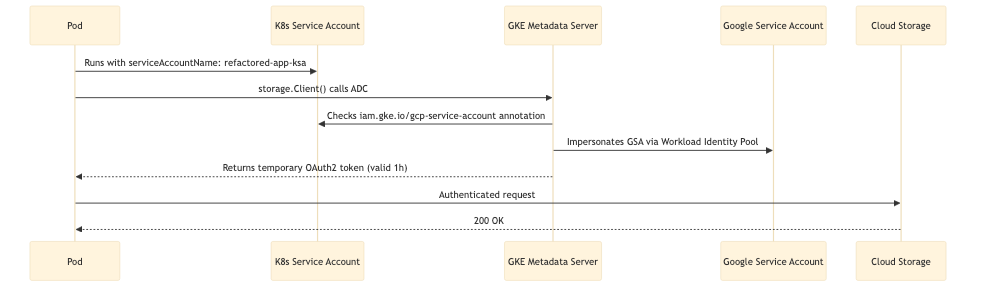
The application code becomes:
# Zero credentials — works automatically on GKE
storage_client = storage.Client()
Terraform provisions the IAM binding automatically:
# terraform/iam.tf
resource "google_service_account_iam_member" "workload_identity" {
  service_account_id = google_service_account.app.name
  role               = "roles/iam.workloadIdentityUser"
  member = "serviceAccount:${var.project_id}.svc.id.goog[default/refactored-app-ksa]"
}
🔐 This binding is the handshake between the Kubernetes world and GCP IAM. Without it, no token is issued —
storage.Client()returns a 403.
Part 6: The agy Plugin Structure
When I first tested, /scan-deps and /spawn-refactor did not appear in the agy autocomplete. I spent a good chunk of time debugging this.
The discovery: agy has three distinct skill-loading mechanisms:
| Mechanism | Location | Shows in / autocomplete? |
|---|---|---|
| Project skill | .agents/skills/<name>/SKILL.md | ❌ No |
| Global contextual skill | ~/.gemini/antigravity-cli/skills/ | ❌ No |
| Plugin with namespace | ~/.gemini/config/plugins/<plugin>/ | ✅ Yes |
To make the commands appear, create the plugin structure:
mkdir -p ~/.gemini/config/plugins/agnostic-cluster-refactor/skills/scan-deps
mkdir -p ~/.gemini/config/plugins/agnostic-cluster-refactor/skills/spawn-refactor

cat > ~/.gemini/config/plugins/agnostic-cluster-refactor/plugin.json << 'EOF'
{
  "name": "agnostic-cluster-refactor",
  "version": "1.0.0",
  "description": "Migrates apps from AWS to GCP GKE with Workload Identity."
}
EOF
After restarting agy, the autocomplete shows:
/agnostic-cluster-refactor:scan-deps
/agnostic-cluster-refactor:spawn-refactor
The namespace prevents collisions — two different plugins can both have a skill named scan-deps and they'll appear as /plugin-a:scan-deps and /plugin-b:scan-deps.
What the Agent Actually Did
When I ran /agnostic-cluster-refactor:spawn-refactor and confirmed the HITL Gate, Gemini (the agy engine) orchestrated:
Subagent A (Backend) — in shadow-worktree-backend:
- Read
dependency-map.jsonto identify boto3 files - Replaced
import boto3→from google.cloud import storage, pubsub_v1in each file - Replaced
boto3.client('s3', ...)→storage.Client().bucket(...)with semantically equivalent calls - Replaced
boto3.client('sqs', ...)→pubsub_v1.SubscriberClient() - Updated
requirements.txt: removedboto3==1.28.0, addedgoogle-cloud-storage==2.10.0andgoogle-cloud-pubsub==2.18.0
Subagent B (Infra) — in shadow-worktree-infra:
- Generated
serviceaccount.yamlwith theiam.gke.io/gcp-service-accountannotation - Generated
deployment.yamlwith env vars via ConfigMap/Secret — no hardcoded credentials - Generated
ingress.yamlwithingressClassName: gce(the current format, not the deprecated annotation)
All in isolated Git Worktrees, in parallel, without touching main.
Lessons Learned
1. The conditional import is intentional, not lazy.
When LOCAL_MOCK=true, from google.cloud import storage must not run at module level. Without GCP credentials, it throws at startup before any request is served. Import conditionally.
2. Docker Desktop K8s and the Docker daemon live in separate worlds.
imagePullPolicy: Never breaks with Docker Desktop because K8s uses containerd, not the daemon. Use a local registry on port 5001 (5000 is taken by macOS) and imagePullPolicy: Always.
3. .agents/workflows/ does not create slash commands in agy.
Skills in .agents/skills/ are context injections, not interactive commands. The / autocomplete requires a plugin installed in ~/.gemini/config/plugins/.
4. The HITL Gate needs two independent layers.
A hook catches unexpected writes automatically. But for /spawn-refactor — which modifies multiple files in parallel — explicit plan confirmation in the SKILL.md is non-negotiable. Without both layers, the agent can act before you understand the blast radius.
5. Workload Identity eliminates an entire security problem class.
No JSON keys in containers means no credential leaks in logs, no manual rotation, no hardcoded keys in Dockerfiles, and no Secret volumes mounted on Pod disk. The Metadata Server's short-lived tokens are genuinely safer.
Try It Yourself
# Clone
git clone https://github.com/carlosrgomes/agnostic-cluster-refactor
cd agnostic-cluster-refactor

# Test locally without GCP (Docker Desktop K8s)
make build      # build + push to local registry
make local-up   # apply manifests to docker-desktop context
curl http://localhost:8080/health

# Scan your own project's dependencies
python3 scripts/scan_deps.py /path/to/your/project
cat dependency-map.json | python3 -m json.tool

# Validate the HITL Gate hook
echo '{"toolCall":{"name":"write_to_file","args":{"TargetFile":"/project/src/main.py"}},
      "workspacePaths":["/project"]}' | python3 scripts/scan_deps.py --check-only
# → {"decision": "force_ask", ...}

# Teardown
make local-down
For the full GKE deployment with Workload Identity, the project README includes the Terraform that provisions all the infrastructure.
Conclusion
The project started from a real problem (boto3 everywhere) and ended up with a surprisingly complete solution: automatic dependency scanning, parallel subagent refactoring, mandatory human oversight, local K8s testing without cloud credentials, and keyless production auth.
What impressed me most wasn't the AI doing the refactoring — it was the supervision system design: hooks intercepting any write outside safe directories, SKILL.md with an explicit gate before destructive actions, and Git Worktrees ensuring main is never touched without human review.
An autonomous agent without oversight is a chaotic script. An agent with a well-designed HITL Gate is a trustworthy teammate.
{% embed https://github.com/carlosrgomes/agnostic-cluster-refactor %}
Comments
More Blog
View allaiContext bankruptcy: The case for strategic forgetting for AI Agents
Most of us have seen a coding agent fail to complete a task we know it can do. We just don't...
J
James O'ReillygooglecloudParallel Compliance Engine: Drive-to-Sheets Multi-Agent Orchestration
When building Generative AI applications, developers often encounter a massive bottleneck: sequential...
A
Aryan IranidiscussIs It Ethical to Post and Ask About Circuits on Dev.to?
I’ve been thinking about sharing some electronic circuit posts on Dev.to — small circuits, DIY...
C
codebunny20agentsThe One-Click Exporter: AI Studio Antigravity, Probed to Its Limits
What nobody tells you about exporting your multi-agent prototype to a local workspace. Every...
L
leslysandraagenticarchitectGuarding the till while autonomous data agents do the digging
Autonomous agents are genuinely good at answering messy business questions. Give one an LLM and a set...
S
Sireesha PulipatiaiReturn on Attention: Why AI Code Reviews Are Wearing Us Out
PR volume went up, ticket quality didn't, and the gap got filled with LLMs on both sides of the review: bots reviewing, bots replying, bots occasionally arguing with bots about priorities that only existed in a teammate's head. Our CEO named the actual problem, and it's bigger than code review.
C
christineReady-made automations for this
Workflows from the Neura Market marketplace related to this Stable Diffusion resource
- Extract Business Leads from Google Maps with Dumpling AI to Google Sheetsn8n · Free · Related topic
- Extract Text from Images & PDFs via Telegram with Mistral OCR to Markdownn8n · Free · Related topic
- Cold Email Icebreakers from Local Business Search with GP-4 and Dumpling AIn8n · Free · Related topic
- Microsoft Outlook AI Email Assistant with Contact Support from Monday and Airtablen8n · Free · Related topic