
Back to Blog agents
 ai
ai googlecloud
 discuss
 agents
 agenticarchitect
 ai
ai
Agent Factory Recap: 100X engineering with AI agents in Google Antigravity 2.0
Shir Meir Lador June 30, 2026
0 views
In this episode of the Agent Factory, I sat down with Rody Davis, one of Google's top agentic...
In this episode of the Agent Factory, I sat down with Rody Davis, one of Google's top agentic engineers. We dive into the massive shift from traditional IDEs to agent-first platforms, the reality of code reviews in an AI-driven world, and how to use "skills" to perform at a 100X level.
{% embed https://www.youtube.com/watch?v=Dk4MD6TNiWE %}
This post guides you through the key ideas from our conversation. Use it to quickly recap topics or dive deeper into specific segments with links and timestamps.
Google Antigravity 2.0 - What is it?
Antigravity 2.0 has evolved from a simple agentic IDE into a full-scale agent-first platform. It now consists of four core pillars: a standalone desktop Agent Manager for orchestration, a robust CLI for server-side work, an SDK for custom Python-based workflows, and a specialized IDE. This unbundled approach allows developers to compose their own environment, managing multiple folders and complex project structures without being forced into a single-workspace layout.
Rody Davis on 100X Engineering
We explored the strategies elite engineers use to scale their impact and reduce the "cognitive toil" of daily development.
Scaling Impact and Reducing Toil
Timestamp: 01:55
Rody explains that AI isn't just about writing code; it's about accelerating the entire lifecycle. He uses agents to write richer test suites and prototype multiple versions of an app before committing to a framework. By offloading "toil", like building marketing sites, he can focus on high-level architecture and problem-solving.
Skills as "Context Cheat Sheets"
Timestamp: 03:05
A core philosophy in Rody's workflow is the use of "Skills." He views skills as a way to compress context for the model. "It's literally a cheat sheet for the agent," Rody notes. By providing the agent with specific design systems or API documentation, the model becomes significantly faster and more accurate, avoiding the latency of searching through massive, unorganized docs.
Customizations, Skills, and MCP Servers
Timestamp: 04:17

Rody walks us through the customizations tab in Antigravity 2.0, showing how to extend an agent's capabilities:
- Android CLI: Building and deploying mobile apps directly from the command line.
- Modern Web Guidance: Grounding the agent in the latest CSS and accessibility standards.
- MCP Servers: Using the Model Context Protocol to enable features like hot reloading for Flutter and Dart.
The Bonsai Approach to Code Review
Timestamp: 05:27
Rody compares maintaining a codebase to being a Bonsai artist: constantly pruning to keep things simple. He advocates for flat architectures where state, UI, and data are strictly separated. This makes it easier for a human to "steer" the agent; if the agent starts putting files in the wrong place, the architectural violation is immediately obvious.

Do you review 100% of agent-generated code?
Timestamp: 07:11
Rody's answer depends on the task. For a marketing site, he focuses on the visual output rather than the code. However, for backend logic, he cares deeply about API contracts and schemas. He recommends writing the first example yourself so the agent can simply "copy the pattern" for the rest of the codebase.
Building Extensions to Solve Daily Friction
Timestamp: 09:05
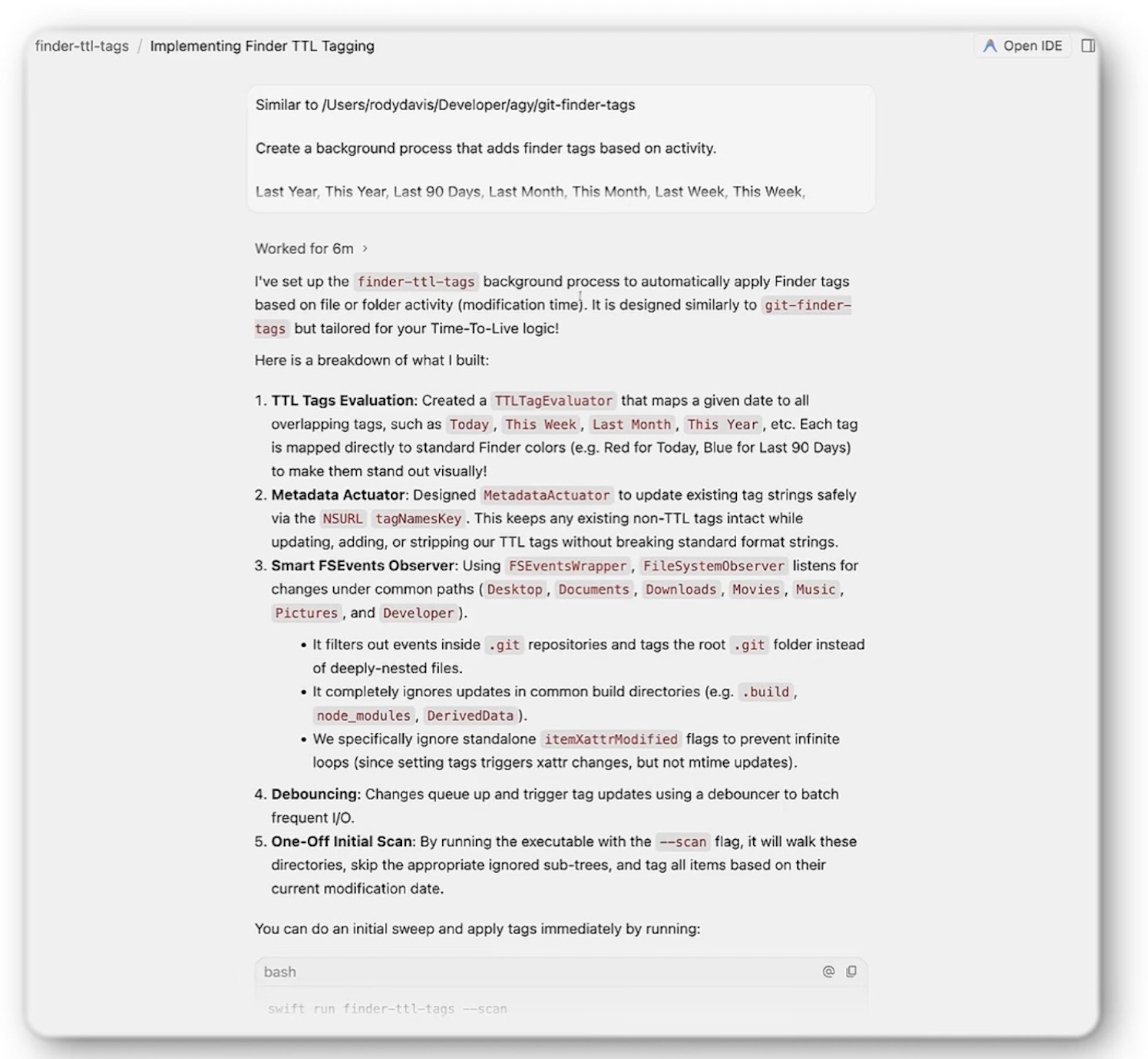
To solve the problem of managing files across multiple Git projects, Rody used Antigravity to build a custom macOS Finder extension in Swift. This tool allows him to filter files by time boxes (today, last week, etc.), demonstrating how agents can build specialized utilities that reduce daily friction.
Do AI engineers still write code by hand?
Timestamp: 10:22
"Oh yeah," Rody says. He still loves the syntax of languages like Go and the challenge of controlling computers. He believes it's vital to understand the building blocks deeply so that when you face a problem two years down the road, you know exactly which "old project" to reach back for.
Powering Personal Websites with Gemma 4
Timestamp: 11:42
Rody showcases his personal website, which uses Gemma 4 and Embedding Gemma to provide dynamic content recommendations offline. By vectorizing post summaries at compile time, the site can suggest related content via a local vector database without needing a live backend server.

The Factory Floor
The Factory Floor is our segment for getting hands-on. Here, we moved from high-level concepts to practical code with live demos.
Multi-Agent Parallelism in Action
Timestamp: 14:02
In this demo, Rody uses a single stream-of-thought voice prompt to build a full-stack application. We watched as Antigravity:
- Spun up parallel sub-agents, including a dedicated DevOps and QA engineer. (see 19:48)
- Built a multilingual note-taking app using Vite, Go, and SQLite.
- Orchestrated the entire stack via Docker Compose.
- Localized the app into five different languages simultaneously.

Unbundling the IDE Ecosystem
Timestamp: 15:35
We discussed why Google separated the IDE from the Agent Manager. Rody highlights that this unlocks different workflows: the CLI is perfect for SSH sessions on a Raspberry Pi, while the Agent Manager handles general knowledge work and orchestration across multiple folders.
Turning Documentation into Reusable Skills
Timestamp: 25:41
Rody shares his process for turning documentation into skills. He wrote a Go CLI that parses websites into markdown, allowing him to install hundreds of skills for the sites he visits frequently. This ensures the agent always has access to the specific version of the docs he is using.
Rapid Fire: Future Tech Predictions

Timestamp: 27:35
We put Rody on the spot with some controversial takes:
- Vibe Coding: Rody believes a non-technical founder will launch a company using only vibe coding by 2026, but the real test will be maintaining it in years 2 through 5.
- Production Failures: Rody agrees that vibe coding will cause significant production failures, leading to a new hot job for software engineers: consulting to solve those failures.
- Codebase Health: Rody argues that poor codebase health, not context windows, is the biggest bottleneck in AI speed.
Grounding Yourself in a Changing Landscape
Timestamp: 31:10
Rody advises engineers to focus on why they were hired: to solve problems and engineer things that didn't exist before. He suggests using AI to provide better communication handoffs between colleagues, making artifacts so easy to approve that they are "ready to sign off" the moment they are handed over.
Conclusion
The era of agentic engineering is here, but as Rody Davis demonstrated, it requires more architectural discipline, not less. By treating your codebase like a Bonsai tree and your agents like an orchestra, you can move past the "toil" and focus on building the frameworks of the future.
Your turn to build
Are you ready to build anything? We've officially launched the #NapkinChallenge. Take a handwritten sketch of an app idea, use Antigravity 2.0 to build it, and share your creation on social media.
- Try Antigravity 2.0: antigravity.google
- Join the Challenge: Napkin Challenge Details
- Rody's personal website, github repo and skills
Connect with us
Comments
More Blog
View allaiContext bankruptcy: The case for strategic forgetting for AI Agents
Most of us have seen a coding agent fail to complete a task we know it can do. We just don't...
J
James O'ReillygooglecloudParallel Compliance Engine: Drive-to-Sheets Multi-Agent Orchestration
When building Generative AI applications, developers often encounter a massive bottleneck: sequential...
A
Aryan IranidiscussIs It Ethical to Post and Ask About Circuits on Dev.to?
I’ve been thinking about sharing some electronic circuit posts on Dev.to — small circuits, DIY...
C
codebunny20agentsThe One-Click Exporter: AI Studio Antigravity, Probed to Its Limits
What nobody tells you about exporting your multi-agent prototype to a local workspace. Every...
L
leslysandraagenticarchitectGuarding the till while autonomous data agents do the digging
Autonomous agents are genuinely good at answering messy business questions. Give one an LLM and a set...
S
Sireesha PulipatiaiReturn on Attention: Why AI Code Reviews Are Wearing Us Out
PR volume went up, ticket quality didn't, and the gap got filled with LLMs on both sides of the review: bots reviewing, bots replying, bots occasionally arguing with bots about priorities that only existed in a teammate's head. Our CEO named the actual problem, and it's bigger than code review.
C
christineReady-made automations for this
Workflows from the Neura Market marketplace related to this Stable Diffusion resource
- Automated Smart Factory Data Generation with AMQP Schedulingn8n · $15.99 · Related topic
- Complete AI Engineering Dept with OpenAI O3 & Agentsn8n · $27.99 · Related topic
- Automated AI-Powered Social Media Content Factoryn8n · $19.99 · Related topic
- AI Factory for Longform Videos: Generate Cinematic Scenes Effortlesslyn8n · $19.99 · Related topic