
Back to Blog webassembly
 ai
ai googlecloud
 discuss
 agents
 agenticarchitect
 ai
ai
Midsommer Madness with WASM, Rust, and Azure Container Apps
xbill July 2, 2026
0 views
This article covers debugging and deploying a Rust backed WASM module with an Azure Container Apps...
title: Midsommer Madness with WASM, Rust, and Azure Container Apps published: true series: Azure date: 2026-07-02 19:14:36 UTC tags: wasm,midsommer,azurecontainerapps,azure canonical_url: https://medium.com/codetodeploy/midsommer-madness-with-wasm-rust-and-azure-container-apps-a95217db781a
This article covers debugging and deploying a Rust backed WASM module with an Azure Container Apps hosted web app celebrating the Swedish Midsommar traditions.
How did we get Here?
What started as a submission for the dev.to June Solstace Jam:
June Solstice Game Jam - DEV Challenge - DEV Community
Blossomed into a whole series exploring new approaches to building out interactive apps across various platforms:
Earlier articles covered Web, Flutter, Firebase, and IOS/Android deployment.
So what is new about this installment?
This installment brings a WASM build with Rust to Midsommer Madness via Antigravity CLI. The Midsommer Madness web app is deployed to Azure Container Apps (ACA) with Rust and WASM — and the Maypole was saved!
What I Built
When it comes to Summar Solstace — the place to be is Sweden. It is one of the highlights of the calendar.
This project aimed to recreate some of the mystique around the event- just in time for some fresh surestromming!
Now you can get it with Azure enhancements! And WASM! And Rust!
So Why Am I reading this?
So what is different about this lab compared to all the others out there?
This is one of the first deep dives into deploying a Rust based WASM deployment ported from an existing working web application.
Is it comprehensive? Not really. The goal was to explore, extend, and exercise the powerful combination of a Rust backed WASM application served from an Azure ACA endpoint.
Rust Setup
Instructions to install Rust are available here:
For a Linux like environment the command looks like this:
curl — proto ‘=https’ — tlsv1.2 -sSf https://sh.rustup.rs | sh
WASM
WebAssembly (often abbreviated as Wasm ) is a low-level binary instruction format that allows developers to run code written in languages like C, C++, Rust, and Go directly in modern web browsers at near-native speeds. [1, 2, 3]
How it Works
Unlike traditional web code that requires step-by-step interpretation, Wasm compiles code into a compact binary format ahead of time. [1]
- Compilation Target: You don’t write Wasm directly. Instead, you write high-level code in your preferred language and use a compiler to translate it into a .wasm file. [1, 2, 3, 4, 5]
- The Virtual Machine: This binary is run inside a lightweight, stack-based virtual machine built into the browser. [1, 2]
- Teamwork with JavaScript: Wasm is designed to complement JavaScript, not replace it. JavaScript is still used to structure the web page, while Wasm handles heavy computations in the background. [1, 2, 3]
Azure Container App Service
Azure Container Apps (ACA) is a fully managed, serverless platform designed for running containerized applications and microservices without managing underlying infrastructure. Built on Azure Kubernetes Service (AKS), it offers built-in autoscaling (including to zero), traffic splitting for blue/green deployments, and Dapr integration, making it ideal for event-driven, API, and background processing workloads.
https://azure.microsoft.com/en-us/products/container-apps
Azure Container App Configuration
To configure your Azure Service with the base system tools- this article provides a reference:
MCP Development with Python, and Azure Container Apps
Setup the Basic Environment
At this point you should have a working Python environment and a working Antigravity CLI installation. All of the relevant code examples and documentation is available in GitHub.
The next step is to clone the GitHub repository to your local environment:
cd ~
git clone https://github.com/xbill9/gemini-cli-azure
cd midsommer-wasm-rust-azure
Then run init.sh from the cloned directory.
The script will attempt to determine your shell environment and set the correct variables:
source init.sh
If your session times out or you need to re-authenticate- you can run the set_env.sh script to reset your environment variables:
source set_env.sh
Variables like PROJECT_ID need to be setup for use in the various build scripts- so the set_env script can be used to reset the environment if you time-out.
OK it Got Weird. How Did Rust get involved?
Ferris is sneaky crab.
> how is Rust used in this project?

96.4k in | 501 out | 420 thinking
● Read(/home/xbill/midsommer-wasm/game-wasm/src/lib.rs) (ctrl+o to expand)

In this project, Rust acts as the high-performance core engine of the game, compiled to WebAssembly (WASM). It manages
  physics calculations, collision systems, game entities, and particle logic, delegating rendering and media management to
  the JavaScript/browser layer.

Here are the specific ways Rust is utilized in the codebase:

### 1. High-Performance Physics & Vector Math
  Rather than running heavy game physics and coordinate tracking in the main JavaScript thread, the game uses Rust for 60Hz
  fixed-timestep updates:

• Collision Detection: Implements precise Axis-Aligned Bounding Box (AABB) collision checks ( check_aabb_collision ) and
  circle-based proximity checks ( check_circle_collision ).
  • Vector Mechanics: Handles directional speeds, distance calculations, and fast vector normalization directly in compiled
  machine code.
  ### 2. Zero-Allocation Particle System
  Under game-wasm/src/lib.rs , a custom particle emitter system handles up to 1000 simultaneous particles ( Particle
  struct):

• State Updates: Tracks coordinates, velocity, damping (friction/drag), life expectancy, and color indexes.
  • Performance Optimization: Utilizes flat, contiguous memory allocations ( static mut PARTICLES: [Particle; 1000] ) to
  process particle logic without memory allocations during runtime, keeping CPU caching friendly and ensuring smooth
  gameplay.

### 3. Centralized Entity State Logic

The internal state of the player and active characters is maintained in Rust-native memory:

• The Player Struct: Tracks attributes like health, coordinates, score, active status effects (speed boosts, shields), and
  weapon parameters—including uniquely Swedish themed ammo varieties ( ammo_surstromming and ammo_flatpack ).
  • The Enemy Struct: Houses state definitions for subclasses of enemies (e.g., Shoppers, Drunkards, ABBAbots).

### 4. Seamless JavaScript Bridging (WASM Interface)

To bridge the memory boundaries between JavaScript and WebAssembly, Rust uses an extern "C" layout:

• No-Mangle Primitive APIs: Employs #[no_mangle] pub extern "C" to export functions like get_particle_x(idx) or
  spawn_particle(...) using primitive data types ( f32 , i32 ) for absolute compatibility.
  • Inline Packaging: When compiling via the Makefile ( make build-wasm ), the compiled output in assets/game_physics.
  wasm is base64-inlined into assets/wasm_binary.js . This allows the game rendering file ( assets/game.js ) to load the
  game engine instantly inline without needing separate network requests. Use-Interaction-free.
WASM, Rust, And Javascript? What’s Next? Flying Cars?
The high level design allows the performance sensitive calculations to be done within the memory safe Rust layer:
> Do WASM and Rust work well together?
  Yes, Rust and WebAssembly (WASM) are widely considered to be one of the strongest pairings in modern software engineering.
  They were designed with overlapping goals—speed, safety, and efficiency—and have developed highly mature ecosystems
  together.

Here is why they work exceptionally well together:
  ### 1. No Garbage Collector (Zero-Cost Abstractions)
  Unlike languages like Go, C#, or Java, Rust does not require a garbage collector or a heavy runtime to manage memory.
  • Tiny Binary Footprints: Since WebAssembly payloads must be downloaded over the network to run in a browser, keeping
  compiled file sizes small is crucial.
  • Predictable Performance: Rust uses compile-time memory management (borrow checker), meaning there are no garbage
  collection pauses during gameplay or high-frequency calculations.

### 2. Memory Safety in a Linear Sandbox
  WebAssembly operates on a flat, linear memory space. In languages like C or C++, a buffer overflow can overwrite arbitrary
  locations in this memory, leading to major security exploits or hard-to-debug crashes.

• Rust’s compile-time guarantees ensure that memory access is safe, bounds-checked, and free of data races before the code
  ever compiles to WASM.

### 3. Industry-Leading Tooling

The Rust community has built the most advanced tools for WebAssembly development:

• wasm32-unknown-unknown : A native compiler target built directly into the Rust compiler ( rustc ), allowing you to
  compile Rust to WASM out of the box with zero dependencies.
  • wasm-pack : A one-stop CLI tool that compiles Rust code to WASM, optimizes it (using wasm-opt ), and packages it with
  auto-generated JavaScript/TypeScript bindings.
  • wasm-bindgen & web-sys : Libraries that enable high-performance, seamless sharing of complex structures (objects,
  strings, arrays) between Rust and JavaScript, and provide direct, type-safe access to browser APIs (like DOM, WebGL, and
  Web Audio).

### 4. Code Reuse Across Ecosystems

You can write high-performance computation blocks once in Rust, compile them to WebAssembly, and run them anywhere:

• In the browser (as done in this project's canvas UI).
  • On mobile devices (wrapped in Flutter webviews or React Native).
  • On servers and edge computing platforms (Cloudflare Workers, Fastly).
My Lingonberries are ripening- get to work!
How do you deploy this?
> make help

● Bash(make help) (ctrl+o to expand)

  I have run make help for you:

    ========================================================================
    🇸🇪 Midsommer Madness Azure ACA & Development Controls 🇸🇪
      ========================================================================
      Available commands:
        make dev - Start the local web server for browser play (from assets/)
        make build-wasm - Compile the Rust WebAssembly physics and particle engine
        make test - Run the Flutter unit/widget test suite
        make build-apk - Compile the Flutter App and build Debug APK
        make build-ios - Compile the Flutter App and build iOS app (no codesign)
        make install-apk - Install the compiled debug APK on a connected device/emulator
        make clean - Clean Flutter build outputs and temporary caches
        make logcat - Monitor application logs using Flutter logger
        make check-requirements - Check if Azure CLI (az) and Docker are installed
        make az-login - Log in to Azure CLI
        make deploy - Package WASM, build Docker, push to ACR and deploy to ACA
        make aca-status - Check status of Azure Container App
        make endpoint - Get the public endpoint FQDN of the deployed container app
        make aca-logs - Follow/stream logs from Azure Container App
        make destroy - Delete all created Azure resources (ACA, ACR, Resource Group)
        Note: Pushing/merging to 'master' on GitHub automatically triggers deployment.
      ========================================================================
WASM + Rust Build:
> make build-wasm

● Bash(make build-wasm) (ctrl+o to expand)

  I have compiled the Rust WebAssembly physics and particle engine:

    Compiling Rust WebAssembly module...
    cd game-wasm && cargo build --target wasm32-unknown-unknown --release
        Finished `release` profile [optimized] target(s) in 0.02s
    WebAssembly compiled and base64 helper assets/wasm_binary.js generated successfully!
Deploying to Azure Container Apps:
> make deploy

● Bash(make deploy) (ctrl+o to expand)

  I have kicked off the deployment in the background as task task-105 . I will monitor the execution and notify you
  immediately once the new deployment is completed and active!

  The new deployment is officially complete!

  Your updated container has been fully registered and deployed to Azure Container Apps.

  You can visit and play the Swedish-themed retro arcade game directly here:
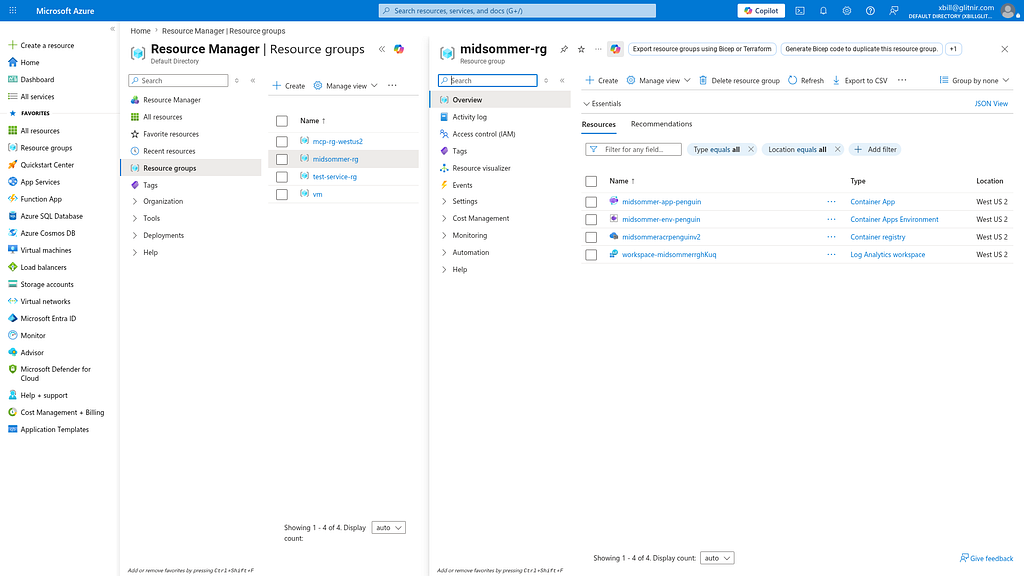
  👉 https://midsommer-app-penguin.jollymoss-b0dba861.westus2.azurecontainerapps.io/
The service will be available on the Azure console:
Rust Code Patterns
Is Rust Overkill for a simple web game? Probably.
The interesting pattern is the matching of Rust + WASM along with some Javascript glue code.
What does Antigravity CLI have to say about this?
> what does the combo of Rust and WASM bring to this project?
  The combination of Rust and WebAssembly (WASM) brings several distinct architectural and execution-level advantages
  specifically tailored to the requirements of this hybrid Flutter/Web game:
  ──────
  ### 1. Jitter-Free 60Hz Physics (Eliminating Garbage Collection)
  • The Challenge: Standard JavaScript games frequently suffer from micro-stuttering or "jitter" because of the
  browser's Garbage Collector (GC) reclaiming memory from expired particles, projectiles, and dead enemies.
  • The Rust + WASM Solution: In lib.rs, all game entities are kept in fixed-size, pre-allocated static
  arrays ( PARTICLES , ENEMIES , PROJECTILES ). Because Rust handles memory directly without a garbage collector
  and WASM operates on a flat, linear memory space, there are zero heap allocations or deallocations during gameplay.
  This guarantees that the physics tick maintains a stable 16.6ms frame budget.
  ### 2. High-Density Simulation Capability
  • At any moment, the game can track:
      • 1,000 active particles (running position updates, damping velocity, and linear array compaction).
      • 100 enemies (processing complex AI routines, state machines, and distance checks).
      • 200 projectiles (testing bounds, collision overlapping, and ticking Area-of-Effect surströmming gas).
  • WASM runs at near-native speed. This execution density allows the physics loop to complete in microseconds,
  leaving the majority of the frame time for the browser's main thread to handle CSS transitions, canvas rendering,
  and procedural audio synthesis.
  ### 3. Inline Zero-Fetch Loading (Base64 JS Module)
  • The Challenge: Traditional WASM deployment requires fetching a .wasm file over the network, which can trigger
  CORS issues, MIME-type mismatches, or file-not-found errors in local mobile webviews (like Flutter's WebViewWidget
  ).
  • The Rust + WASM Solution: The compiled WASM bytecode is serialized directly into a Base64 string inside
  assets/wasm_binary.js . Rust compiles down to a highly optimized, compact binary (using opt-level = "s" as noted
  in Cargo.toml ). This allows the entire physics module to be loaded inline instantly from memory with zero
  additional HTTP network requests.

### 4. Mathematical Determinism Across Platforms

• JavaScript floats can sometimes behave slightly differently depending on the browser engine's JIT implementation
  (V8 on Android, JavaScriptCore on iOS).
  • Because WebAssembly compiles Rust's explicit math logic directly into standard WASM bytecode instructions,
  computations like distance , check_circle_collision , and trigonometric AI angles ( atan2 , cos , sin ) yield
  identical results on any hardware or operating system.

### 5. Clear Separation of Concerns (MVC Boundary)

The combination enforces a strict architectural boundary:

• Rust/WASM (The Model/Simulation): Calculates the absolute state, velocities, damage ticks, AI states, and
  coordinate limits.
  • JavaScript/Canvas (The View/Presentation): Polls the WASM memory buffer, handles touch/keyboard inputs, renders
  sprites onto the HTML5 Canvas, and triggers procedural synthesizers.
  ──────
Run it on the Web!
The current version is now available at:
Midsommer Madness - Swedish Retro Arcade
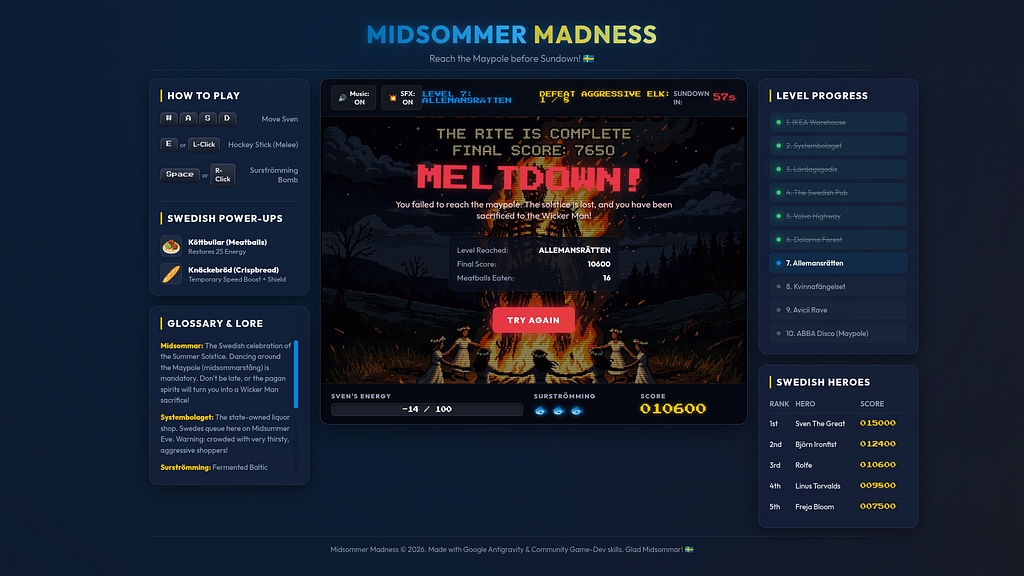
The deployed system will be live on the ACA URL:
Level Design
The key levels include:
- IKEA Warehouse: Battle crowded, flatpack-carrying shoppers who throw box projectiles at you.
- Systembolaget: The state-owned liquor shop crowded with drunk Swedes stumbling and lobbing green beer bottles.
- Lördagsgodis: Sugar rush Saturday! Dodge hyperactive, strung-out Swedish kids throwing sweet candy projectiles.
- The Swedish Pub: Sing along with Frank Zappa fans singing “Bobby Brown” (shouting and firing glowing letters B, O, B, B, Y).
- Volvo Highway: A survival lane-crossing level where…
This is Fun! How do I add my own levels?
Antigravity CLI has full visibility into the game:
> add a godis level where strung out kids throw lordagsgodis ▸ Thought for 2s, 525 tokens Considering Level Placement I will search for level ID checks referencing level 9 in game.js to prepare for adding a 10th level. ● Search(Search for lvl.id === 9 checks) (ctrl+o to expand) I will view lines 495 to 585 in game.js to inspect the current level configurations. ● Read(/home/xbill/midsommer-madness/game.js) (ctrl+o to expand) ▸ Thought for 2s, 1.8k tokens Sequencing the Levels I will view the setLevelAudioMode method in game.js to prepare for adding Level 3 "Lördagsgodis". ● Read(/home/xbill/midsommer-madness/game.js) (ctrl+o to expand) I will update the setLevelAudioMode method in game.js to map the scales and tempos for the 10-level layout. ● Edit(/home/xbill/midsommer-madness/game.js) (ctrl+o to expand) I will view the current level checks in tickSequencer inside game.js to prepare the next set of replacements. ● Read(/home/xbill/midsommer-madness/game.js) (ctrl+o to expand) I will shift the level conditionals in the music sequencer tickSequencer method to accommodate the 10-level progression. ● Edit(/home/xbill/midsommer-madness/game.js) (ctrl+o to expand) I will view lines 920 to 935 of game.js to locate the exact Maypole check in initLevel . ● Read(/home/xbill/midsommer-madness/game.js) (ctrl+o to expand) I will view lines 1060 to 1070 of game.js. ● Read(/home/xbill/midsommer-madness/game.js) (ctrl+o to expand) I will view lines 1290 to 1300 of game.js. ● Read(/home/xbill/midsommer-madness/game.js) (ctrl+o to expand) I will view lines 1360 to 1375 of game.js. ● Read(/home/xbill/midsommer-madness/game.js) (ctrl+o to expand) I will view lines 1370 to 1385 of game.js. ● Read(/home/xbill/midsommer-madness/game.js) (ctrl+o to expand) I will view lines 1460 to 1475 of game.js. ● Read(/home/xbill/midsommer-madness/game.js) (ctrl+o to expand) I will update the level ID checks for the final Maypole level from 9 to 10 and register the candy-throwing kids target name in the HUD. ● Edit(/home/xbill/midsommer-madness/game.js) (ctrl+o to expand) I will view the start of the levels array in game.js to prepare the level insertion edit. ● Read(/home/xbill/midsommer-madness/game.js) (ctrl+o to expand) I will view lines 545 to 585 of game.js. ● Read(/home/xbill/midsommer-madness/game.js) (ctrl+o to expand) ▸ Thought for 3s, 1.2k tokens Refining The Level Design I will update the levels array in game.js to insert Lördagsgodis as Level 3, shift subsequent level IDs, and re-calculate scores. ● Edit(/home/xbill/midsommer-madness/game.js) (ctrl+o to expand) I will view lines 950 to 985 of game.js to locate the spawnEnemy switch statement. ● Read(/home/xbill/midsommer-madness/game.js) (ctrl+o to expand) I will view lines 985 to 1010 of game.js. ● Read(/home/xbill/midsommer-madness/game.js) (ctrl+o to expand) I will add the "kid" case to the spawnEnemy switch block. ● Edit(/home/xbill/midsommer-madness/game.js) (ctrl+o to expand) ▸ Thought for 3s, 2.1k tokens Considering Projectile Design I will search for class ZappaFan in game.js to locate a suitable place to insert CandyKid and Lordagsgodis . ● Search(Search for ZappaFan in game.js) (ctrl+o to expand) I will view lines 2120 to 2145 in game.js. ● Read(/home/xbill/midsommer-madness/game.js) (ctrl+o to expand) I will insert the CandyKid and Lordagsgodis class definitions in game.js right after the Drunkard class. ● Edit(/home/xbill/midsommer-madness/game.js) (ctrl+o to expand) I will view lines 275 to 325 of index.html. ● Read(/home/xbill/midsommer-madness/index.html) (ctrl+o to expand) I will update index.html to add Level 3 Lördagsgodis to the sidebar levels tracker and update levels 4 through 10. ● Edit(/home/xbill/midsommer-madness/index.html) (ctrl+o to expand) I will run a syntax check on game.js using node to ensure the new classes and level configurations are syntax-error free. ● Bash(node -c game.js) (ctrl+o to expand) I will view lines 20 to 45 of game_overview.md to inspect the levels sequence list. ● Read(/home/xbill/.gemini/antigravity-cli/brain/a...2ba-4622-b252-003672e1b73f/game_overview.md) (ctrl+o to expand) I will update game_overview.md to describe the 10-level layout including Lördagsgodis. ● Edit(/home/xbill/.gemini/antigravity-cli/brain/a...2ba-4622-b252-003672e1b73f/game_overview.md) (ctrl+o to expand) I have successfully added the Lördagsgodis level to Midsommer Madness, featuring hyperactive, sugar-rushed children throwing Saturday candy at Sven!
Summary of Changes
- Level Setup ( game.js ): * Inserted Lördagsgodis as game.js in the levels array, shifting following levels up to Level 10 (ABBA Disco). * Updated all final-level check logic throughout game.js from Level 9 to Level 10.
- Added CandyKid & Lordagsgodis Classes ( game.js ):
* Defined game.js and game.js right after the Drunkard class.
* Behavior:
* CandyKid has high speed (1.8), low health (35), and throws sweets rapidly.
* Kids shiver/vibrate rapidly on screen to depict their extreme sugar rush.
* Lordagsgodis are fast-moving candy projectiles (round jelly drops, square sweet gel blocks, and candy
star crosses) that rotate in flight and come in a variety of bright colors. - Music & Audio:
* Modified game.js to include a happy, hyperactive 150 BPM C Major chiptune track for Level 3
(Lördagsgodis).
* Shifted level conditions in game.js to map Levels 8, 9, and 10 to their respective custom chiptune
hooks. - UI & Documentation:
* renumerated the sidebar tracker list in index.html to show the 10-level layout.
* Updated the level progression descriptions in game_overview.md.
We have a Winner!
Midsommer is saved!
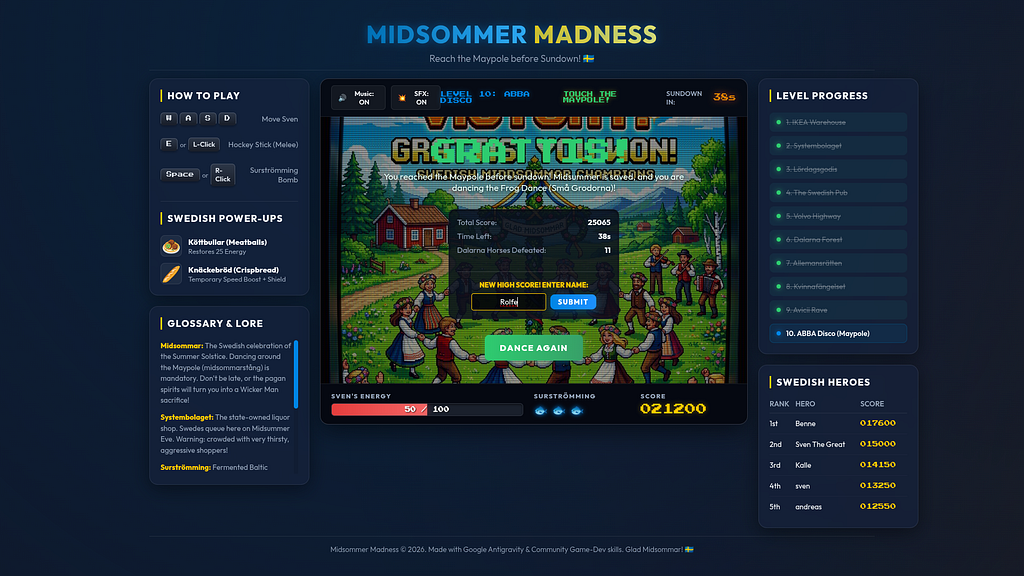
Phew! That was a lot!
This installment covered extending the Midsommer madness app with Rust and WASM to play the web based versions deployed to Azure ACA. Future enhancements under consideration include experimenting with WASM across mobile platforms.
Comments
More Blog
View allaiContext bankruptcy: The case for strategic forgetting for AI Agents
Most of us have seen a coding agent fail to complete a task we know it can do. We just don't...
J
James O'ReillygooglecloudParallel Compliance Engine: Drive-to-Sheets Multi-Agent Orchestration
When building Generative AI applications, developers often encounter a massive bottleneck: sequential...
A
Aryan IranidiscussIs It Ethical to Post and Ask About Circuits on Dev.to?
I’ve been thinking about sharing some electronic circuit posts on Dev.to — small circuits, DIY...
C
codebunny20agentsThe One-Click Exporter: AI Studio Antigravity, Probed to Its Limits
What nobody tells you about exporting your multi-agent prototype to a local workspace. Every...
L
leslysandraagenticarchitectGuarding the till while autonomous data agents do the digging
Autonomous agents are genuinely good at answering messy business questions. Give one an LLM and a set...
S
Sireesha PulipatiaiReturn on Attention: Why AI Code Reviews Are Wearing Us Out
PR volume went up, ticket quality didn't, and the gap got filled with LLMs on both sides of the review: bots reviewing, bots replying, bots occasionally arguing with bots about priorities that only existed in a teammate's head. Our CEO named the actual problem, and it's bigger than code review.
C
christineReady-made automations for this
Workflows from the Neura Market marketplace related to this Stable Diffusion resource
- Interactive n8n Lesson 1: Data Flow, Execution & Debuggingn8n · $12.99 · Related topic
- Debug: Lightweight Node.js & Browser Debugging Utilityn8n · $6.99 · Related topic
- Telegram Echo Bot for Debugging Messagesn8n · $4.99 · Related topic
- Implement Interactive Debugging in n8n with Slackn8n · Free · Related topic