
Back to Blog ai
ai
Layer 1:
 ai
ai googlecloud
 discuss
 agents
 agenticarchitect
 ai
ai
KubeOrchestrator: Autonomous Kubernetes Operations Powered by Antigravity
Ibtissem Hattab July 6, 2026
0 views
How Antigravity's Dynamic Subagents, Isolated Git Worktree Mode, and Declarative Safety Policies come together to build a production-grade, autonomous Kubernetes operations platform.
description: "How Antigravity's Dynamic Subagents, Isolated Git Worktree Mode, and Declarative Safety Policies come together to build a production-grade, autonomous Kubernetes operations platform."
TL;DR — Single-agent LLMs struggle with the scale and complexity of real Kubernetes environments. KubeOrchestrator is a reference architecture that demonstrates how Antigravity's core capabilities Dynamic Subagents, Isolated Git Worktree Mode, Declarative Safety Policies, and /goal execution work together to enable safe, autonomous Kubernetes operations. This article explains how each architectural layer maps directly to an Antigravity feature.
Why Autonomous Kubernetes Needs a New Architecture
Single-agent LLMs hit context ceilings fast on real Kubernetes clusters. KubeOrchestrator is a reference architecture that shows how Antigravity's orchestration primitives Dynamic Subagents, Isolated Git Worktree Mode, Declarative Safety Policies, and /goal execution can power a genuinely autonomous, enterprise-safe operations platform. Every architectural decision maps to a specific Antigravity feature. This article walks through all of them.
The Problem with Single-Agent LLM Operations
Ask any platform engineer who has tried to bolt an LLM onto Kubernetes operations and they will tell you the same story. The first demo looks impressive. A single prompt reads cluster state, proposes a patch, and applies it. Everyone nods.
Then you try it in production.
Real cluster state is too large, too multi-dimensional, and too concurrent for a single context window. You need to reason about Prometheus metrics, kubectl patches, resource cost analysis, and OPA policy compliance simultaneously, across multiple repositories, without any single agent losing the thread. Flat prompts saturate. Context spills. The agent hallucinates a patch it has never seen.
The solution is not a smarter prompt. It is a different architecture entirely.
Introducing KubeOrchestrator
KubeOrchestrator is a reference architecture for autonomous Kubernetes operations built on top of Antigravity. Rather than a single LLM reacting to cluster events, it deploys a tree of isolated, purpose-built agents each scoped to a single concern, running in parallel, and gated behind enterprise-grade safety controls before touching any live infrastructure.
The project targets platform engineers and cloud architects who need to move beyond "AI-assisted" tooling into genuinely autonomous operations without sacrificing auditability, cost control, or system integrity.
The entry point is a single natural-language command:
/goal Optimise namespace production for cost by 30%
What happens next is the architecture.
The Architecture, Layer by Layer
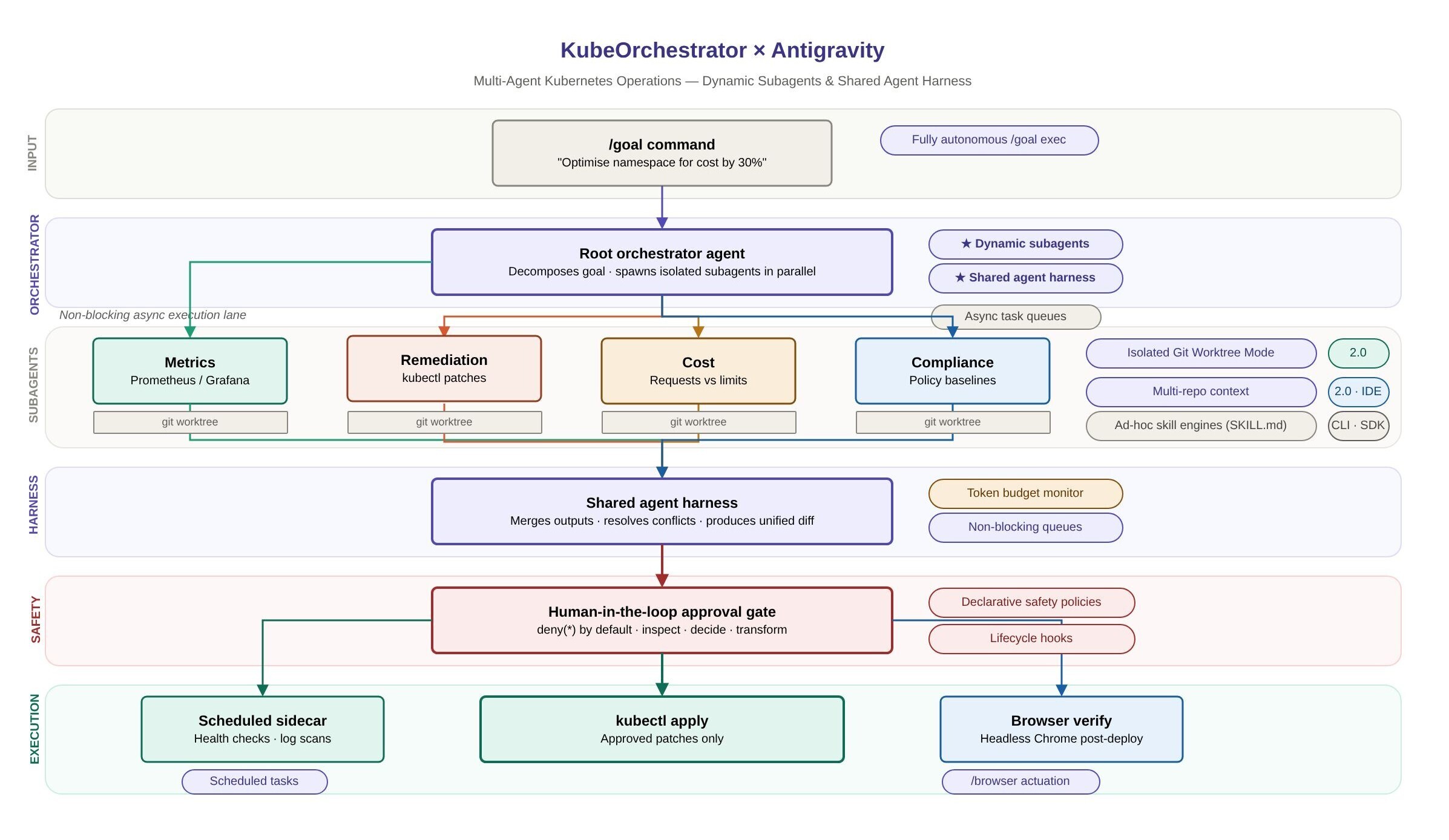
Layer 1: /goal — Fully Autonomous Goal Execution
Everything starts with Antigravity's /goal command. This is not a one-shot prompt. It is an execution mode that commands the engine to run iteratively until a complex task is verified complete without intermediate prompts from the operator.
In KubeOrchestrator, /goal is the contract between the operator and the system. You state the outcome. The orchestrator figures out the plan.
Antigravity feature: Fully Autonomous Goal Execution (/goal)
Layer 2: Root Orchestrator — Dynamic Subagents & Shared Agent Harness
The root orchestrator receives the /goal and immediately does two things: it decomposes the goal into parallel workstreams and spawns an isolated child agent for each one.
This is the core Antigravity pattern Dynamic Subagents. Each subagent is short-lived, scoped to a single concern, and runs in its own isolated context window. There is no shared state between them at spawn time. Context saturation is structurally impossible because no single agent ever holds the full problem space.
# Four subagents spawned in parallel no shared context
results = await asyncio.gather(
    metrics_agent(namespace, monitor),
    remediation_agent(findings, namespace, monitor),
    cost_agent(namespace, monitor),
    compliance_agent(namespace, monitor),
)
The Shared Agent Harness is the coordination layer. It waits for all subagents to complete, merges their outputs, resolves conflicts (duplicate patches for the same manifest are deduplicated automatically), and surfaces a single unified diff to the operator. No subagent ever writes directly to production. The harness is the only path to execution.
Antigravity features: Dynamic Subagents, Shared Agent Harness
Layer 3: Subagents — Isolated Git Worktree Mode
Each of the four subagents has a specific role:
- Metrics Agent — queries Prometheus and Grafana, identifies CPU and memory waste percentages and the top offending pods
- Remediation Agent — generates
kubectlresource patches targeting those pods - Cost Agent — models current spending against resource requests vs. limits and projects monthly savings
- Compliance Agent — runs OPA policy evaluation against all proposed changes before they leave the subagent context
The critical safety detail: every subagent operates inside an Isolated Git Worktree. It stages all changes to its own sandboxed branch. No agent ever mutates live manifests directly. The worktree is the blast radius boundary.
class GitWorktree:
    def __post_init__(self):
        self.branch = f"agent/{self.agent_name}/{int(time.time())}"
        # Each subagent gets its own isolated branch

    def stage_patch(self, manifest: str, change: dict):
        # Changes are staged here never applied directly
        patch = {"manifest": manifest, "change": change, "branch": self.branch}
        self.patches.append(patch)
Antigravity feature: Isolated Git Worktree Mode
Layer 4: Parallel Execution — Non-Blocking Async Task Queues
The four subagents do not run sequentially. They run concurrently via Antigravity's Non-Blocking Asynchronous Task Queues. The main orchestrator thread stays responsive while each subagent executes its own compile, query, and analysis cycles independently.
This matters operationally. A metrics query against a large Prometheus instance can take seconds. A compliance check against a complex OPA policy set takes time too. Running them serially would make the system impractically slow for production use. Running them in parallel via async task queues means total execution time is bounded by the slowest subagent, not the sum of all of them.
Antigravity feature: Non-Blocking Asynchronous Task Queues
Layer 5: Cross-Repository Context
Kubernetes operations never live in a single repository. In a realistic enterprise environment the infrastructure definitions, application manifests, and policy baselines all live in separate repos with separate ownership and separate CI pipelines.
Antigravity's Multi-Folder Cross-Repository Project Context allows the orchestrator to hold parallel context across all three simultaneously. The Compliance Agent can check the policy repo. The Remediation Agent can patch the app manifest repo. The Cost Agent can read the infrastructure repo. All in the same orchestration run, without the context boundaries collapsing.
Antigravity feature: Multi-Folder Cross-Repository Context
Layer 6: SKILL.md Engines — Ephemeral Tool Packs
KubeOrchestrator does not ship a monolithic tool layer. Instead it uses Antigravity's Serverless Ad-hoc Skill Execution Engines directory-based SKILL.md packages that spin up ephemeral instruction sets for specific tools without persistent server runtimes.
For this architecture, three skill packs are loaded on demand:
| Skill | Version | Used by |
|---|---|---|
kubectl | 1.29 | Remediation Agent, final apply |
helm | 3.14 | Infrastructure patching |
opa | 0.63 | Compliance Agent policy evaluation |
class SkillEngine:
    @classmethod
    def run(cls, skill: str, verb: str, args: str) -> dict:
        spec = cls.load(skill)   # ephemeral load — no persistent runtime
        return {"tool": skill, "verb": verb, "args": f"{verb} {args}"}
Each skill pack is loaded when needed and discarded after use. No persistent daemon. No version lock-in across the cluster.
Antigravity feature: Serverless Ad-hoc Skill Execution Engines
Layer 7: The Safety Gate — Declarative Safety Policies & Lifecycle Hooks
This is the layer that makes enterprise architects comfortable signing off on autonomous operations.
Every command produced by the harness must pass through the Declarative Safety Gate before execution. The gate operates on a deny(*) by default model nothing executes unless it is explicitly permitted. Three lifecycle hook phases run in sequence for every command:
- Inspect — does this policy apply to this command?
- Decide — ALLOW, DENY, or TRANSFORM?
- Transform — rewrite the command before execution (e.g. strip
--forceflags automatically)
# deny(*) by default — destructive operations blocked outright
SafetyPolicy(
    name="deny-destructive-kubectl",
    inspect=lambda cmd: cmd.get("tool") == "kubectl" and
                       any(op in cmd.get("args", "") for op in ["delete", "drain", "cordon"]),
    decide=lambda cmd: Decision.DENY,
)

# strip --force automatically via TRANSFORM hook
SafetyPolicy(
    name="strip-force-flag",
    inspect=lambda cmd: "--force" in cmd.get("args", ""),
    decide=lambda cmd: Decision.TRANSFORM,
    transform=lambda cmd: {**cmd, "args": cmd["args"].replace("--force", "").strip()},
)
The key design principle: the safety boundary sits below the automation layer. The system can reason and plan freely. Execution is always gated.
Antigravity feature: Declarative Safety Policies & Lifecycle Hooks
Layer 8: Human-in-the-Loop Approval Gate
For any kubectl apply that would mutate live cluster state, the system pauses and polls for operator confirmation before proceeding. This is Antigravity's Interactive Human-in-the-Loop Approval Gate a programmatic pause mechanic via SDK hooks that creates an escrow architecture around shell execution.
No patch ever touches the cluster without a human seeing the unified diff first. The gate is not optional and is not bypassable by the orchestrator.
Antigravity feature: Interactive Human-in-the-Loop Approval Gates
Layer 9: Token Budget Monitor — The Kill-Switch
Autonomous agents in long-running reconciliation loops can degrade. A misconfigured agent can loop indefinitely, burning tokens and producing nothing useful. Antigravity's Zero-Overhead Token Budget & Accumulation Monitor tracks per-turn and cumulative token usage in real time, with a programmable kill-switch that halts execution the moment a budget is exceeded.
class TokenBudgetMonitor:
    def consume(self, tokens: int, label: str = ""):
        self.used += tokens
        if self.used > self.max_tokens:
            raise TokenBudgetExceeded(
                f"Kill-switch triggered: {self.used} tokens exceeds budget"
            )
In the KubeOrchestrator demo run, the full pipeline four parallel subagents, harness merge, safety evaluation, apply, browser verification, and sidecar consumed 4,050 tokens out of a 20,000 budget. That is the kind of cost engineering that makes autonomous operations viable at scale.
Antigravity feature: Zero-Overhead Token Budgets & Accumulation Monitors
Layer 10: Scheduled Sidecar — Headless Background Operations
KubeOrchestrator is not just an on-demand tool. It is also a continuous headless sidecar. Using Antigravity's Scheduled Tasks and Uncoupled Projects, routine operations health checks, log scans, cost drift detection run on a cron schedule without keeping any GUI open.
This is the shift in Antigravity's value proposition that matters most for enterprise adoption. It moves the product from "a desktop coding utility" to "a platform for continuous, headless engineering operations."
Antigravity feature: Scheduled Tasks & Uncoupled Projects
Layer 11: Browser Actuation — Post-Deploy Verification
After patches are applied, KubeOrchestrator does not stop at kubectl apply. It fires Antigravity's /browser command, which maps agent tool usage to a headless Chrome instance and verifies the post-deploy UI state of any affected services.
[BrowserActuator] /browser verify https://production.internal/health
[BrowserActuator] ✓ 200 OK  |  7 assertions passed  |  Visual regression: False
This closes the loop. The agent does not just apply changes it verifies they produced the intended outcome.
Antigravity feature: Continuous Verification & Browser Actuation
The Full Sample Output
Run python kubeorchestrator_demo.py and this is what you get:
════════════════════════════════════════════════════════════
  /goal  Optimise namespace production for cost by 30%
  namespace: production
════════════════════════════════════════════════════════════

[ Step 1 ] Spawning isolated subagents in parallel...

  [MetricsAgent]     → CPU waste: 67%  |  Memory waste: 43%
  [RemediationAgent] → Staged 3 resource patches
  [CostAgent]        → Projected savings: $228/mo (67% reduction)
  [ComplianceAgent]  → Policy violations: 0  |  Warnings: 1

[ Step 2 ] Shared Agent Harness: merging outputs...
  → Unified diff ready: 3 patches across 4 subagent workstreams

[ Step 3 ] Safety Gate evaluation...
  → Policy 'require-approval-for-apply' → allow

[ Step 4 ] Human-in-the-loop approval gate...
  → Operator approval: ✓

[ Step 5 ] Applying approved patches...
  → Applied 3 patches to namespace 'production'
  → Projected savings: $228/mo

[ Step 6 ] Post-deploy browser verification...
  → ✓ 200 OK  |  7 assertions passed  |  Visual regression: False

[ Step 7 ] Scheduled sidecar: post-apply health check...
  → Health check complete — no critical issues detected

════════════════════════════════════════════════════════════
  /goal  COMPLETE
  Tokens used: 4,050 / 20,000  (7 turns)
════════════════════════════════════════════════════════════
Antigravity Feature Coverage Map
Every architectural decision in KubeOrchestrator maps to a specific Antigravity capability:
| Architecture Layer | Antigravity Feature | Product |
|---|---|---|
/goal entry point | Fully Autonomous Goal Execution | 2.0, CLI |
| Root orchestrator | Dynamic Subagents | 2.0, SDK |
| Subagent coordination | Shared Agent Harness | 2.0, SDK |
| Sandboxed changes | Isolated Git Worktree Mode | 2.0 |
| Concurrent execution | Non-Blocking Async Task Queues | 2.0, SDK, IDE |
| Multi-repo awareness | Cross-Repository Project Context | 2.0, IDE |
| kubectl/Helm/OPA | Ad-hoc Skill Execution Engines | CLI, SDK |
| Safety enforcement | Declarative Safety Policies | SDK |
| Runtime interception | Lifecycle Hooks | 2.0, SDK |
| Operator confirmation | Human-in-the-Loop Approval Gates | 2.0, SDK |
| Cost control | Token Budget Monitor | SDK |
| Continuous operations | Scheduled Tasks & Uncoupled Projects | 2.0 |
| Post-deploy checks | Browser Actuation (/browser) | 2.0, IDE |
12 features. 12 covered. This architecture is not a showcase of one or two Antigravity capabilities — it is a reference implementation of the entire enterprise feature surface.
Why This Architecture Matters
There is a pattern in enterprise AI adoption. Teams start with a single-agent assistant, hit context limits, add more context, hit the limits again, and conclude that LLMs are not ready for production infrastructure operations. They are right but the conclusion is wrong.
The problem is not LLMs. The problem is the architecture. A single flat context window was never the right model for distributed infrastructure. The right model is the one Kubernetes itself uses: declare the desired state, decompose into specialised controllers, enforce policy at the boundary, and verify continuously.
KubeOrchestrator applies exactly that model to AI-driven operations. The agents are the controllers. The harness is the reconciliation loop. The safety gate is the admission webhook. The token budget monitor is the resource quota.
Antigravity provides every primitive needed to build this. The question is not whether autonomous Kubernetes operations are possible. It is whether your architecture is ready for them.
Getting Started
To run the demo on Colab:
# Python 3.11+ required
https://github.com/ihattab/KubeOrchestrator/blob/main/KubeOrchestrator.ipynb
No dependencies beyond the standard library. The sample is self-contained and fully annotated every class maps directly to an Antigravity architectural primitive described in this article.
Built as part of the Agentic Architect Sprint a deep-dive into Antigravity's enterprise orchestration capabilities for platform engineers and cloud architects.
Tags: #AgenticArchitect #GoogleAntigravity #kubernetes #ai #devops #cloudnative #antigravity #mlops #platformengineering
Comments
More Blog
View allaiContext bankruptcy: The case for strategic forgetting for AI Agents
Most of us have seen a coding agent fail to complete a task we know it can do. We just don't...
J
James O'ReillygooglecloudParallel Compliance Engine: Drive-to-Sheets Multi-Agent Orchestration
When building Generative AI applications, developers often encounter a massive bottleneck: sequential...
A
Aryan IranidiscussIs It Ethical to Post and Ask About Circuits on Dev.to?
I’ve been thinking about sharing some electronic circuit posts on Dev.to — small circuits, DIY...
C
codebunny20agentsThe One-Click Exporter: AI Studio Antigravity, Probed to Its Limits
What nobody tells you about exporting your multi-agent prototype to a local workspace. Every...
L
leslysandraagenticarchitectGuarding the till while autonomous data agents do the digging
Autonomous agents are genuinely good at answering messy business questions. Give one an LLM and a set...
S
Sireesha PulipatiaiReturn on Attention: Why AI Code Reviews Are Wearing Us Out
PR volume went up, ticket quality didn't, and the gap got filled with LLMs on both sides of the review: bots reviewing, bots replying, bots occasionally arguing with bots about priorities that only existed in a teammate's head. Our CEO named the actual problem, and it's bigger than code review.
C
christineReady-made automations for this
Workflows from the Neura Market marketplace related to this Stable Diffusion resource
- AI-Powered Autonomous Research Workflow for Content Monetizationn8n · $4.52 · Related topic
- Autonomous Vehicle Log Summarizer: Streamlining Vehicle Data Managementn8n · $4.91 · Related topic
- Autonomous AI Crawler for Financial Insightsn8n · $4.76 · Related topic
- AI-Powered Autonomous Deep Research Workflown8n · $24.99 · Related topic