
Back to Blog ai
ai ai
ai googlecloud
 discuss
 agents
 agenticarchitect
 ai
ai
A New Developer Platform for Agent-Human Collaboration
Rizèl Scarlett July 8, 2026
0 views
We've entered a new coding paradigm. Agents can now generate full features at a pace that outstrips...
We've entered a new coding paradigm. Agents can now generate full features at a pace that outstrips traditional engineering workflows, but the systems we use to review, understand, and ship software still assume humans wrote every line.
For decades, the software development lifecycle was paced by human comprehension. Teams had time and mental bandwidth to align on implementation, intent, and quality before code reached production.
AI-assisted coding changes that balance. Code generation has accelerated, but the diff still does not carry the reasoning, tradeoffs, or intent that shaped it.
According to data from Cursor, PRs are 3x bigger than they were 18 months ago! Consequently, developers resort to rubber-stamping agent-generated code with little understanding or accountability. As ownership erodes, codebases accumulate hidden risks, and poor-quality software inevitably slips into production.
And human cognition isn't the only system under strain.
As coding agents create more branches, commits, clones, pushes, and automated workflows, today's Git infrastructure is hitting limits it was never designed around. Rate limits, latency, and outages are becoming part of the developer experience.
It's time to rebuild the software development lifecycle for human-to-agent collaboration.
Today we're launching an entirely new Git network, built for agent scale. The Entire Developer Platform is now in public preview: an open-core, agent-agnostic, distributed Git-hosting platform built to restore comprehension, traceability, and intent to how teams review and ship code.
But wait, what is Entire?
Let's take a step back. Entire is a CLI-first system of record that captures the context behind agent-assisted code changes and links it to Git. In other words, whenever you commit changes from your agent, Entire automatically captures:
- Your prompts
- The agent's response
- The full transcript
- Files the agent inspected
- Tools it ran
- Decisions it made
This helps you review, search, share, and continue agent work with confidence. This means if something goes wrong in production, you don't have to say, "I don't know. The agent did it." For example, Entire allows you to run commands such as:
entire search: search not just your code history, but the prompts and reasoning behind it. "Why did we add this workaround?" is finally an answerable question.entire blame: likegit blame, but for why. Surface the session, prompt, and decision behind any line, not just who last touched it.entire review: send a branch to multiple agents in parallel and get a review grounded in the actual sessions and intent behind the diff, not just the syntax./session handoff: move work from one agent to another with the full session state carried forward, so the new agent doesn't rebuild context from scratch.
We're Launching: An Entirely New Git-Hosting Network
All of that context lives in your repo. But your repo still lives on infrastructure that struggles to support your agents. That's what we're fixing today.
Starting today, you can mirror your public or private GitHub repositories onto Entire's distributed Git network.
Here's how it works: your repo stays on GitHub, and you keep pushing exactly like you do now. Commands like git clone, git fetch, and git push all work exactly as they always have. Behind the scenes, Entire syncs your changes into a read-optimized copy in the region you choose. Your coding agents clone and fetch from that regional Entire mirror, which absorbs the heavy, concurrent read traffic, so they run fast without hitting the origin repo's rate limits. And when we say fast, we mean it.
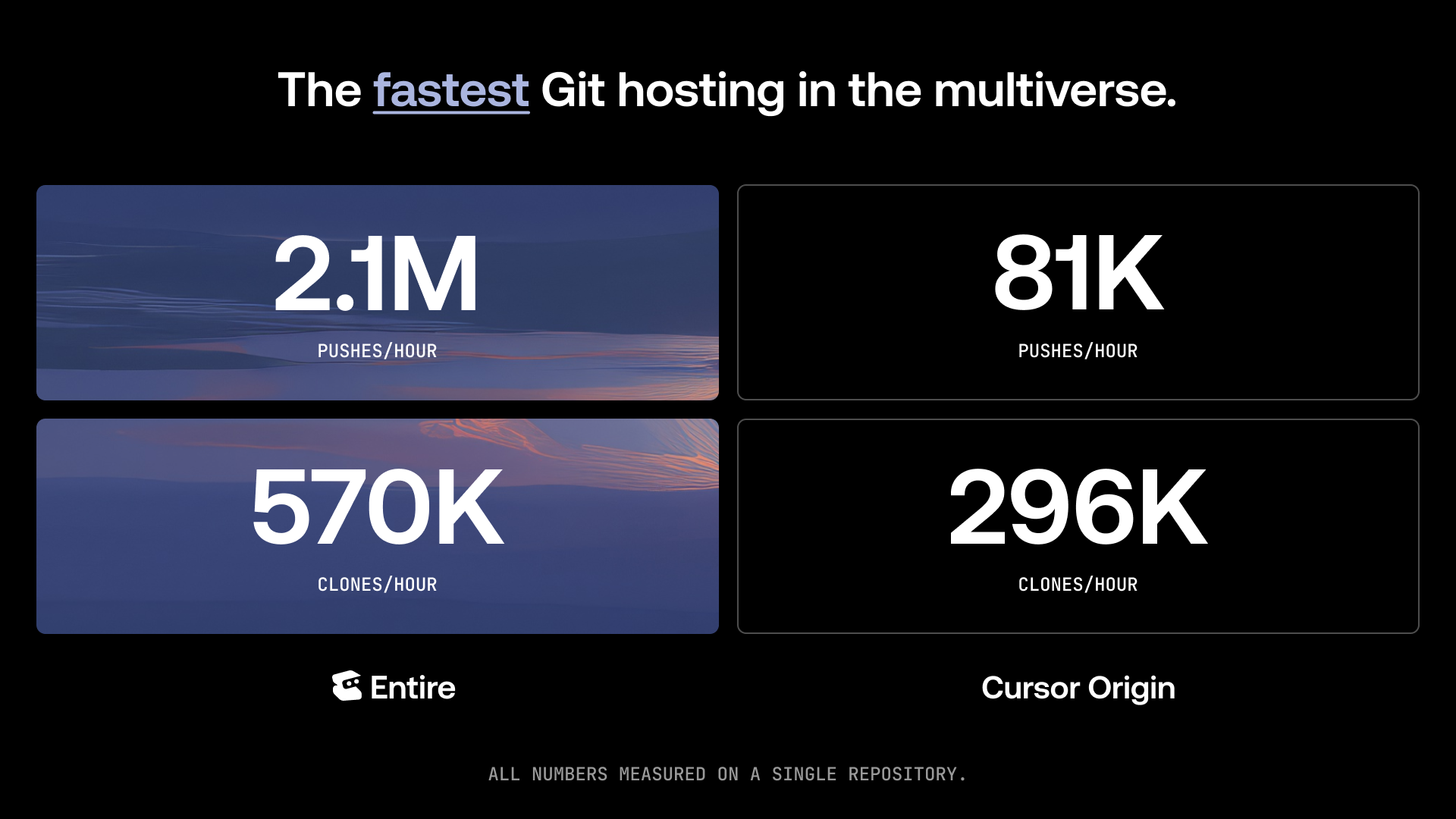
We benchmarked the network under agent-fleet load patterns, and here's what it sustained:
- ~570,000 clones per hour from a single repository
- 586 pushes per second (about 2.1 million per hour)
- ~470 clone + push operations per second on a single repo, at 50 to 60 ms p50 latency, simulating the real loop agents actually run: clone, push, repeat
We measured all of this with ForgeMark, an open source benchmarking tool we're also releasing today, so you can run the numbers yourself.
How to Mirror Your Repos
# 1. Install the Entire GitHub App: https://github.com/apps/entire

# 2. Install the CLI and log in
curl -fsSL https://entire.io/install.sh | bash
entire login

# 3. Create your mirror (interactive: pick repos, pick regions)
entire repo mirror create

# 4. Clone from your regional mirror
entire repo clone /gh/OWNER/REPO
Under the hood, Entire runs distributed nodes across multiple regions and jurisdictions, with our first active cells in the US, EU, and Australia. You pin your data to the region you choose, reads get served from the cell closest to your agents, and writes are replicated across multiple providers and availability zones so your repos stay available even if a node goes down.
We're rolling users off the waitlist progressively starting today, aiming for full capacity in the coming weeks.
Tune In
Our CEO Thomas Dohmke is speaking at WeAreDevelopers World Congress about why Git hosting needs to change and what we're building next. The talk streams live on Thursday, July 9th at 9:30 am CEST (3:30 am ET for the night owls):
{% embed https://www.youtube.com/watch?v=eSoHzgrhk6Q %}
What's Next
This launch is only the beginning of what's to come! Here's what's on the horizon:
- Native repos: public and private repositories hosted directly on Entire's network, no GitHub required
- Multi-region mirroring for a single repo
- Intent-based review: a developer lifecycle where reviewers start with the prompt and the reasoning, not a 500-line diff
- Open sourcing more of Entire. (Our CLI is already open source!)
- Full decentralization, including self-hosting, so no single company (us included) sits at the center of how the world's software is hosted. We recognize that Git was designed to be decentralized, but we traded that for convenience. We're making a committed effort to build our way back to that original promise without giving up the convenience.
Join the Rebellion
Sign up for the waitlist, and while you wait:
- 📚 Read the docs to go deeper on mirroring and the CLI
- 💬 Join our Discord and tell us what works, what breaks, and what you want next
- 🐦 Follow @EntireHQ for updates as we roll out
And because no launch is complete without him, meet our lovable, sarcastic, robot mascot, Marvin:
{% embed https://www.youtube.com/watch?v=2UDXavEqkog %}
Comments
More Blog
View allaiContext bankruptcy: The case for strategic forgetting for AI Agents
Most of us have seen a coding agent fail to complete a task we know it can do. We just don't...
J
James O'ReillygooglecloudParallel Compliance Engine: Drive-to-Sheets Multi-Agent Orchestration
When building Generative AI applications, developers often encounter a massive bottleneck: sequential...
A
Aryan IranidiscussIs It Ethical to Post and Ask About Circuits on Dev.to?
I’ve been thinking about sharing some electronic circuit posts on Dev.to — small circuits, DIY...
C
codebunny20agentsThe One-Click Exporter: AI Studio Antigravity, Probed to Its Limits
What nobody tells you about exporting your multi-agent prototype to a local workspace. Every...
L
leslysandraagenticarchitectGuarding the till while autonomous data agents do the digging
Autonomous agents are genuinely good at answering messy business questions. Give one an LLM and a set...
S
Sireesha PulipatiaiReturn on Attention: Why AI Code Reviews Are Wearing Us Out
PR volume went up, ticket quality didn't, and the gap got filled with LLMs on both sides of the review: bots reviewing, bots replying, bots occasionally arguing with bots about priorities that only existed in a teammate's head. Our CEO named the actual problem, and it's bigger than code review.
C
christineReady-made automations for this
Workflows from the Neura Market marketplace related to this Stable Diffusion resource
- Automated AI Video Summarization for Enhanced Team Collaborationn8n · $19.99 · Related topic
- Automate Slack Message Scheduling for Enhanced Team Collaborationn8n · $19.21 · Related topic
- Streamline PDF Processing with Adobe Developer API Workflown8n · $16.81 · Related topic
- Automate Content Collaboration with GitHub and n8nn8n · $15.99 · Related topic