
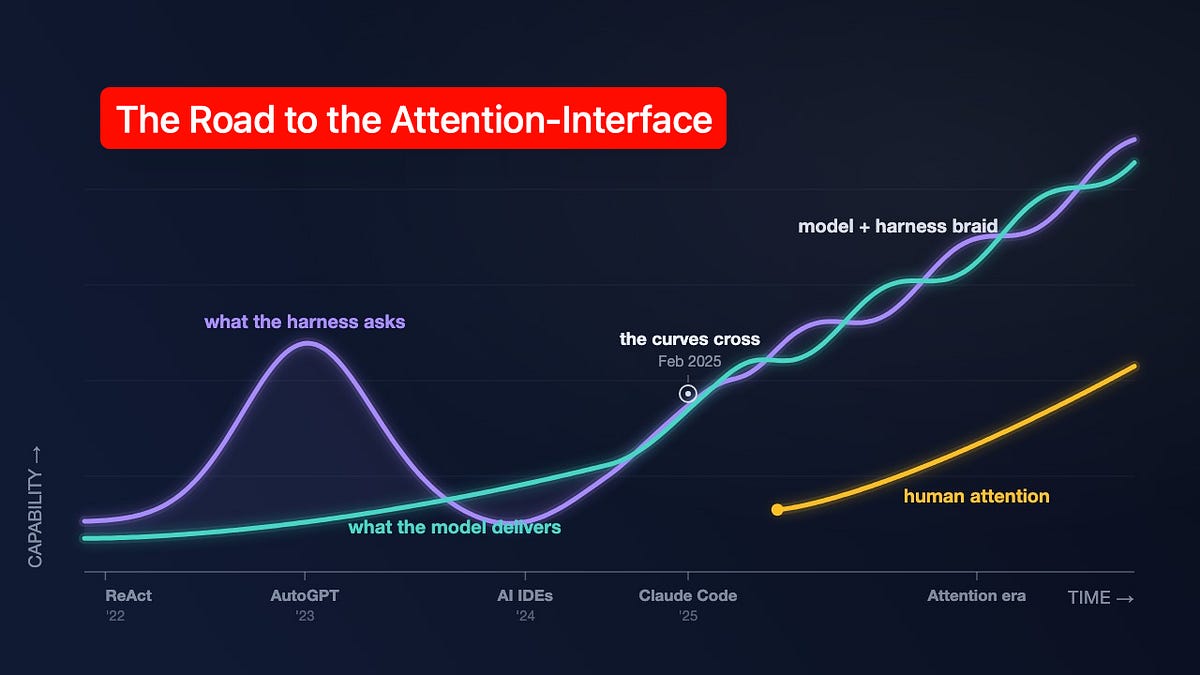
The agents that suddenly started working around Christmas 2025 were not the product of a single breakthrough. They were the result of two curves finally crossing: model capability and agent harness maturity. The harness, the invisible scaffolding of tools, context, and guardrails that turns a raw model into an agent, is now being absorbed into the models themselves. And the next phase, according to agentic engineer Dan McAteer, will turn the harness into something entirely different: an interface for human attention.
McAteer, who writes the "Attention Heads" essays, published the analysis as a guest post on Latent.Space on August 22, 2026. His central claim is that the harness is the key to understanding agent improvement. Without a harness, a model is a "brain in a vat." The harness gives it perception through context, action through tools, persistence through memory and compaction, and boundaries through permissions and guardrails. The gap between what the harness demands and what the model can do equals agent effectiveness. When that gap closes, agents work. When it widens, they fail.
The Bolt-On Era: When the Harness Ran Ahead
The history of agent harnesses begins before ChatGPT existed. The ReAct prompting technique, introduced in October 2022, predates the chatbot by one month. ReAct established the loop that still defines agentic behavior: reason, act, observe, repeat. At the time, it was a clever prompt pattern, not a product. ChatGPT, released in November 2022, had no tools, no search, and no reasoning. It was a brain in a vat with only next-token prediction and RLHF.
The harness curve and the model curve evolved separately at first. In February 2023, Meta's Toolformer hinted at a different path: training tool use into model weights rather than prompting for it. That was the seed of absorption. But the spring of 2023 brought a wave of premature autonomy. AutoGPT and BabyAGI gave models full autonomy before the models could handle it. The agentic loop amplifies capability, but below a capability threshold, it amplifies errors instead.
The math is brutal. At 95% reliability per step over a 20-step task, the average success rate drops to roughly 36%. That is not a usable agent. The loop amplifies every small mistake into a cascading failure. AutoGPT and BabyAGI failed because they were harnesses ahead of model capability. They demanded more than the models could deliver.
The industry noticed. From 2023 to 2024, Cursor and Copilot retreated to a human-in-the-loop approach. That retreat was correct, not cowardly. It was the only way to build useful tools when models could not yet sustain long autonomous chains. Devin, the autonomous coding agent, suffered the same problem. Answer.AI tested the first version and found a success rate of roughly 15%. The harness was asking for autonomy the model could not provide.
The Crossover: o1, Claude Code, and the Christmas Jump
The inversion came in late 2024. OpenAI's o1, the first reasoning model, marked the beginning of capability overhang. For the first time, the model could do more than the harness asked of it. The gap flipped. The harness was no longer the bottleneck. The model was ready for more.
Claude Code, launched in February 2025, was the first agent to seize the crossover opportunity. Boris Cherny, who built Claude Code, designed it with future model capabilities in mind. The agent abandoned the IDE for the terminal, gave the model bash and file read/write access, and used permission rules to keep it bounded. It worked. Claude Code reached roughly $1 billion in annual recurring revenue within six months of launch.
The harness and model curves had braided. By May 2025, OpenAI's codex-1 release announcement made the shift explicit. As the announcement stated, "codex-1 was trained using reinforcement learning on real-world coding tasks in a variety of environments." Reinforcement learning had moved inside the harness. Models were no longer being prompted to use tools. They were being trained to use them.
The jump that everyone noticed around Christmas 2025 is hard to attribute to any single cause. Lukasz Kaiser, co-inventor of the Transformer, said as much in a June 2025 interview on "Unsupervised Learning": "The change last winter, last Christmas, it's a little hard to pin down. I mean, the harness changed and a little post-training changed and then new pre-trained models came… but it felt like a big jump which is not that easy to pin down what did it."
Kaiser's difficulty is the point. The improvement was not one event. It was a co-evolution. The harness matured, post-training improved, and new pre-trained models arrived, all at once. The convergence produced a qualitative shift. Agents started to work noticeably better, not because of any single breakthrough, but because the two curves finally crossed.
Absorption: When the Harness Dissolves Into the Model
The pattern is now clear. McAteer describes it as a loop: train, absorb, shed, repeat. Models train on harness behaviors, absorb those behaviors into their weights, and then the harness can shed the parts that are no longer needed. The pace of harness evolution is measured by how much you can delete while retaining capability.
The evidence is strong. Harness-Bench, a benchmark for agent harnesses, ran the same model over 106 tasks in different harnesses. The scores ranged from 52.4 to 76.2, a spread of 23.8 points. The same model, the same tasks, and wildly different results based solely on the harness. That spread is the harness's contribution. It is also the harness's vulnerability. Anything the harness can add, the model can eventually learn.
The absorption is already happening. GPT-5.6 Sol's ARC-AGI-3 score tripled from 13.3% to 38.3% with retained reasoning and compaction. That is not a new model. That is the same model with a better harness, or rather, a harness that had been partially absorbed. The model gained capability because the harness stopped wasting its context and reasoning budget.
OpenAI's GPT-5.1-Codex-Max pushed absorption further. It was, as the company described it, "The first model natively trained to operate across multiple context windows through compaction." The model no longer needs the harness to manage memory. It does that natively, in its weights. The harness's persistence function is being absorbed.
Anthropic is shedding too. Thariq Shihipar, an Anthropic team member, reported that the team deleted 80% of Claude Code's system prompt. The model no longer needed all those instructions. It had absorbed them. The harness got lighter, and the agent got better. That is the loop working as intended.
The future absorption candidates are predictable: multi-agent orchestration, tool selection, and memory. These are currently harness functions. They will become model functions. The harness will shed them, and the models will be better for it.
Stay ahead of the AI curve
The most important updates, news, and content — delivered weekly.
No spam. Unsubscribe anytime.
The Attention Era: The Harness Becomes a Human Interface
Not everything can be absorbed. Permissions, identity, trust, and legibility are human-centric capabilities. They will not dissolve into model weights. Instead, they will invert the harness. The harness will stop being an interface to the model and become an interface to human attention.
The reasoning is simple. Human attention is the only fundamentally scarce resource in the loop. Ryan Lopopolo, speaking on the Latent Space podcast episode "Extreme Harness Engineering for Token Billionaires," put it directly: "The only fundamentally scarce thing is the synchronous human attention of my team."
Models are cheap. Compute is cheap. Harnesses are getting cheaper as models absorb them. But a human sitting at a desk, deciding whether to approve an agent's action, is expensive and finite. The harness's job will shift from managing the model to managing that human attention.
Anthropic is already working on the pieces. The company is building agent progress files and agentic approval queues. These are early versions of what McAteer calls an attention-interface. The harness will govern interruptions, decide when the agent should keep working, and determine which decisions need human approval. It will be a policy surface for attention, not a technical scaffold for the model.
The precedent already exists. AGENTS.md, the file format for agent instructions, is a primitive version of this idea. McAteer predicts that within a year of publication, every agentic AI company will ship a human attention policy surface, something like AGENTS.md but for attention. The prediction is bold but plausible. The pieces are already in motion.
The attention-interface will be learnable. Every correction a human makes becomes useful data for the interface. Each time a human overrides an agent, the interface learns when to ask and when to stay silent. The harness becomes a filter for human attention, deciding what deserves it and what does not.
The Gap Migrates: From Model to Human
The shift has a deeper implication. The gap between model and harness is closing. The gap between agent and human is opening. As models absorb harness capabilities, the bottleneck moves. It stops being about what the model can do and starts being about what the human can attend to.
McAteer's metaphor is striking. The brain in a vat gains a body, and then the body dissolves into the brain. The harness builds the model out, gives it tools and memory and boundaries, and then the model absorbs all of it. What remains is not a technical scaffold but a human interface. The harness becomes the place where human attention meets agent action.
The three-stage evolution is clear. The Bolt-On Era, from ReAct in October 2022 through the premature autonomy of 2023, bolted capabilities onto models that could not yet use them. The Co-Training Era, from o1 in late 2024 through codex-1 and GPT-5.1-Codex-Max, trained harness behaviors into model weights. The Attention Era, now beginning, will turn the harness into an interface for human attention.
The practical implications for engineers are direct. Build towards deletion. The measure of progress is how much you can remove from the harness while keeping capability. If a prompt can be absorbed into the model, absorb it. If a tool can be trained into the weights, train it. The harness should be shrinking, not growing.
The parts that remain will be the human parts. Permissions, identity, trust, and legibility will not be absorbed because they are not model functions. They are human functions. The harness will mediate them. It will decide when to interrupt, when to ask, and when to proceed. It will learn from every correction.
The Christmas 2025 jump was the moment the curves crossed. The next jump will be the moment the harness stops being about the model and starts being about the human. The agents that worked so well last winter were the product of convergence. The agents that will work even better next year will be the product of attention management.
McAteer's analysis suggests a strange conclusion. The harness is not disappearing. It is becoming something else. It is becoming the interface through which scarce human attention is allocated to abundant machine capability. The brain in a vat got a body, and now the body is becoming a lens.
The loop continues. Train, absorb, shed, repeat. The harness sheds its technical functions into the model. What remains is the human interface. The gap between harness demands and model capability becomes the gap between agent and human. And that gap is where the next era of agent engineering will happen.
The figures tell the story. The 23.8-point spread on Harness-Bench shows how much the harness matters. The jump from 13.3% to 38.3% on ARC-AGI-3 shows how much absorption helps. The 80% deletion of Claude Code's system prompt shows how much models have learned. The roughly $1 billion in Claude Code's ARR shows the market has noticed. The 95% per-step reliability that yields only 36% average success over 20 steps shows why the harness mattered so much. And the 15% success rate of Devin's first version shows what happens when the harness runs ahead.
The timeline is compressed. ReAct arrived in October 2022. ChatGPT followed in November 2022. Toolformer came in February 2023. AutoGPT and BabyAGI hit in spring 2023. Cursor and Copilot retreated through 2023 and 2024. o1 arrived in late 2024. Claude Code launched in February 2025. codex-1 followed in May 2025. The jump came around Christmas 2025. The article was published on August 22, 2026. And within a year, the prediction goes, every agentic AI company will ship an attention policy surface.
The harness is not dying. It is being reborn as something human. The model absorbs the technical scaffolding, and the harness becomes the interface for the one resource that cannot be trained into weights: human attention. The only fundamentally scarce thing is the synchronous human attention of a team. The harness is becoming the system that allocates it.