
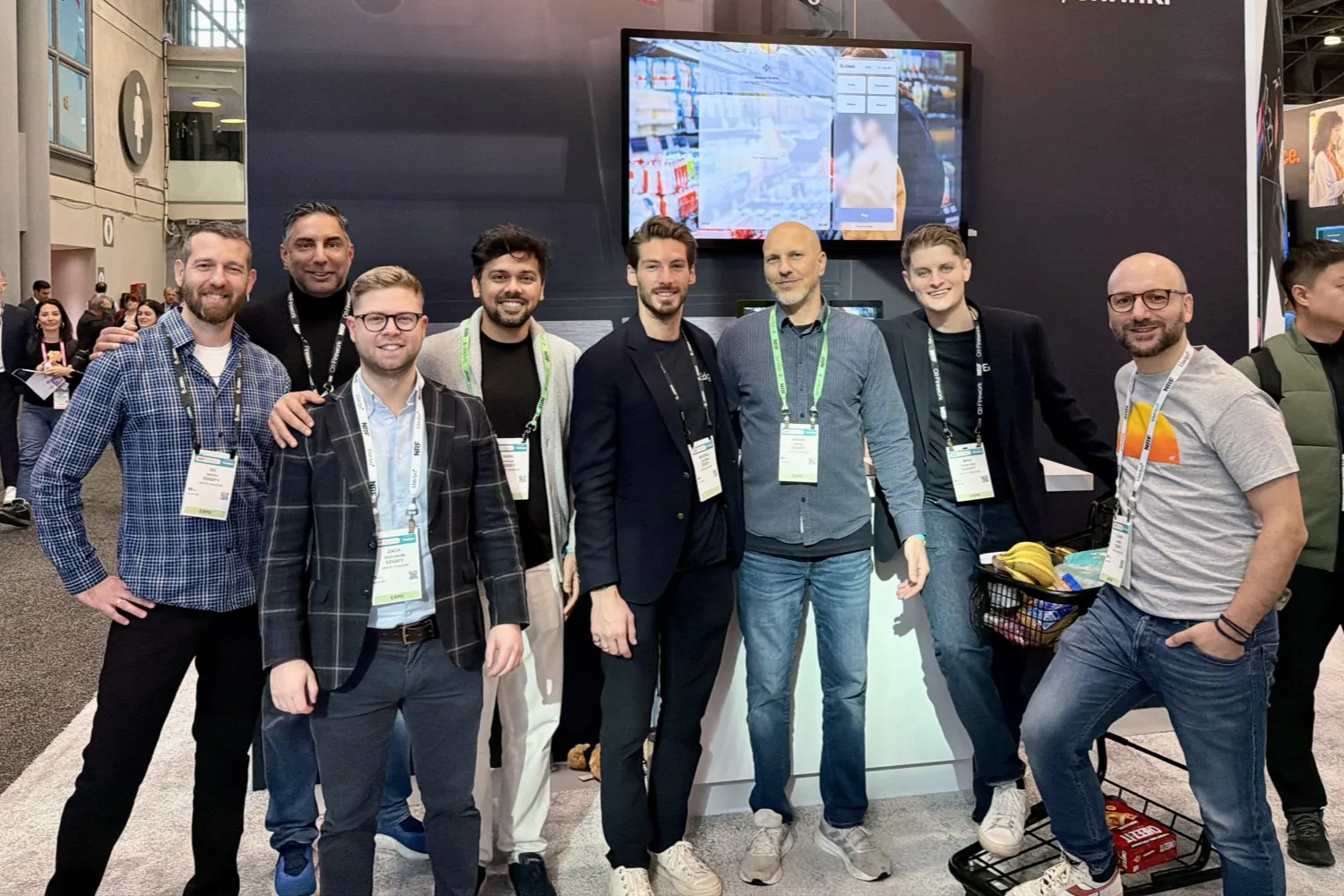
Edgify, a London-based company building edge artificial intelligence for physical retail, has raised $9 million in Series A+ funding. The round, backed by Rank Ventures and Mangrove Capital Partners, brings the company's total funding to $25 million. The new capital will accelerate deployments in physical retail and push the platform toward becoming a broader infrastructure layer for managing AI models across distributed devices.
The company's initial traction has come from grocery retail, where computer vision applications are already in use. These applications recognize products, identify unscanned items, detect barcode switching, and reduce losses at self-checkout. Edgify's goal is to provide a common AI layer that connects cameras, scales, scanners, self-checkout terminals, and point-of-sale systems.
A Different Approach to Retail AI
Most AI systems in retail rely on sending data to the cloud for processing. Edgify runs, updates, and manages AI models directly on edge devices instead. That means raw data never has to travel to a centralized cloud. The software integrates with existing point-of-sale systems and self-checkout machines through APIs, and computer vision models can run on standard USB cameras, scanners, and scales.
Edgify says its models can continue learning from data generated during normal store operations. Processing at the edge reduces network requirements and lowers latency. Raw customer data can remain within the retailer's perimeter, which may be attractive for privacy or data residency requirements.
The company lists 2,042 stores, 9,437 connected devices, and more than 400 million samples on its platform. These figures are self-reported by Edgify. The numbers point to a system already operating at a meaningful scale, even if the company has not disclosed independent verification.
Loss Prevention as the First Big Use Case
Loss prevention is the first major use case for Edgify's technology. At self-checkout, the platform can identify discrepancies between an item and its barcode. It can detect unscanned products in the bagging area and alert employees or trigger automated intervention. Product-recognition models can also identify fresh produce and other items without barcodes.
The technology operates within existing scanner and scale infrastructure, which lowers the barrier to adoption. Retailers do not need to replace their hardware. They can add an AI layer on top of what they already have.
Waste management is another application. Cameras can identify discarded products and improve inventory records. That helps retailers track what is being thrown away and adjust ordering or stocking decisions.
Building a Model Lifecycle Infrastructure
The funding will support expansion of Edgify's model lifecycle infrastructure, covering training, deployment, monitoring, and updating. This is a significant part of the company's ambition. Managing AI models across thousands of devices is not the same as managing a single model in a data center.
Edgify works on federated learning, where multiple devices contribute to improving models without centrally pooling datasets. This approach is technically interesting but complicated by non-IID data, meaning the data generated by different devices in physical environments is rarely independent and identically distributed. A scale in one store may see different products than a scale in another, and the same camera model may face different lighting conditions.
Edgify researchers have proposed a method to encourage local models toward a shared optimum without adding privacy risks or significantly increasing communication requirements. Distributed training could allow edge devices to collectively improve without uploading every image or transaction to a central dataset. That is a meaningful technical challenge, and the company is investing in solving it.
Stay ahead of the AI curve
The most important updates, news, and content — delivered weekly.
No spam. Unsubscribe anytime.
Beyond Grocery Retail
Edgify is not limiting itself to grocery stores. The company targets additional environments, including quick-service restaurants, distribution centers, apparel retail, logistics, manufacturing, transportation, and warehouse operations. These sectors share constraints: significant local data, existing hardware, real-time response needs, and limited or expensive cloud connectivity.
Edgify's edge-first architecture distributes AI execution across devices while maintaining a management layer for coordination. The company's broader objective is making AI practical wherever real-world decisions are generated. That is a wide ambition, but the company sees retail as an entry point rather than the limit of its technology.
The $9 million round is modest compared to the capital flowing into AI model developers and data-center infrastructure. For context, other recent funding news includes Lemma raising $2.3 million in pre-seed funding, SkinBit raising $6 million in pre-seed funding, Wordsmith extending its Series B with $14 million, Buzz Solutions raising $20 million in Series A funding, and Convex raising $57 million in Series B funding. DeepSeek has also bought into Unitree's Shanghai IPO.
The Edge as the Next Battleground
Edgify operates in a different part of the stack than those companies. The current AI infrastructure boom has centered around centralized computing in hyperscale data centers. Physical AI creates a different infrastructure problem. Decisions may need to be made immediately, continuously, and potentially without sending entire data streams elsewhere.
As AI spreads into physical environments, organizations need ways to deploy and maintain models across thousands or millions of heterogeneous devices. This creates a machine learning operations challenge: where inference happens, where training data remains, how models learn from distributed environments, and how updates are coordinated.
Retail provides a demanding environment to solve these problems. Physical retailers operate large networks of intelligent or semi-intelligent devices, often deployed independently. Video and image data can be expensive to continually transmit and process in the cloud. The need for real-time responses at self-checkout, for example, does not tolerate network delays.
If Edgify's platform generalizes beyond checkout and loss prevention, the opportunity could be orchestration infrastructure for AI moving out of the cloud. The next battleground for AI may be at the edge, and retail is a demanding testbed for that transition.
The company's self-reported numbers suggest it has already made progress. More than 400 million samples on the platform, across 2,042 stores and 9,437 connected devices, indicate real-world deployment. Whether those numbers grow significantly will depend on how well Edgify can expand beyond its initial use cases.
The funding round was completed at an unspecified time, and the article was published on August 10, 2026. The author is Antoine Tardif, CEO and Founder of Unite.AI. The round's backers, Rank Ventures and Mangrove Capital Partners, have not publicly commented on their investment rationale.
Edgify's approach is one answer to a question many retailers are starting to ask: how do you deploy AI across a distributed physical footprint without losing control of your data or breaking the bank on cloud costs? The company's answer is to keep the intelligence on the device and manage it centrally. That is a simple idea with complex technical implications, and Edgify is betting that the complexity is worth solving.