
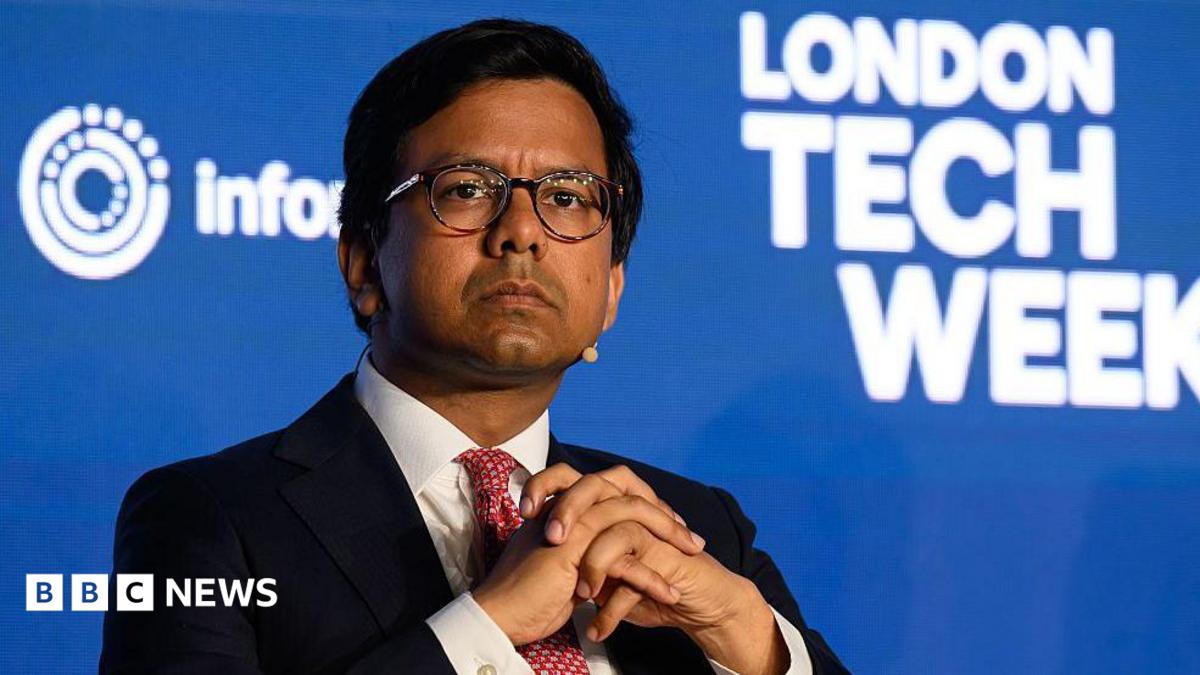
{ "TITLE": "Burnham abolishes DSIT, gives AI minister cabinet seat in tech shake-up", "BODY": "Prime Minister Andy Burnham has abolished the Department for Science, Innovation and Technology (DSIT) and elevated AI Minister Kanishka Narayan to a cabinet seat, in a major shake-up of technology policy just one day after announcing his new government.\n\nThe move, confirmed on 21 July 2026, scraps the department created by the Conservative Sunak government in 2023. Its responsibilities are now split between other government departments, and there is no dedicated technology secretary. Narayan, who was appointed Parliamentary Under-Secretary of State by former Prime Minister Sir Keir Starmer, will attend cabinet as minister for AI.\n\n## A minister with a cabinet seat\n\nNarayan, MP for Vale of Glamorgan since 2024, was born in India and raised in Cardiff. He previously held briefs covering AI opportunities, the AI Security Institute, semiconductors and online safety, and worked in government and business before entering Parliament.\n\nIn the early hours of Tuesday (21 July 2026), Narayan wrote on X about AI's significance. He called it a "sign of his deep commitment to AI's importance." He added: "AI is likely the most significant technology in human history. Its impact will dwarf other things."\n\nNarayan outlined a bold vision. "The best case for it is compelling beyond our dreams: a reindustrialised Britain, stronger national security, public services transformed for the better." But he acknowledged the risks, saying "it is right that the British public shares those worries, for jobs, for the pace of change."\n\nDom Hallas, head of tech trade body Startup Coalition, said the DSIT abolition is "clearly a bad thing." But he noted Narayan could make up for it in Cabinet "with tech. He said the previous department had provided good foundations - and now the priority should be spreading AI tech adoption through government and the wider public." Hallas said the previous department had provided good foundations, and now the priority should be spreading AI tech adoption through government and the wider public. He praised Narayan's knowledge of start-ups and the ecosystem.\n\nProfessor Gina Neff, head of the Minderoo Centre for Technology and Democracy at the University of Cambridge, said elevating the AI minister to cabinet signals the PM is "serious about having someone serious in this key role." She highlighted the most pressing policy challenge: AI replacing jobs.\n\n"For any Labour government to hitch their future electability to benefits to AI, then the political challenge for a new government is people need to feel the benefits before any job losses," Neff said. She added: "How do you jump start the British economy to get growth? AI may be that solution, or it might be a longer term investment."\n\n## Energy and resilience concerns\n\nProfessor Adam Beaumont, chairman of telecoms and digital infrastructure firm AQL, stressed the need for resilience. He warned against too many reorganisations, saying there is a danger of "changing too many things at once."\n\nBeaumont said the most pressing issue is ensuring the UK has enough compute power. "We're a small island but the internet is borderless, we need more compute within our shores," he said. He advocated for building more data centres and delivering abundant and reliable energy for the grid immediately.\n\n"Without power there's no compute, without the compute there's no knowledge economy," Beaumont said. He warned that energy supply is not keeping pace with demand. "All our aspirations on digital growth are reliant on the assumption of readily available energy, but that is not growing in line with the exponential growth of AI."\n\nThe government's plans to make the UK a "world leader" in AI could put already stretched supplies of drinking water under strain, the BBC was told in February. Data centres expansion is controversial; the BBC reported on 15 August 2025 that data centres are to be expanded across the UK.\n\n## Policy challenges mount\n\nThe government backtracked on AI and copyright on 18 March after an outcry from major artists. The new structure leaves Narayan as the most senior voice on technology in government, but without a department behind him.\n\nProfessor Neff said the political stakes are high. "People want to see the economy improving and kids getting jobs." For a Labour government, she said, the challenge is to deliver visible benefits from AI before the public feels the pain of job displacement.\n\nThe abolition of DSIT marks a sharp reversal from the 2023 creation of the department under the Conservatives. Whether the new model gives AI the focus Burnham intends, or creates confusion over who is in charge, remains to be seen.\n\n## Related on Neura Market\n\n- Artificial Intelligence\n- Social Media\n- UK Government Policy" }
Stay ahead of the AI curve
The most important updates, news, and content — delivered weekly.
No spam. Unsubscribe anytime.