
Back to Blog opencode
 ai
ai googlecloud
 discuss
 agents
 agenticarchitect
 ai
ai
Agentp: Turn OpenCode Into a Headless AI Engine for Your Editor, Terminal, and Telegram
Joan Miquel Torres June 17, 2026
0 views
I've always felt out of step with the prevailing trends. Before the AI explosion, the mantra was...
title: Agentp: Turn OpenCode Into a Headless AI Engine for Your Editor, Terminal, and Telegram published: true description: tags: Opencode, AI, Vim, Productivity cover_image: https://dev-to-uploads.s3.us-east-2.amazonaws.com/uploads/articles/e5g6r4hgq06senla9dzi.png
Use a ratio of 100:42 for best results.
published_at: 2026-06-17 22:17 +0000
I've always felt out of step with the prevailing trends.
Before the AI explosion, the mantra was "ship fast" — the Minimum Viable Product. If you weren't first, you were nobody. Quality, testing, documentation? Nice-to-haves. I could never stomach shipping "human slop" just to be first.
Now we're in the AI era, and suddenly everyone is alarmed about "AI slop." And I find myself out of step again — because from where I stand, the AI helps me produce the opposite.
Just as an example, I have a personal side project called SmarkForm and very little time to invest in it (but I keep pushing). Before AI it had a few "not-to-break-again" tests and a bare "just-the-docs" Jekyll site on GitHub Pages with often outdated code snippets and only a separate Examples section (which still exists) as the sole real demo.
Nowadays almost every code snippet in the documentation is a working example of a SmarkForm-powered form whose source code can be edited in place. The test suite has been fully migrated to Playwright, covering up to 5 platforms and including a suite of co-located tests that ensure every example in the documentation keeps working. Moreover, the most recent inline examples are AI-authored (in Copilot's words: "SmarkForm's clean, declarative API makes it a natural fit for AI-assisted development"). The last "AI-free" bastion in the repository was the actual source code of the library, but nowadays I use AI there too — just with a more thorough review and a test-first approach.
Put simply: my documentation is better. I write more tests than I could have imagined before. The code is cleaner. Even the worst AI-generated test is harmless: the most it can do is be useless. Unlike buggy production code rushed out to win a race, it won't break anything — an occasional garbage-collection pass is all you need.
The same goes for tooling. Every few years — sometimes months — a new IDE becomes the baseline, and if you haven't switched you're suddenly irrelevant. I use Neovim and tmux. Not because they're trendy, but because I spent years evolving a workflow that works across physical terminals, remote servers, and whatever machine I happen to be sitting at. And, more importantly, it lets me focus on what I'm doing rather than how to do it. I'm not about to throw that away for a shinier editor.
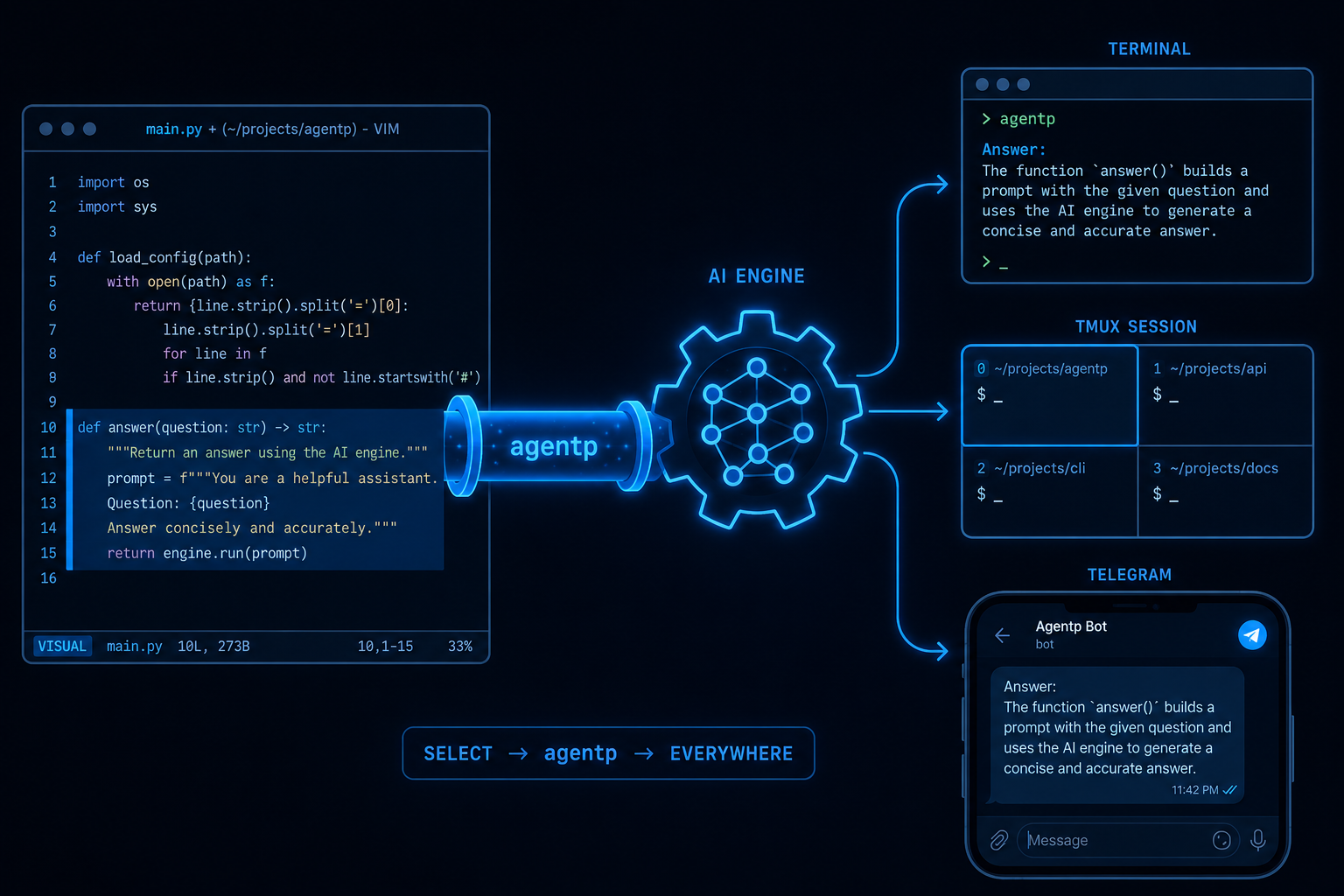
That's the mindset behind the agentp trio. It started with just agentp, a simple CLI tool that pipes a prompt to an OpenCode server and returns the final answer while you see what's going on in a spare monitor (when you have it). Then came ocmux, a project manager that manages a tmux session labeled as "Opencode" and keeps a dedicated OpenCode server and TUI for each project in a separate window. Finally, tgagentp is a Telegram bot that lets me talk to my projects (and even send and receive files) while away from the keyboard — and so much more.
Agentp grew from there — piece by piece, idea by idea — into a set of three zero-dependency Node.js CLI tools. It's heavily AI-assisted, including the tests. I review every stage before shipping, but the real test is using it every day. Bugs happen; I value a working feature more than a flawless one.
In summary, now I can:
- Pipe a prompt straight from Vim and replace my selection with the answer.
- See what's going on in an Opencode TUI that automatically switches to the right project.
- Get notified in Telegram when the answer is ready.
- Talk to the agent in charge of my project from Telegram while away from the keyboard.
- Handle multiple projects and servers simultaneously from a Telegram group with topics.
- Queue messages while a server is busy and get threaded replies.
- Leave private comments and public (for the agent awareness) notes in my telegram conversation.
- Send files to the agent and ask the agent to send files to me through Telegram.
- Record a Telegram conversation and inject it as context into the next agentp response.
- Threaded replies, permission request handling, and more...
The Three Tools
agentp — The Pipe
Stdin in, answer out. That's the core loop.
When you get used to writing text in Vim, all other text input methods feel clunky — and OpenCode TUI's editor is no exception. Its /editor command lets you edit prompts in an external editor, but the whole TUI screen blanks out during the edit, which means a complete loss of context.
My solution: I open the OpenCode TUI in a dedicated tmux session that I can maximize on a spare vertical monitor or just switch back and forth when working from a laptop. Then I write my prompts directly in Vim, visually select them, and send them to OpenCode by filtering them through agentp. I can either ask for a code snippet and get the answer in place, or use the --qa modifier to keep my prompt together with the answer. The latter lets me maintain a kind of logbook of prompts and answers so I can go back to review, copy chunks of code (or former prompts), etc.
Basic usage:
printf "Summarize this file" | agentp
cat prompt.txt | agentp

# Target a specific session by name (partial match works)
cat prompt.txt | agentp --session "My Task"
cat prompt.txt | agentp --session "New Task" --new   # create if not found

# Pull the last N answers without sending a new prompt
agentp --getLast 5
agentp --getLast 3 --qa    # full QA pairs with rulers
Real magic from Vim/Neovim:
:'<,'>!agentp --qa
This replaces your visual selection with the answer. The optional --qa modifier preserves the prompt + answer with labels, so you keep the full context.
🚀 Spoiler:
Passing the output of
ocmux(without arguments) ensures the prompt goes to the right server and automatically switches the TUI in your spare monitor (or wherever) to the right project, instantly.:'<,'>!agentp --qa $(ocmux)
ocmux — The Project Manager
Each project gets its own tmux window with a dedicated
opencode serve+ TUI pane. Auto-restarts dead panes, pins window names, stores state in.ocmux.json(discovered upward like.git).
Having the OpenCode TUI aside while you send work to it and receive answers in place is great. But what if you want to switch to another project while the agent is processing?
- Open another OpenCode Server + TUI in a new tmux window.
- Remember the port of each server.
- Manually switch to the right TUI pane and zoom it.
- Pass the correct port to
agentpevery time you call it from a different directory…
None of this is a big deal on its own. But by the time you finish working on the second project, the first one has probably finished — and you'd want to switch back.
Ocmux handles all of that. With no arguments, it switches the Opencode tmux session to the window for the current project (based on the working directory) and prints the server URL.
Combine it with agentp as agentp $(ocmux) or agentp --qa $(ocmux) and you not only send the prompt to the right server and get the answer back — at the same time, OpenCode automatically switches to the right TUI window for that project. It feels like magic when you're juggling multiple projects.
ocmux serve ~/projects/myapp        # create (new window)
ocmux serve --print-logs ~/projects/myapp  # also print server logs to terminal
ocmux list                          # list all
ocmux list -l                       # list with full URLs
ocmux ~/projects/myapp              # switch (shows url)
ocmux                               # same as ocmux $(pwd)
ocmux kill ~/projects/myapp         # remove
ocmux kill                          # same as ocmux $(pwd)
ocmux also supports --git and --GIT flags for git base directory resolution: --git matches with either worktrees or repository roots, while --GIT requires an actual repository root (not a worktree).
ocmux --last prints the URL of the active tmux window — useful when calling agentp from outside the project directory.
When an opencode server crashes, ocmux resurrect reads .ocmux.json, kills the stale tmux window, and starts a fresh server + TUI in the same directory. Works even with a dead tmux window (stale state file).
tgagentp — The Telegram Bridge
A Telegram bot that routes messages to your OpenCode servers. Multi-chat, multi-server, slash-commands for everything.
Ever wanted to work on a project while away from the keyboard? Writing notes is fine, but you get no feedback — you can't see or explore the project environment. What if you could send a prompt to an agent handling your project and get the answer back in Telegram? Queue messages while the server is busy and get threaded replies? Send files to the agent, or — even better — ask the agent to send files to you?
That's tgagentp. And way more: handle multiple servers simultaneously (with a Telegram group using topics), "record" your messages so the next agentp --qa prepends the conversation as context… And vice versa: get prompts and responses from agentp --qa delivered to Telegram so you can follow the conversation from anywhere — or just go grab a coffee and get notified when the agent finishes.
tgagentp                                  # default port 4096
tgagentp --think                          # start with thinking forwarding enabled
tgagentp --dev                            # enable /shutdown for remote restart
TGAGENTP_ROOT=/srv/projects tgagentp      # enable /serve and /new commands
TGAGENTP_ALLOWED_CHAT_IDS="123,-456" tgagentp  # restrict to specific chats
Slash commands:
| Command | What it does |
|---|---|
/help | Show available commands |
/status | Show current server, session, agent, and health |
/servers | List/switch between ocmux projects |
/sessions | List/switch/create/rename sessions |
/agents | List/switch active agent |
/models | List providers and models |
/serve <path> | Start a server in an existing project (requires TGAGENTP_ROOT) |
/new <path> | Create a directory, init git, and start a server (requires TGAGENTP_ROOT) |
/allow | Approve a tool permission once |
/reject | Deny a tool permission |
/always | Approve a permission and remember the choice |
/answer <number> | Respond to a structured question from the AI |
/markdown | Send original markdown response as .md file (reply to get that specific one) |
//<command> | Send a raw TUI command (e.g., //init, //clear) — answer or confirmation forwarded |
/queue <msg> | Queue message when busy — auto-sent after current task finishes (replies chain!) |
/record | Record / pause / retrofill conversation for agentp context |
/flush | Clear all queued messages (manual or auto-queued) |
/note <text> | Forward context for agent awareness (agent replies "Ack", info informs future responses) |
/comment <text> | Save a comment in chat (not forwarded to agent — context via reply quoting) |
/think | Toggle real-time thinking message forwarding |
/cancel | Abort the running prompt |
/disconnect | Disconnect from current server, clear ownership and connection file |
/force-switch <server> | Switch server bypassing ownership check (two-phase matching) |
/resurrect | Restart a crashed server and reconnect the chat to the new instance |
Permission prompts from OpenCode (tool access requests) are forwarded automatically — respond with /allow, /reject, or /always directly in the chat.
When the AI asks a structured question (e.g., tool configuration), tgagentp forwards it as a numbered multiple-choice poll — respond with /answer <number>. If the command produces a quick answer, it arrives immediately; otherwise a confirmation (✅ /init submitted.) is sent.
File sharing: Ask the agent to send you a file and it will know how. Send a file to the chat and the agent will be notified and can download it on demand.
!! wildcard: Use !! in any command to reference the previous user message. For example, /queue !! queues your last message, /note !! sends it as a note.
On formatting: The agent produces Markdown, but Telegram only supports a limited subset (bold, italic, code, pre). tgagentp converts Markdown to Telegram's HTML automatically, which works great for prose, lists, and code — but complex tables, nested formatting, or raw HTML may not survive the trip. If something looks mangled, use
/markdownto download the original response as a.mdfile and read it comfortably in any Markdown viewer or editor.
agentp and ocmux together
Combine both tools and you never need to think about ports or URLs again. agentp $(ocmux) sends your prompt to the right server for the current project AND switches the TUI to show that project — all in one command. From Vim:
:'<,'>!agentp --qa $(ocmux)
Note: You may think you can just run
ocmuxonce and pass the URL as a literal toagentp— the command is recorded in your Vim command history, after all.But calling
ocmuxevery time also automatically switches the TUI to the right project in the "Opencode" tmux session. That's the real value.
The Agentp Gateway
The killer integration: agentp and tgagentp talk to each other through a tiny HTTP gateway.
agentp --tg— forwards the answer to your Telegram chat after every pipe (hard error if tgagentp not running).agentp --no-tg— explicitly disable Telegram forwarding (overrides auto-detection in--qamode).agentp --qa— auto-detects tgagentp and sends the full QA pair (rulers + prompt + answer) if tgagentp is running./record— buffers the Telegram conversation. On the nextagentpcall, the gateway returns the buffer, and--qaprepends it to stdout with rulers — so OpenCode sees the full Telegram thread as context. Retroactively buffer past messages with/record N.agentp --flush— clears the buffer without prepending.agentp --getLast 5— retrieves the last 5 assistant answers from session history (or QA pairs with--getLast 5 --qa).- Exclusive ownership — each server belongs to at most one chat. New chats start disconnected.
/servers switch <name> --forcetakes over and notifies the previous owner. - Auto-queue — when a server is unreachable, messages are automatically queued and delivered when it comes back.
/flushclears the queue. - Server health detection — tgagentp periodically checks server connectivity. Dead servers are shown as ❌ unreachable in
/status. - Multi-chat — each Telegram chat or forum thread has independent server, session, and recorder state. Perfect for teams sharing one bot.
- Auto tmux switch — every message or
/notefrom any chat/topic automatically selects and zooms the corresponding server's tmux window, so the TUI follows the conversation across topics. - Message splitting — long answers are split at 4096 characters (respecting newlines) to stay within Telegram limits.
- State persistence — chat-to-server directory mappings survive restarts via
/tmp/tgagentp-connections.json. On reboot, tgagentp re-discovers the live server URL from.ocmux.jsonand reconnects automatically./shutdown clearwipes the saved state. - Remote resurrect —
/resurrectrestarts a crashed server from Telegram: callsresurrectServer()from the library, then transfers session state (serverOwners, active session/agent) to the new URL.
:'<,'>!agentp --qa --tg          " answer in editor + Telegram (hard error if no tgagentp)
:'<,'>!agentp --qa               " same + Telegram only if tgagentp detected
:'<,'>!agentp --qa --flush       " flush /record buffer
:'<,'>!agentp                    " only replaces. Useful for simple snippets.
:'<,'>!agentp --no-tg            " same as above, explicitly skip Telegram
Environment variables:
| Variable | Required | Default | Description |
|---|---|---|---|
TELEGRAM_BOT_TOKEN | Yes | — | Bot token from @BotFather |
TGAGENTP_ALLOWED_CHAT_IDS | No | all | Comma-separated chat IDs to allow (e.g. "123456,-789012") |
TGAGENTP_ROOT | No | — | Root directory for /serve and /new commands (must be writable) |
TGAGENTP_PORT | No | random | Port for the agentp gateway (agentp --tg discovers it automatically) |
TGAGENTP_DEBOUNCE_MS | No | 5000 | Debounce interval for queued-agentp Telegram notifications (ms) |
OPENCODE_SERVER_PASSWORD | No | — | Password for authenticated OpenCode servers |
All of this with zero npm dependencies — just Node.js 18+ stdlib.
Why This Setup Works
- Always-visible TUI, hands-free — The dedicated TUI lives on a spare monitor, a virtual desktop, or a tmux window. You work elsewhere. The TUI shows the full picture without you touching it.
- Multi-project agility — Each project gets its own server and TUI. Switch projects with a single
ocmuxcommand (or automatically viaocmuxwith no args), and the displayed TUI follows. The same auto-switch works from Telegram: every message or/noteselects the right tmux window, so the TUI follows you across topics. Start a task in project A, switch to project B while A runs. - Editor ↔ terminal ↔ Telegram loop — Pipe from Vim with
agentp, get the answer inline. Enable--tg(implicit with--qa) and the result also lands in Telegram — so even if you moved to another device or context, you know when it's done. - Remote awareness — tgagentp monitors progress, forwards permission prompts, and queues follow-ups from anywhere.
/recordrecovers Telegram conversation context for your nextagentpcall. Notifications pop the moment a piped task finishes or needs input. - Graceful degradation —
--tgin auto mode silently skips Telegram if tgagentp isn't running. Explicit--tgerrors pre-send, warns post-send. - Async processing — tgagentp never blocks the polling loop. Commands stay responsive even while a prompt runs.
Quick Start
npm install -g agentp

# Start a project server
ocmux serve ~/projects/myapp

# Pipe a prompt
printf "Explain this codebase" | agentp

# With Telegram (set up a bot with @BotFather first)
export TELEGRAM_BOT_TOKEN="your-token"
export OPENCODE_SERVER_PASSWORD="your-password"   # optional but recommended
tgagentp --think
Links
- GitHub: github.com/bitifet/agentp
- npm: npmjs.com/package/agentp
- OpenCode: github.com/anthropics/claude-code
Feedback? Issues? PRs welcome.
Comments
More Blog
View allaiContext bankruptcy: The case for strategic forgetting for AI Agents
Most of us have seen a coding agent fail to complete a task we know it can do. We just don't...
J
James O'ReillygooglecloudParallel Compliance Engine: Drive-to-Sheets Multi-Agent Orchestration
When building Generative AI applications, developers often encounter a massive bottleneck: sequential...
A
Aryan IranidiscussIs It Ethical to Post and Ask About Circuits on Dev.to?
I’ve been thinking about sharing some electronic circuit posts on Dev.to — small circuits, DIY...
C
codebunny20agentsThe One-Click Exporter: AI Studio Antigravity, Probed to Its Limits
What nobody tells you about exporting your multi-agent prototype to a local workspace. Every...
L
leslysandraagenticarchitectGuarding the till while autonomous data agents do the digging
Autonomous agents are genuinely good at answering messy business questions. Give one an LLM and a set...
S
Sireesha PulipatiaiReturn on Attention: Why AI Code Reviews Are Wearing Us Out
PR volume went up, ticket quality didn't, and the gap got filled with LLMs on both sides of the review: bots reviewing, bots replying, bots occasionally arguing with bots about priorities that only existed in a teammate's head. Our CEO named the actual problem, and it's bigger than code review.
C
christineReady-made automations for this
Workflows from the Neura Market marketplace related to this Stable Diffusion resource
- Document Q&A Chatbot with Gemini AI and Supabase Vector Search for Telegramn8n · Free · Related topic
- Extract Text from Images & PDFs via Telegram with Mistral OCR to Markdownn8n · Free · Related topic
- Automated Reservation System with Telegram, Google Gemini AI, and Google Sheetsn8n · Free · Related topic
- Automate Multi-Step Onboarding with Google Sheets, Forms, and Gmail Notificationsn8n · Free · Related topic