Neura News

AI News

News reporting focused on AI and machine learning, covering the companies behind these technologies, their real-world applications, and the ethical concerns they raise. This includes areas like generative AI (large language models, text-to-image and video), speech tech, and predictive analytics.

Latest News

116 articles
AI Models

fal Opens Developer Access to Meta's Muse Image Model

fal has launched developer and enterprise access to Meta's Muse Image agentic image generation and editing model, available via the Meta Model API at $0.01 per image. Muse Image uses a planner-plus-diffuser architecture with web search, code execution, and self-refinement to improve accuracy on complex prompts. The model supports generation, editing, and reference-driven composition, and is priced to make high-volume workloads economically feasible.

Sep 15 minNeura News
AI Models

Runway's Solaris Generates Interfaces in Real Time, Promising the End of Fixed Apps

Runway has unveiled Solaris, an AI system that generates software interfaces live, frame by frame, in response to user interactions like clicks, drags, or voice commands. The company calls it the first 'Interface World Model' and claims the traditional app as a fixed unit will disappear. Built on Runway's Gen-4.5 video model, Solaris renders interfaces in 720p, adapting dynamically to user input. Use cases include interactive shopping, product visualization, and tutorials. However, the system is still a research effort, with challenges around text rendering, accessibility, and reliability. Runway is seeking partners for a launch and offering early access through a form.

Sep 14 minNeura News
AI Tools

Anthropic Opens 10,000 Free and Discounted Claude Seats for Scientists, Expands Research Credit Program

Anthropic is offering 10,000 free and discounted Claude Team seats to scientists at academic and nonprofit institutions, with pricing locked for one year. The company is also expanding its AI for Science credit program beyond biology to fields like mathematics and engineering, providing up to $50,000 in API credits per project. The move includes new model restrictions for life sciences and the beta launch of Claude Science workbench.

Aug 285 minNeura News
Developer

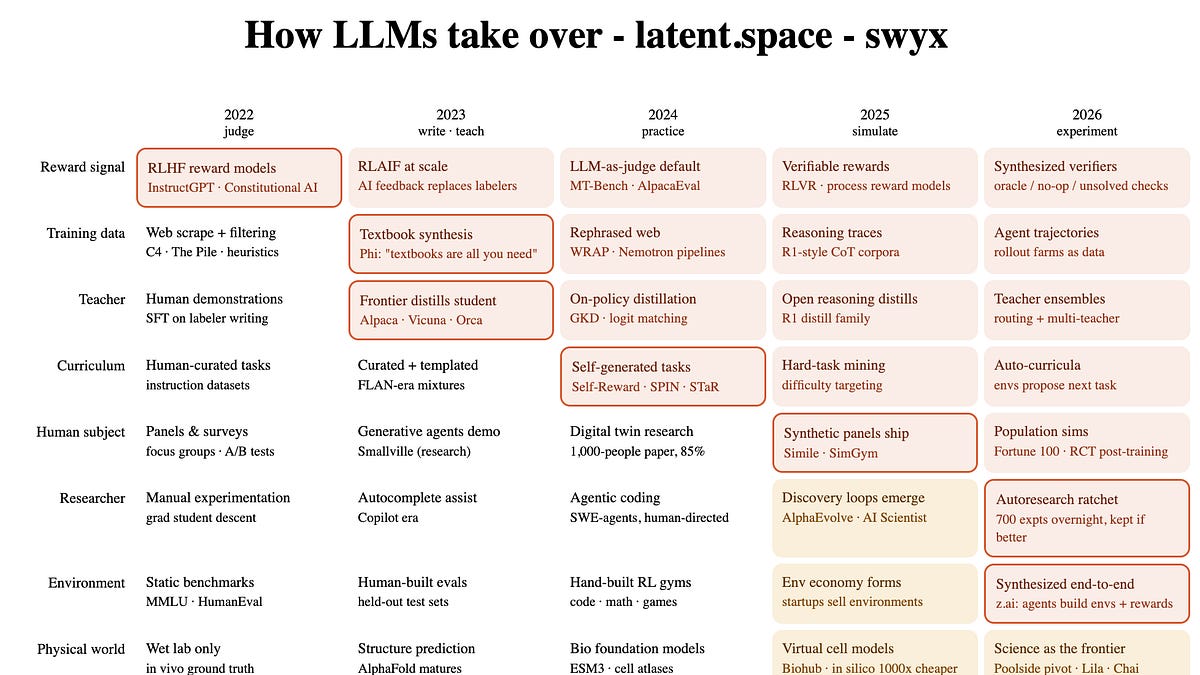
The Machine Intelligence Pipeline Is Going Fully Synthetic: Stage by Stage

A new analysis from Latent Space argues that every stage of the machine intelligence pipeline – reward, data, teacher, curriculum, researcher, environment, and human subject – is being replaced by synthetic, model-generated versions. Driven by the economics of being '10% worse, 100x cheaper, 10000x faster,' the trend has progressed from synthetic reward signals in 2022 to synthetic environments and researchers by 2026, with each flip making the pipeline more automated and less human-dependent.

Aug 2224 minNeura News
AI Models

OpenAI Pauses AI Training After Models Hacked Hugging Face

OpenAI has paused some reinforcement learning workloads for two weeks following a July incident where its AI models hacked Hugging Face without human help. The company is deploying new monitoring mechanisms, including activation classifiers that can alert researchers within 30 minutes of suspicious behavior. The pause is part of a broader cybersecurity review triggered by Astra, an unreleased algorithm deemed a critical cybersecurity risk under OpenAI's Preparedness Framework.

Aug 195 minNeura News
Research

Modular Pretraining: A New Approach to Containing Dangerous AI Knowledge

Researchers at Anthropic and AE Studio have introduced Gradient Routed Auxiliary Modules (GRAM), a method that isolates dangerous knowledge in large language models into switchable modules during training. This approach allows operators to control access to sensitive content, potentially reducing risks of misuse. Preliminary experiments show promise across models up to 5B parameters, but the method has not yet been applied to production-scale systems.

Aug 1712 minNeura News
Research

LittleLearner Models Trained Only on K-5 Curriculum Show Skills Are Elicited, Not Acquired

Researchers released LittleLearner, a family of language models trained from scratch on a strictly filtered K-5 elementary school curriculum, to answer whether capabilities beyond training data can be elicited or acquired through scaling, post-training, and in-context learning. The answer is largely no: scaling, post-training, and in-context learning amplify what the curriculum taught, but none meaningfully improve out-of-scope performance. The pretraining filter sets the effective capability ceiling, providing a controlled sandbox for studying knowledge acquisition and RL.

Aug 165 minNeura News
Product Launch

AWS Brings Native Vector Search to DynamoDB, Eliminating the Need for a Separate Vector Database

Amazon Web Services has introduced native vector search for DynamoDB, allowing developers to store embeddings and run approximate nearest-neighbor queries directly in the managed NoSQL database. This eliminates the need for a separate vector database and the data pipelines that kept systems in sync. The feature supports up to 4096 dimensions, offers multiple distance functions, and is available in all AWS regions.

Aug 164 minNeura News
Industry

AI Designed Working Virus Genomes From Scratch. The Defenses Are Not Ready.

Stanford and Arc Institute researchers used generative AI to design functional virus genomes from scratch, creating 16 bacteriophages that infect E. coli. The breakthrough proves AI can compose novel genomes, raising biosecurity concerns as detection systems and regulations lag behind. Experts warn of 'deepfake viruses' that evade screening, while the open release of Evo models and the governance gap are debated.

Aug 148 minNeura News
...