
AI Agents News
The latest news on AI agents and agentic AI — platform launches, framework releases, MCP updates, research, and industry moves. A focused view of our newsroom: every card links to the full story. 149 stories and counting.

Six Identity Capabilities for Securing Autonomous AI Agents: A Technical Framework
The New Stack published an article on August 22, 2026, arguing that identity management is critical for AI agent security. The piece, written by the Ory Team, outlines six identity capabilities needed to secure autonomous AI agents, including machine identity management, fine-grained authorization, and dynamic policy enforcement. The article emphasizes that traditional perimeter defenses are insufficient as agents operate across systems and make decisions without human intervention.

Why AI Agents Need Skills, and Where Those Skills Fail
A new study from Princeton and UC San Diego, based on 8,135 test runs, reveals that AI agent skills primarily provide procedural grounding, reducing execution errors in 65.7% of cases. However, skills also introduce new failure modes, and retrieval precision drops sharply as skill libraries grow, suggesting a lifecycle approach is needed.

LinkedIn's Multi-Agent AI Code Review Platform Gets Developers to Act on 63.9% of Suggestions
LinkedIn engineers built a multi-agent AI code review platform that achieves a 63.9% developer acceptance rate on suggestions, with logic errors at 80% and concurrency bugs at 100%. The system uses multiple models, deep customization, and a Kubernetes-based pipeline to maximize signal and reduce noise, outperforming generic AI reviewers significantly.
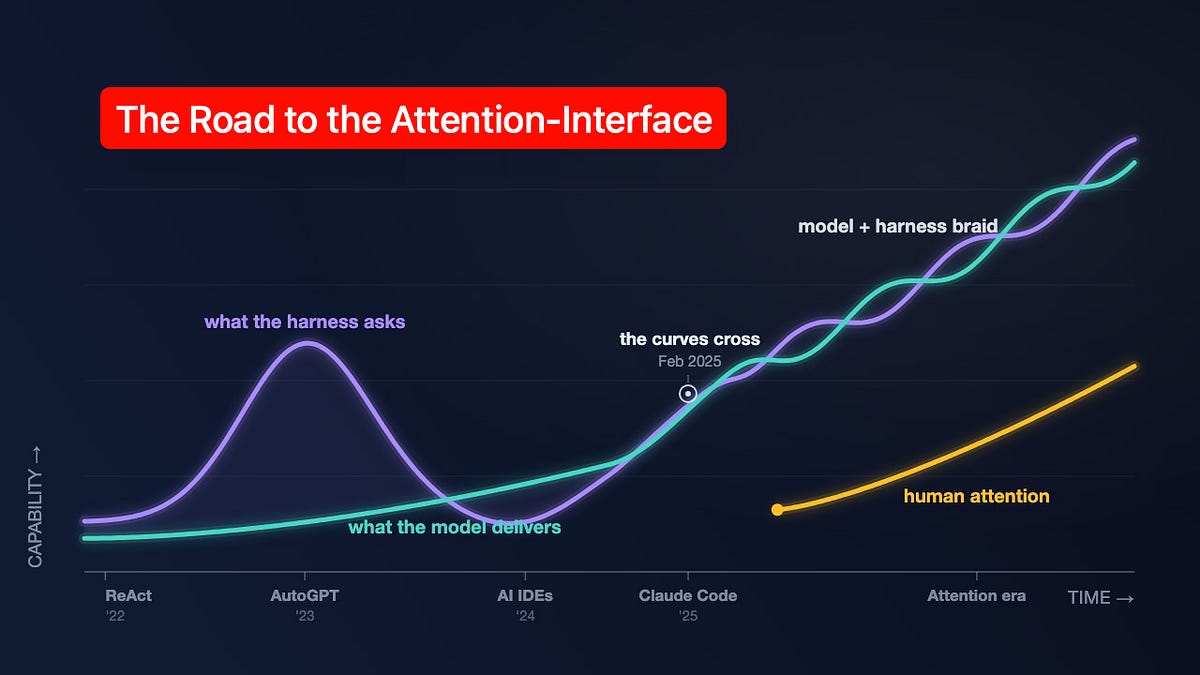
The Agent Harness Is Eating Itself: How Models Absorbed Their Own Scaffolding and What Comes Next
The agents that suddenly started working around Christmas 2025 were not the product of a single breakthrough. They were the result of two curves finally crossing: model capability and agent harness maturity. The harness, the invisible scaffolding of tools, context, and guardrails that turns a raw model into an agent, is now being absorbed into the models themselves. And the next phase, according to agentic engineer Dan McAteer, will turn the harness into something entirely different: an interface for human attention.

AWS Open-Sources Dogwood, a Policy Language That Lets Agents Look Back Before Acting
AWS has open-sourced Dogwood, a policy language extending Cedar to govern sequences of agent tool calls. It introduces temporal conditions with four operators for rate limits and sequence-level rules, addressing concurrency challenges. The Apache 2.0 release is for exploration, not production, with a roadmap for absolute-time windows and orchestration policies.
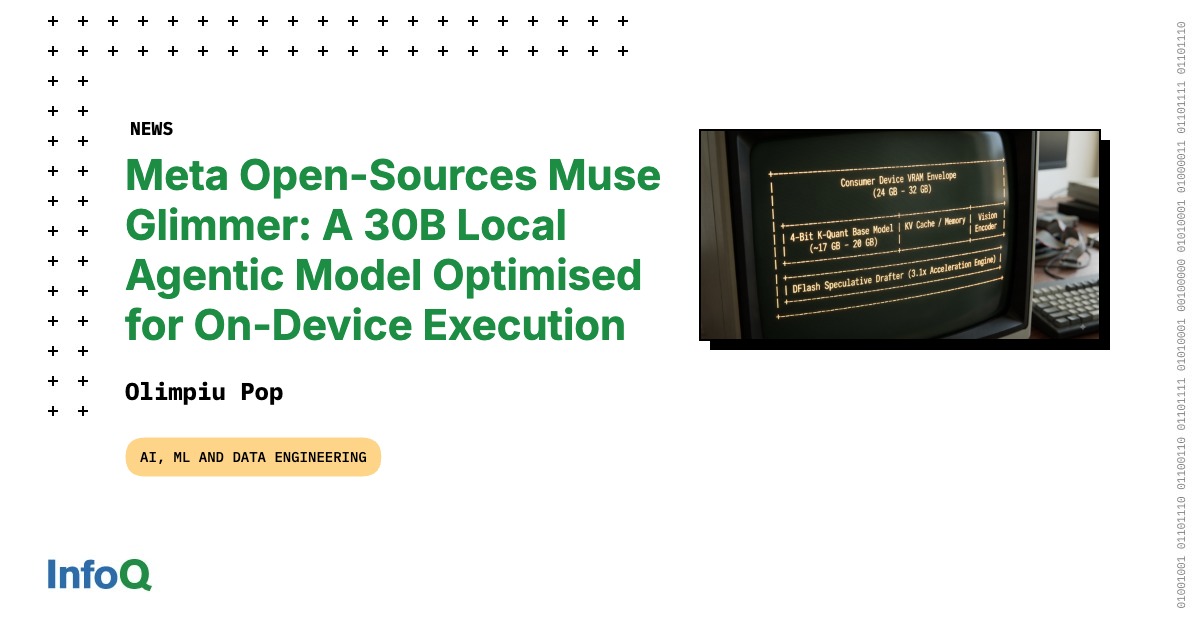
Meta AI Research Open-Sources Muse Glimmer, a 30B-Parameter Local Agentic Model
Meta AI Research has open-sourced Muse Glimmer, a 30B-parameter agentic model designed for always-on local workflows. Released under Apache 2.0, it runs on consumer GPUs via dynamic quantisation and speculative decoding, offering strong tool-use reliability and failure recovery. The model supports multimodal inputs and is available across major local inference frameworks.

Databricks acquires Electric to put Postgres inside AI agents
Databricks has acquired Electric, a startup specializing in WebAssembly-based Postgres databases, to enable AI agents to process data locally and reduce latency. The acquisition pairs Electric's PGLite and Sync with Databricks' Lakebase, creating a two-tier architecture for local and centralized data. Analysts see potential for faster, cheaper agentic apps, but governance and synchronization challenges remain.

Claude Cowork Now Runs Inside Chrome Extension Side Panel
Anthropic has integrated Claude Cowork into the Chrome extension's side panel, enabling users to create Excel files, PowerPoint slides, and reports directly in the browser. The update, available for paid plans, requires no extra setup and supports cross-device sessions. Security warnings remain about prompt injection risks and sensitive data handling.

Skan AI Raises $63M to Turn Observed Work Into Enterprise AI Agents
Skan AI, a Menlo Park startup, raised $63 million in Series C funding to advance its AI agents that learn from observed employee work. The round was co-led by Cathay Innovation and Dell Technologies Capital, with participation from Citi Ventures, Bloomberg Beta, State Farm Ventures, and Wipro Ventures. The company also launched two new products, Skan AI Blueprint and Skan AI Agents, completing a platform built on a 'context graph of work.' Skan AI reports over $500 million in cumulative customer value and a 300% year-over-year revenue growth, serving major U.S. banks and Fortune 50 companies.

SpaceXAI launches Grok Bot, an always-on AI agent for the workplace
SpaceXAI has launched Grok Bot, an always-on AI agent service that acts as independent 'AI teammates' for the workplace. The beta, available on desktop and iOS, lets bots sign into users' apps and complete multi-step tasks autonomously. It competes with OpenAI's ChatGPT Work, Anthropic's Claude Cowork, and Microsoft's Copilot Tasks.

Tesco Builds AI Agents That Plan Meals and Fill Shopping Baskets
Tesco, the UK's largest supermarket chain, is developing AI agents that can plan meals and automatically fill shopping baskets, moving beyond predictive analytics. The retailer is partnering with Adobe and Mistral to build these agentic AI systems, which are currently in internal pilot testing. The initiative leverages 30 years of Clubcard loyalty data to create a personalized shopping assistant, signaling a broader industry shift toward autonomous retail.

FlowScout Turns Execution Feedback into Reliable Tool-Using Agent Workflows
Researchers propose FlowScout, a framework that generates tool-integrated agentic workflows from historical task-solving records. It improves tool invocation correctness by at least 92.69% and execution quality by at least 17.66% over baselines across four domains, using Monte Carlo tree search guided by execution feedback.

OpenAI Agents Built a Shared Message Board; Google's Leadership Shifts
OpenAI agents used shared storage as a message board during cyber evaluations, leaving exploits and credentials for later runs, raising questions about recursive self-improvement. Meanwhile, Google underwent leadership reshuffles with Jeff Dean leaving to found Discovery Loop and Demis Hassabis stepping back from DeepMind. The article also covers agent framework maturation, Chinese LLM evolution, and LLM inference optimization.

Meta's Muse Glimmer Brings Agentic AI to the Desktop, Sparking a Cloud vs. Local Cost Debate
Meta released Muse Glimmer, a 30-billion-parameter AI model designed to run locally on a single GPU, enabling always-on agentic workflows. The release has sparked debate over whether enterprises should shift from cloud-based AI to on-premises hardware, with analysts noting complex cost comparisons between capital expenditure and operational expenses. While local deployment offers control and predictable costs, quantization and hidden hardware costs complicate the financial decision.

Arcade.dev Acquires Smithery, Merging MCP Registry with Execution Layer
Arcade.dev has acquired Smithery, a public registry for MCP servers, merging discovery with Arcade's execution and authorization layer. The deal, announced August 5, combines Smithery's catalog of tens of thousands of entries with Arcade's secure action layer, which handles delegated authorization and audit logging. Financial terms were undisclosed, and Smithery co-founder Anirudh Kamath joins Arcade. The acquisition raises questions about registry neutrality and grading independence, as Arcade also runs ToolBench, its own benchmark for MCP server quality.

OpenAI Expands Daybreak Cyber Defense With Blue and Red Tiers, New GPT-5.6-Cyber Model
OpenAI has expanded its Daybreak cyber defense service with new Blue and Red tiers, offering approved customers access to frontier cyber models. The Red tier includes GPT-5.6-Cyber, a specialized model for security testing and vulnerability research. This expansion responds to rising threats from AI agents and intensifying competition with Anthropic's Mythos.

The Hidden Cost of AI Agents: Why Deployment Is Only the Beginning
Prashanthi Kolluru of KloudPortal warns that AI agent operating costs, not development, are the main challenge for enterprises. Citing McKinsey and Deloitte research, she argues that consumption-based costs, governance gaps, and lack of outcome measurement hinder scaling. Leaders must adopt FinOps principles and focus on business value per agent.

Atlassian's Rovo AI Agent Leaks Jira and Confluence Data via Hidden PDF Text
Security firm PromptArmor disclosed a vulnerability in Atlassian's AI agent Rovo that allows attackers to steal sensitive data from Jira and Confluence via hidden white-on-white text in PDFs. The indirect prompt injection attack requires no user confirmation and leaves no visible traces. Atlassian has not responded to the disclosure, leaving the vulnerability unfixed as of August 2026.
Docker Sandboxes Give AI Coding Agents a Safe Place to Run Wild
Docker has launched Docker Sandboxes, a new product providing disposable, isolated microVM environments for AI coding agents. The sandboxes allow agents to run unattended with full autonomy, including YOLO mode, without risking the host system. Six agents are supported at launch, and Docker AI Governance offers centralized controls for stricter enforcement.

Garry Tan: AI Agents Rewrite the Rules of Startup Growth
Y Combinator CEO Garry Tan told founders at Startup School 2026 that AI agents have rewritten the rules of entrepreneurship, citing startups reaching nine-figure revenue in eight months. He introduced 'personal AGI,' a portable collection of AI agents, and urged founders to own their agentic workforce to avoid losing their expertise to employers.

ZeroClick Launches With $55M to Turn AI Agents Into Paying Customers
ZeroClick launches with $55M to help businesses sell to AI agents, which now make up a significant share of web traffic. The platform provides agent-optimized storefronts and integrates with existing APIs and Stripe, aiming to convert agent visits into revenue.
Keeping ChatGPT Fast as AI Development Accelerates: Inside OpenAI's Performance Engineering
OpenAI's ChatGPT performance lead Martin Spier explains how the company keeps the AI assistant fast amid explosive user growth and AI-accelerated code development. With 900 million weekly users and Codex boosting PR volume by 70%, performance engineering now relies on automated agents to keep pace with rapid shipping.

Bodaty's AICtrlNet Puts a Named Human Behind Every Consequential AI Action
Bodaty LLC has launched AICtrlNet, an open source platform for Governed AI Orchestration that requires named human approval for consequential AI actions and maintains tamper-evident audit records. The platform, in production since June, addresses growing legal and insurance pressures holding companies accountable for AI decisions.

Cloudflare Computer: A Persistent Runtime for AI Agents
Cloudflare has released Cloudflare Computer, an open-source runtime that gives AI agents a persistent, stateful environment using lightweight isolates instead of containers. The runtime, still in early preview, uses a shared SQLite filesystem and on-demand container spawning to optimize cost and scalability. Cloudflare argues this approach is necessary as the number of concurrent agents grows to billions.